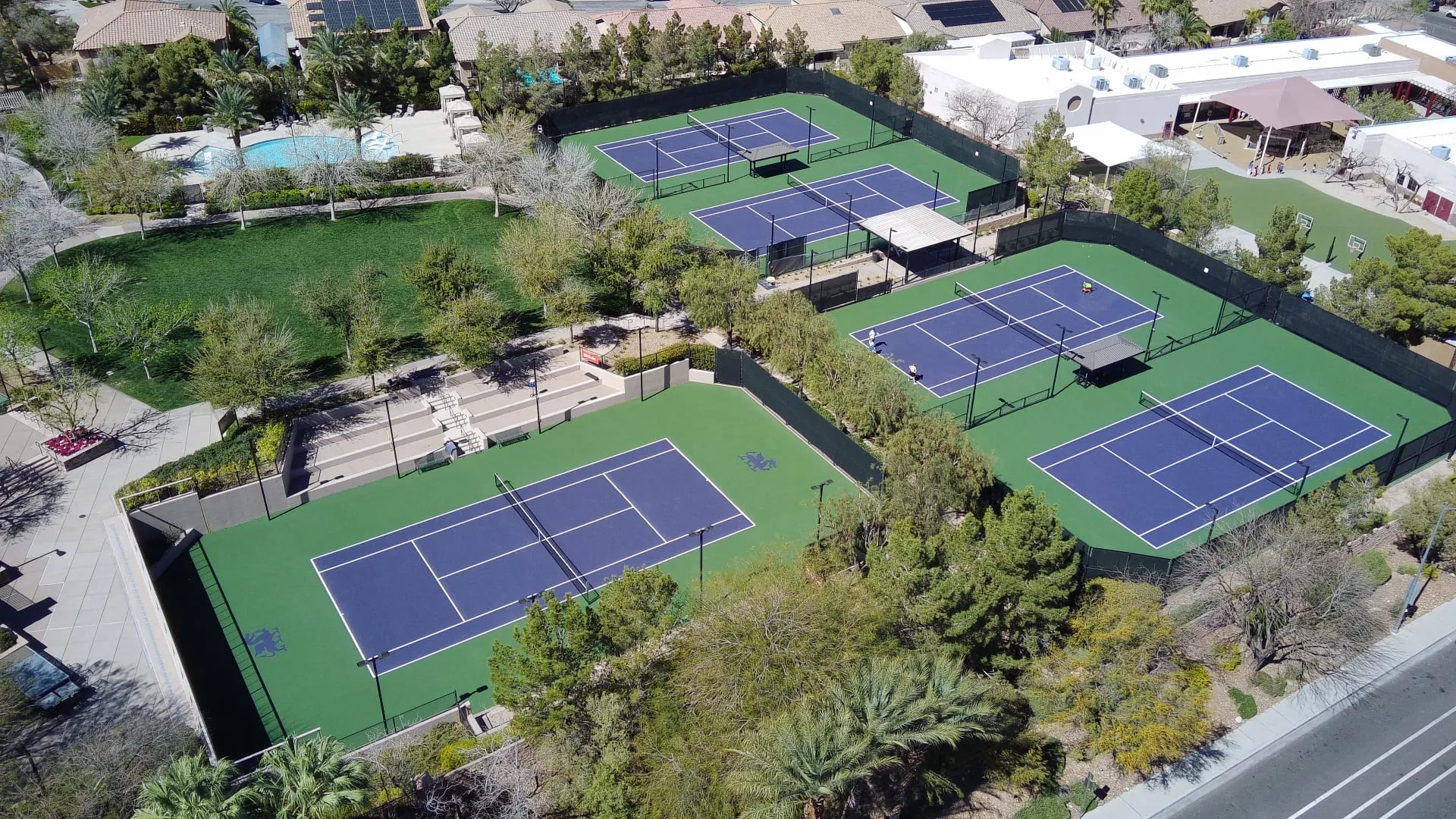
Tennis Guide
Tennis Court Maintenance in Las Vegas: What Actually Protects Your Court
By Brian Foley, Owner · Published · Updated
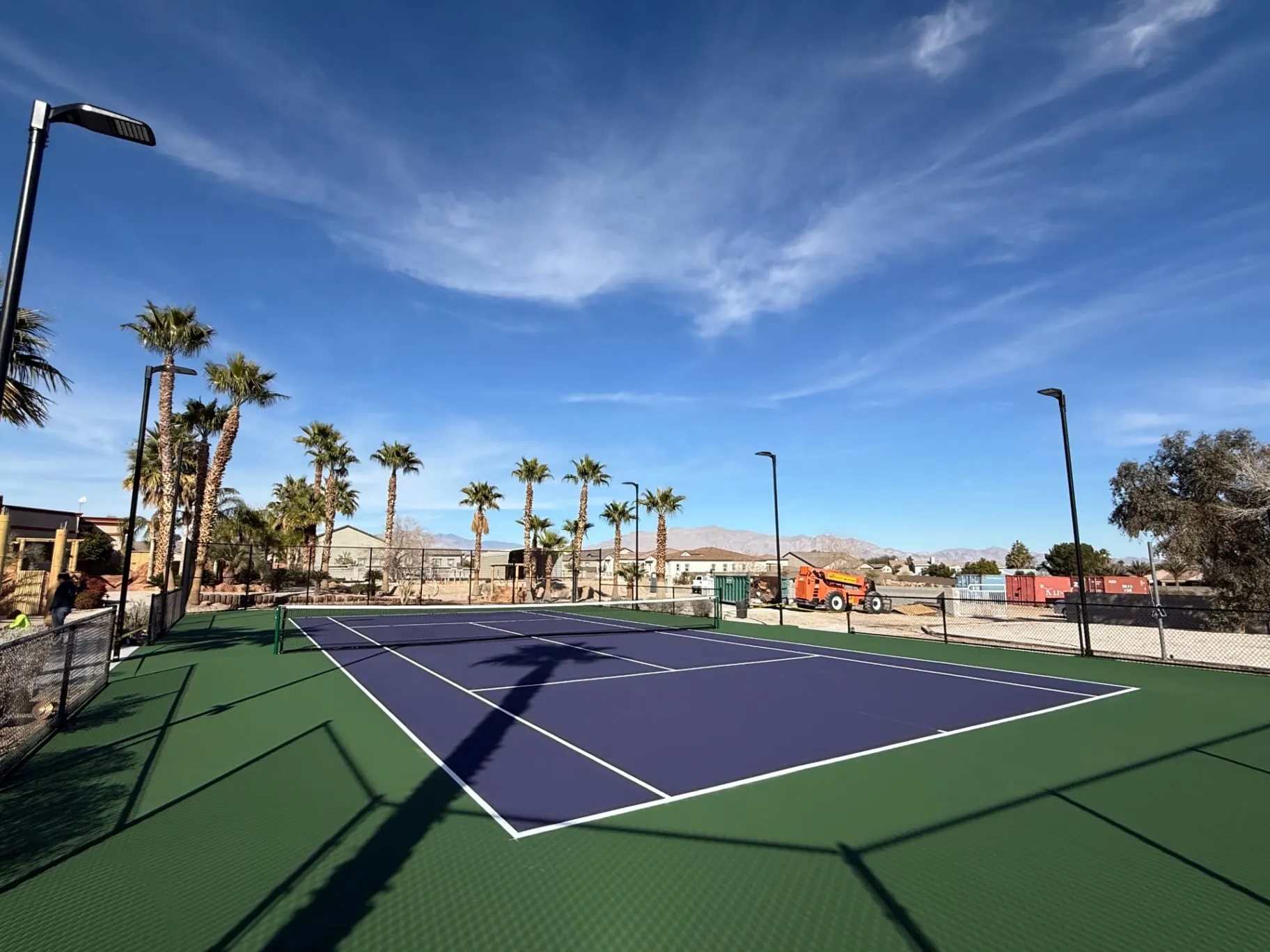
A freshly resurfaced Las Vegas court. Routine maintenance is what keeps it looking like this for years.
Tennis court maintenance is the routine cleaning and inspection, plus the small repairs, that happen between resurfacings. It protects the court's life and appearance, but it won't extend the resurface interval forever, and a moving slab is past what any cleaning can fix.
What Tennis Court Maintenance Covers, and Where It Stops
It keeps the surface clean, dry, and free of small defects. Maintenance isn't the same as a major repair, which addresses one specific failure like a structural crack, or a resurface, which renews the whole coating. Not all tennis courts are built the same, but nearly every outdoor court in the valley is a hard court: a concrete base, sometimes asphalt, topped with an acrylic court surfacing system only three to five millimeters thick. A full court resurfacing lasts five to eight years in this climate; regular upkeep protects that interval, while skipping it drives costly repairs sooner.
The Las Vegas Tennis Court Maintenance Schedule
| Frequency | What to Do | Who Can Do It | Time Needed |
|---|---|---|---|
| After Play | Clear debris and trash. Loosen the net's center strap slightly overnight. | Players or owner | 5 minutes |
| Weekly | Dry-clean with a leaf blower or soft-bristle broom, working from the high side to the low side. Check gate hardware. | Landscaper or owner | 15 to 30 minutes |
| Monthly Deep Clean | Inspect the slab for standing water after rain, and scrub gently at affected areas with a mild detergent solution. | Facility staff or owner | 1 hour |
| Seasonal | Clear silt along the low fence line after the monsoon season. Check perimeter drains before winter rain. | Grounds crew | 2 to 3 hours |
| Annual | Lubricate net posts and inspect windscreen ties, logging any cracks with photos. | Facility manager or contractor | 4 hours |
A court cleaned only once a season builds up wear that later shows through the coating.
How Often Should a Tennis Court Get a Deep Clean?
A tennis court needs a dry sweep or blower pass weekly, plus a closer deep clean monthly, with an extra pass after any dust storm or monsoon rain. Skip the weekly pass and the grime bonds to the surface, so the monthly clean becomes a detergent scrub instead of a five-minute blow-off.
Cleaning Under Southern Nevada's Water Rules
The Las Vegas Valley Water District (LVVWD) counts allowing water to flow or spray off the property as water waste, a rule that extends to washing hard surfaces like courts. Keeping wash water contained on the slab keeps a hand-wash from crossing into a reportable violation.
A first-time fee gets refunded through LVVWD's Curbing Water Waste course, completed within 60 days of the notice. The fee schedule escalates fast, tied to your meter size over an 18-month rolling history:
| Violation | 1 Inch or Less Meter | Over 1 Inch, Under 3 Inch Meter | 3 Inch or Greater Meter |
|---|---|---|---|
| First | $80 | $160 | $320 |
| Second | $160 | $320 | $640 |
| Third | $320 | $640 | $1,280 |
| Fourth | $640 | $1,280 | $2,560 |
| Fifth | $1,280 | $2,560 | $5,120 |
For an HOA on a three-inch meter, one careless landscaping wash that lets water sheet off the court triggers $320 on the first notice alone. Never let crews blow debris onto the court or spray weed killer, fertilizer, or other chemicals near the court perimeter. Keep mulched planting beds clear of the fence line and vegetation trimmed back, too. Hard court maintenance here starts dry: a blower or soft-bristle brush protects the surface before water touches it, and regular cleaning keeps the court free of pine needles, leaves, and other debris before this organic matter builds up. Save water only for shaded-area algae and mineral deposits from irrigation overspray, kept contained so it evaporates on the slab.
Pressure Washing Tennis Courts: Can You Do It Safely?
A pressure washer above 3,000 PSI with a zero-degree or 15-degree nozzle strips silica sand straight out of the acrylic layers, a real safety hazard once the surface goes slick. Stay under 1,500 PSI with a 25-degree fan tip held 12 inches off the surface, per the manufacturer's cleaning guidance for acrylic sport surfaces. Acid cleaners destroy acrylic coatings on contact. The same source recommends two parts bleach to one part water for algae, and mild detergent lifts chewing gum residue, all contained so runoff stays on the slab.
What Breaks Down a Tennis Court Surface in the Desert
UV and heat are the most damaging enemies of a court out here, not moss or freeze-thaw. The National Weather Service recorded 77 days at or above 100 degrees in 2025, peaking at 112, making 2025 the valley's fifth-warmest year on record.
UV bleaches and chalks the color coat, and how color choice affects that fade is its own consideration when a court gets resurfaced. Slab surfaces peak near 150 degrees on a 110-degree day, driving expansion and contraction that show up as fine surface crazing. Wind-blown grit works into the coating with every sprint and pivot, stripping the texture that grips a shoe and keeps a consistent ball bounce. The grit wears that texture down before bare areas ever show.
Why Acrylic Hard Courts Are the Only Real Option Outdoors
Grass courts and clay courts are high maintenance and don't survive Southern Nevada's heat and water rules; clay court maintenance in particular is a losing battle in a climate this dry. Surfacing options built for this climate come down to acrylic hard courts. Indoor courts dodge the UV and grit entirely, but the valley plays outdoors.
Standing Water, Drainage, and Cracks
A regulation court holds a one percent slope, roughly one inch of fall per eight feet, so the drainage system sheets water off the surface instead of letting it pool. The American Sports Builders Association defines a birdbath as standing water deeper than 1/16 inch an hour after rain. Set a nickel in the puddle; if the water covers Jefferson's head, the depression needs a professional acrylic patch. Trapped moisture permeates the acrylic layers, then turns to vapor under the returning sun, and that vapor blisters and peels the coating from underneath. Clear it with a foam squeegee after rain to maintain proper drainage.
What Causes Court Cracks?
Crazing, fine hairline cracking from thermal cycling, is cosmetic and gets filled at the next resurfacing. A structural crack is different: a fissure wide enough to catch a fingernail in, or one with vertical displacement. Either means the slab has moved, often from caliche soil under neighborhoods like Summerlin and MacDonald Highlands, with North Las Vegas seeing the same movement. Hardware-store filler rips back open within a season on a moving crack; structural crack repair needs a professional fiberglass membrane system instead. Our tennis court crack repair guide walks through each crack type and the fix it needs.
Hardware, Lines, and Court Rules
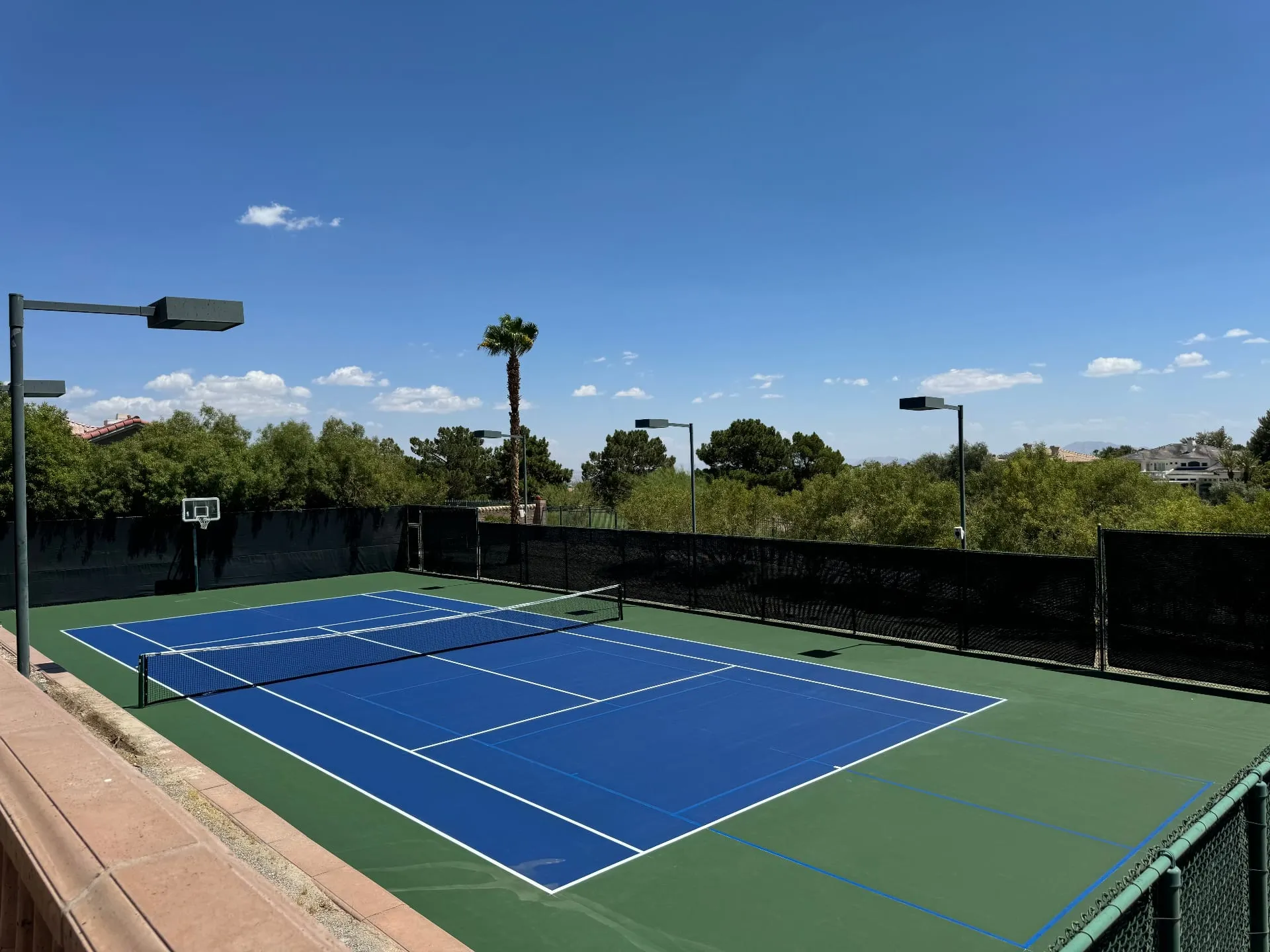
The court's permanent fixtures degrade just as fast as the surface: nets, posts, straps, lighting, and fencing. An unsecured windscreen acts like a sail in high wind, bending fence posts when zip ties fail, and net center straps dry-rot under constant sun. Treat the tennis court accessories as consumables here, since sun and wind are hard on plastic, rubber, and fabric. Check that gate hardware still latches and drains are functioning properly, and fold the rest into an annual inspection: walk the full court area, wipe down the light fixtures, and log any wear with photos. Lines take the hardest UV hit on the playing surface, fading years before the color coat does; under lights at a club like Darling Tennis Center, a faded line reads as a gray blur at full sprint.
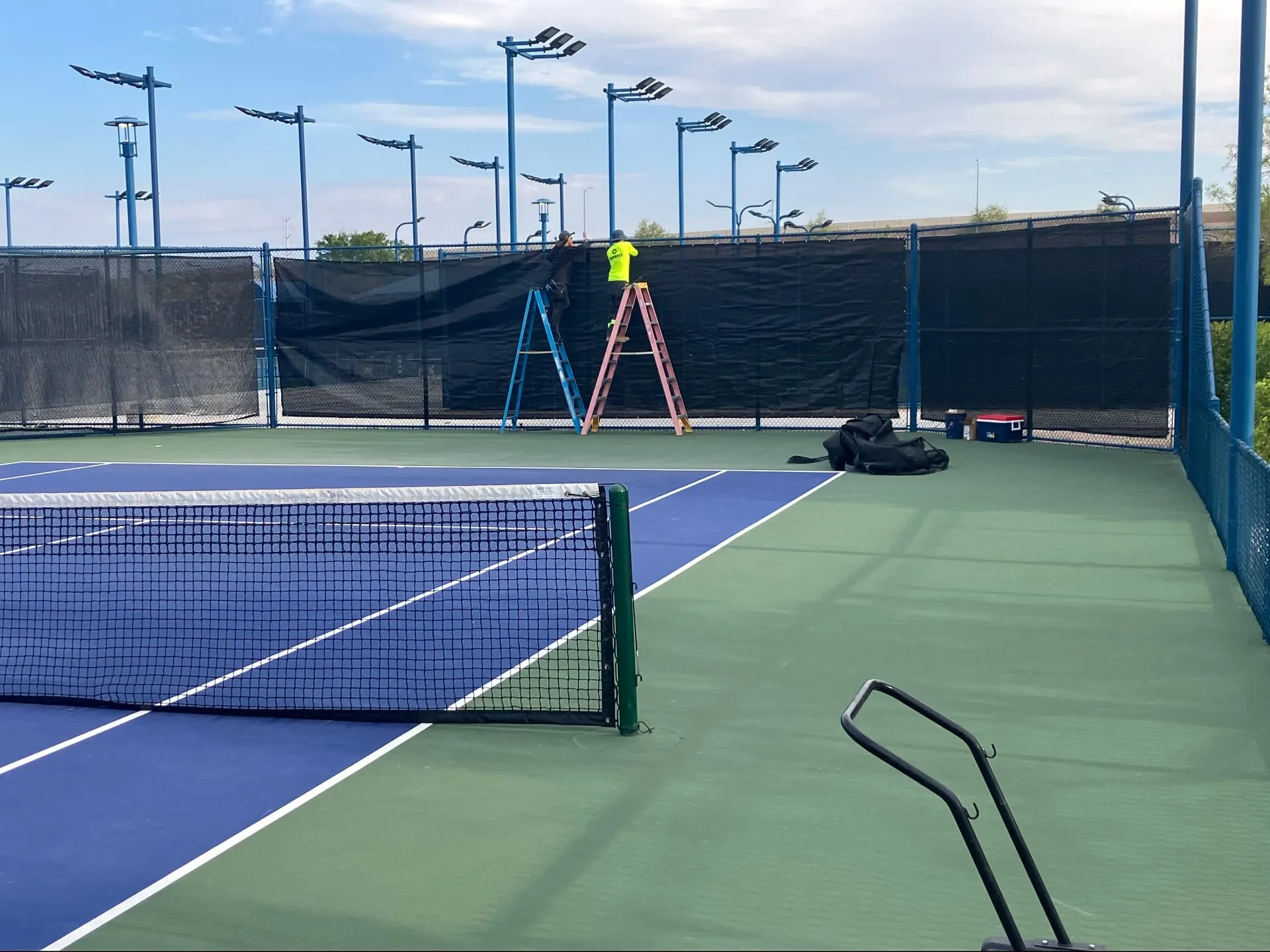
If the texture is sound and only the paint has failed, re-striping fixes it for far less than a full resurface. Court rules protect a well-maintained court and optimal playing conditions better than any product: non-marking tennis shoes only, no bikes, scooters, skateboards, or roller blades, and pads under furniture legs so the load doesn't punch through.
Pickleball Court Maintenance and Basketball Court Maintenance on Shared Courts
Pickleball's lateral shuffling wears the kitchen line and baseline fast, turning those high-traffic areas slick while tennis service boxes stay textured. That wear pattern is part of why courts built for the sport follow pickleball's own surface specification rather than sharing tennis's exact texture.
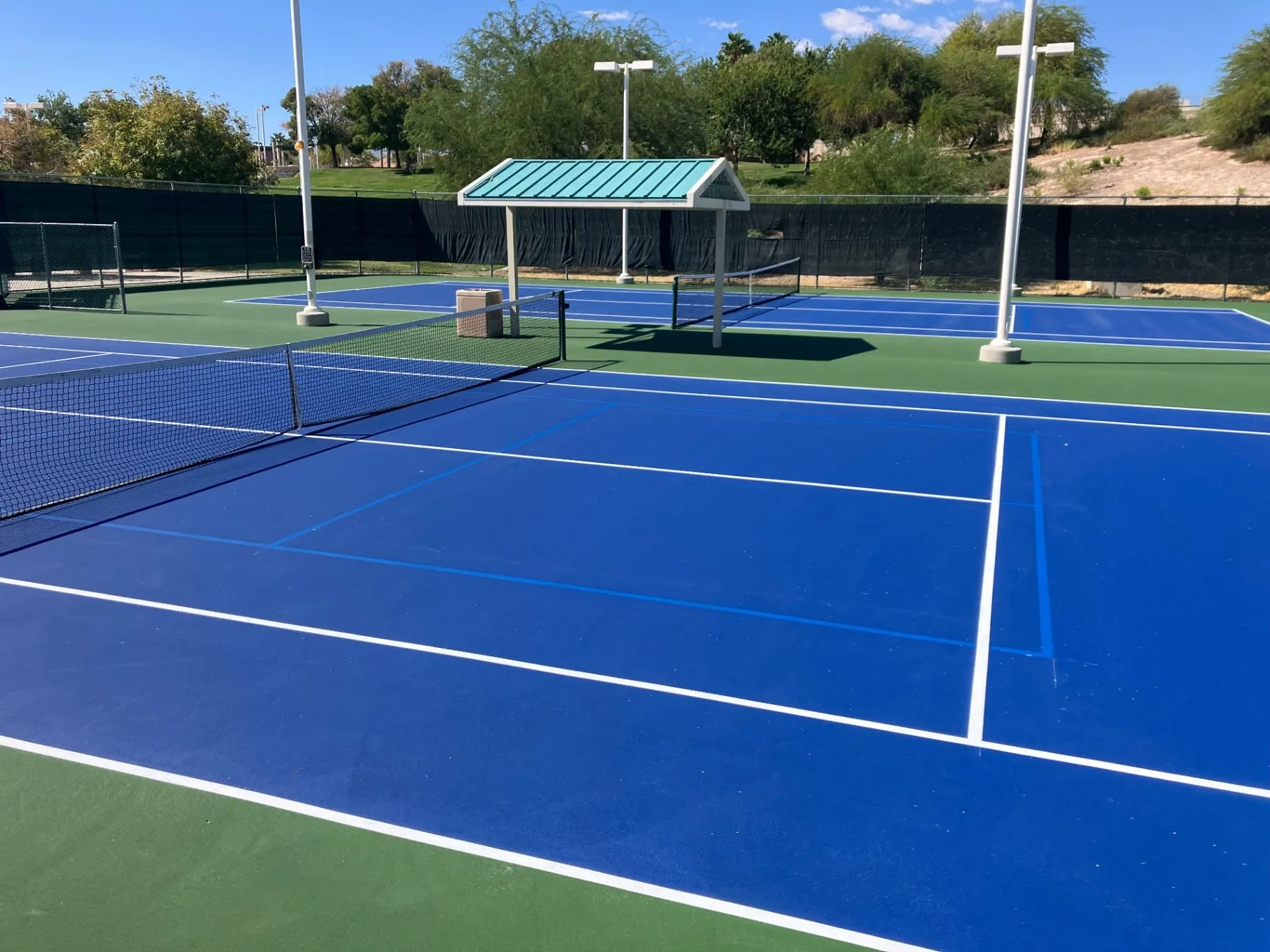
Is pickleball harder on a court than tennis? In that specific zone, yes, since constant side-to-side footwork strips texture faster than tennis's more linear sprinting. We see this constantly: a slick spot at the kitchen line changes how a shuffle plants, and a player who doesn't expect it can lose footing on a shot they'd normally make.
Basketball courts add different hardware to watch: the hoop's anchor system, height-adjustment mechanism, backboard, and safety padding, all sitting on a point load that stresses the slab, with delamination risk if the original bond wasn't clean.
HOA and Multi-Court Maintenance Programs
Routine cleaning and net upkeep fall under a community's annual operating budget, while full resurfacing and structural repair are capital expenses planned into a reserve study. Projects can be phased so part of a facility stays open, and a pickleball resurfacing itself only takes one to two days plus cure time. Facilities like TPC Summerlin run scheduled cleaning and inspection visits for this reason, since sports court cleaning for apartments and HOAs works best as a standing appointment rather than a reaction to a complaint.
Who is responsible for maintaining an HOA court comes down to a split by task: sweeping and drainage checks fall to whoever the HOA contracts for landscaping, while capital decisions about a full resurfacing sit with the board and its reserve study.
The Las Vegas Maintenance Calendar
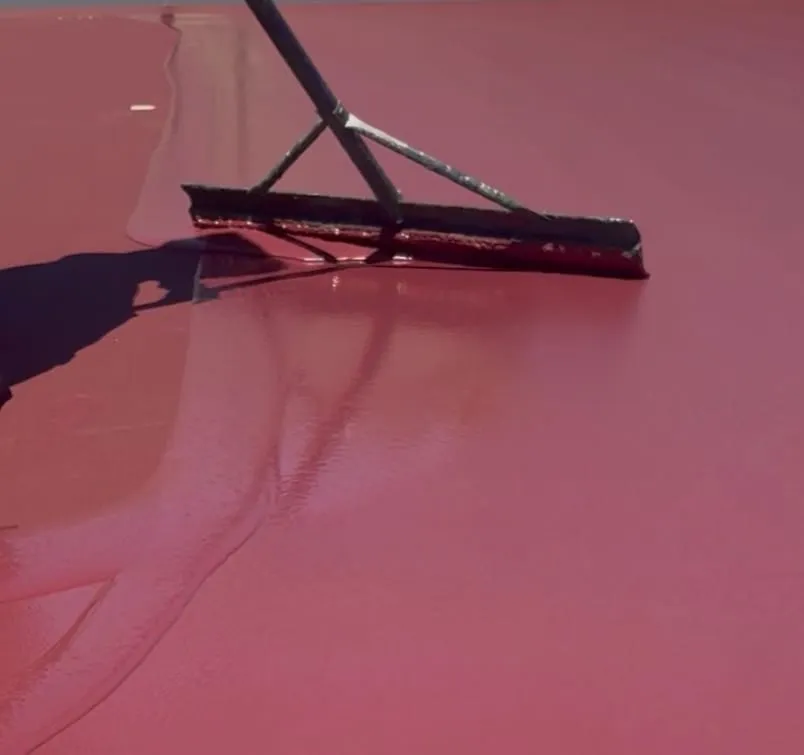
Spring inspection happens before summer heat sets in. Deep summer is the wrong window for wet coating work, while monsoon season adds recurring silt cleanup. Fall into early winter is the shoulder season when resurfacing gets scheduled, once temperatures cool enough to cure without flashing.
When Maintenance Stops Being the Answer
Proper tennis court maintenance protects the five-to-eight-year resurfacing interval this climate allows, and neglect shortens it. For the full signs it's time to resurface, that guide covers the specifics this one doesn't need to repeat.
Keep Your Court on Schedule
These tennis court maintenance guidelines keep upkeep light and protect a Las Vegas court's appearance and playability between resurfacings. On Point Court Surfacing holds NV licenses for Surfacing and Fencing (#0090686) and Concrete (#0095035) and is an ASBA member. It's owner-operated: Brian Foley is on site for the work. When we walk a court, the slick spots and faded lines above are exactly what we're checking for.
Call (702) 686-7738 for a free written quote on inspection, crack repair, or a resurface. HOA and facility managers can also ask about setting up a scheduled cleaning and inspection visit.