September 7, 2026
Pickleball Court Colors: Best Picks for Vegas Heat
Blue and green are lead pickleball court colors, but Las Vegas heat changes the math. See what stays cool, holds contrast, and lasts.
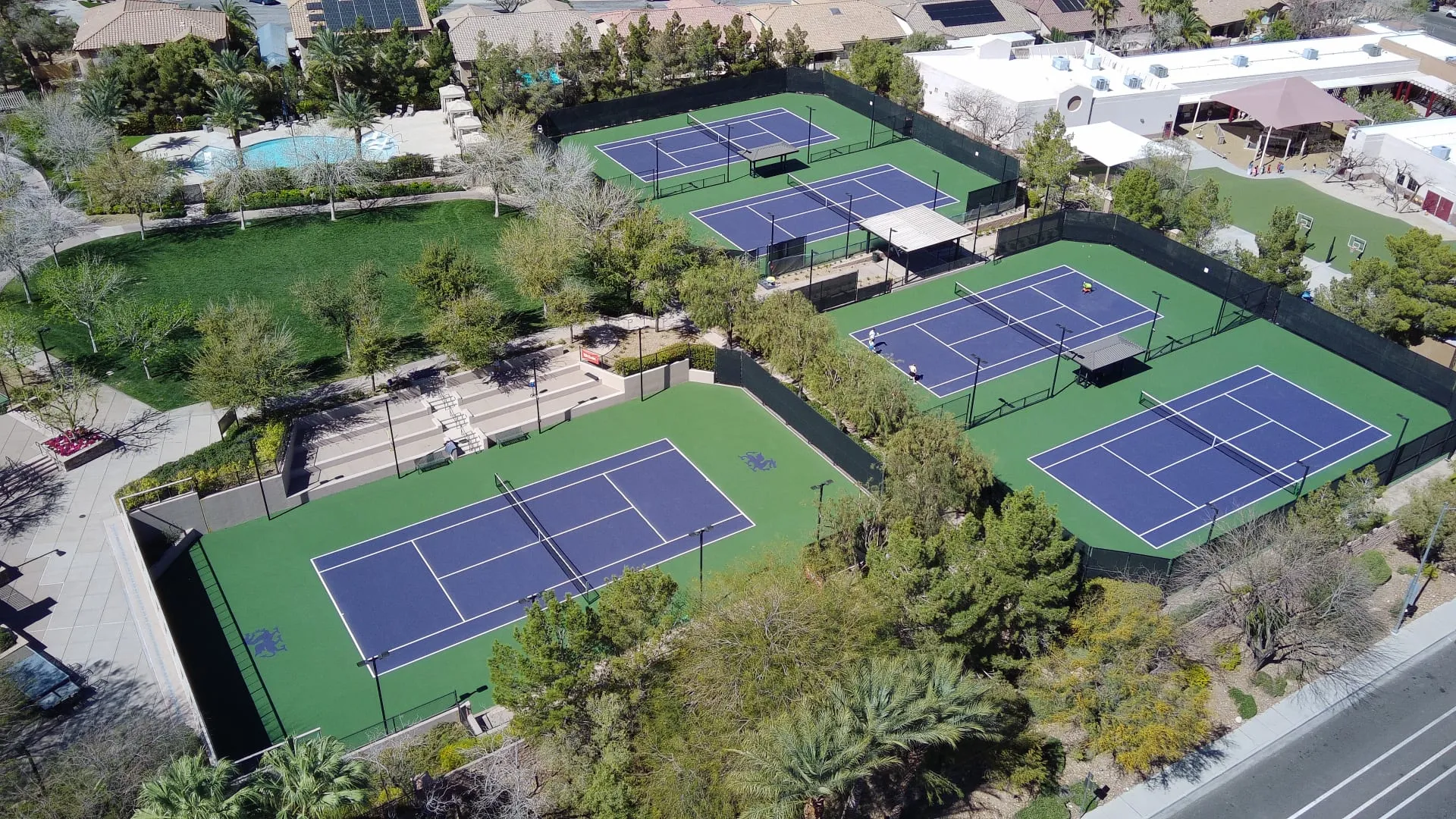
Blue and green dominate pickleball court colors because they contrast well against a yellow or neon green ball. Gray, tan, red, and earth tones round out the options for outdoor courts. In a valley that spends months over 100 degrees, that choice decides whether a court gets played at 2 p.m. or sits empty.
The Most Popular Pickleball Court Colors
Blue and green win because they sit almost opposite optic yellow on the color wheel, giving the ball maximum visual pop. Many players prefer one for that reason, though USA Pickleball doesn’t mandate any color. Gray, light blue, tan, and terracotta are legitimate color options too.
Do Dark Courts Get Hotter in a Las Vegas Summer?
Yes, and ambient air here already reaches 105 to 115 degrees in summer. Dark asphalt climbs to 170 to 180 degrees under that heat, well past the 140-degree mark where skin contact for a few seconds causes a first-degree burn, the kind of heated-surface safety threshold ASTM C1055 was built to define.
NASA’s ECOSTRESS instrument, which averages surface heat across wide areas from orbit, still clocked Las Vegas pavement above 122°F in a June heat wave, and a dark court in direct sun runs far hotter than that citywide average, since asphalt absorbs up to 95 percent of solar radiation.
Darker colors carry a lower Solar Reflectance Index, a measure of how much sun a surface reflects, so they absorb more heat than lighter ones do. That difference is measurable before the coating goes down, and it decides whether a court stays playable on a hot afternoon or gets too hot to use.
Standing at the baseline in a summer match, you feel the radiant heat coming up through your shoes before the first serve lands, the part a swatch never shows.
| Surface Tone | What Happens in the Sun |
|---|---|
| Light gray, sandstone, ice blue, or pale tan | Coolest, highest reflectance |
| Medium-to-dark blue, green, purple, or near-black | Hottest, passes 140°F by mid-morning |
Why Contrast Matters More Than Color
Outdoor pickleballs run bright yellow or neon green, so the surface has to read differently to keep the ball visible. Blue, dark green, purple, and navy hold maximum contrast, with medium gray close behind, while pale yellow or light green leaves a yellow ball barely visible.
What Color Should the Lines Be?
Section 2.A.2 of the USA Pickleball rulebook is direct: all pickleball court lines must be 2 inches wide, a single color throughout, and clearly contrasting with the surface. White makes sense on blue and green, but it washes out on tan, light gray, or off-white courts, needing a darker contrasting color, navy, black, or deep gray, instead.
Playing Area, Non-Volley Zone, or a Different Color for Each?
Court design comes down to factors like contrast and heat. A court has three zones: the playing area, the kitchen (7 feet from the net), and the margin outside the 20-by-44-foot surface, with net height set separately by the rulebook.
A single color is the cheapest route and still passes the rules. Most tournament facilities use two, pairing the playing area with a contrasting margin and sometimes a separate kitchen color. Three colors sharpen spatial awareness for competitive play but can clutter a small backyard court.
Pickleball Court Color Combinations That Work
| Combination | Look | Heat | Ball Contrast | Best Fit |
|---|---|---|---|---|
| Classic blue and green | Blue area, green surround | 20-30°F above ambient | Excellent | Clubs, shade, off-peak play |
| Modern gray with a border | Gray area, forest green or blue border | Cooler, higher reflectance | Good | Midday sun backyards |
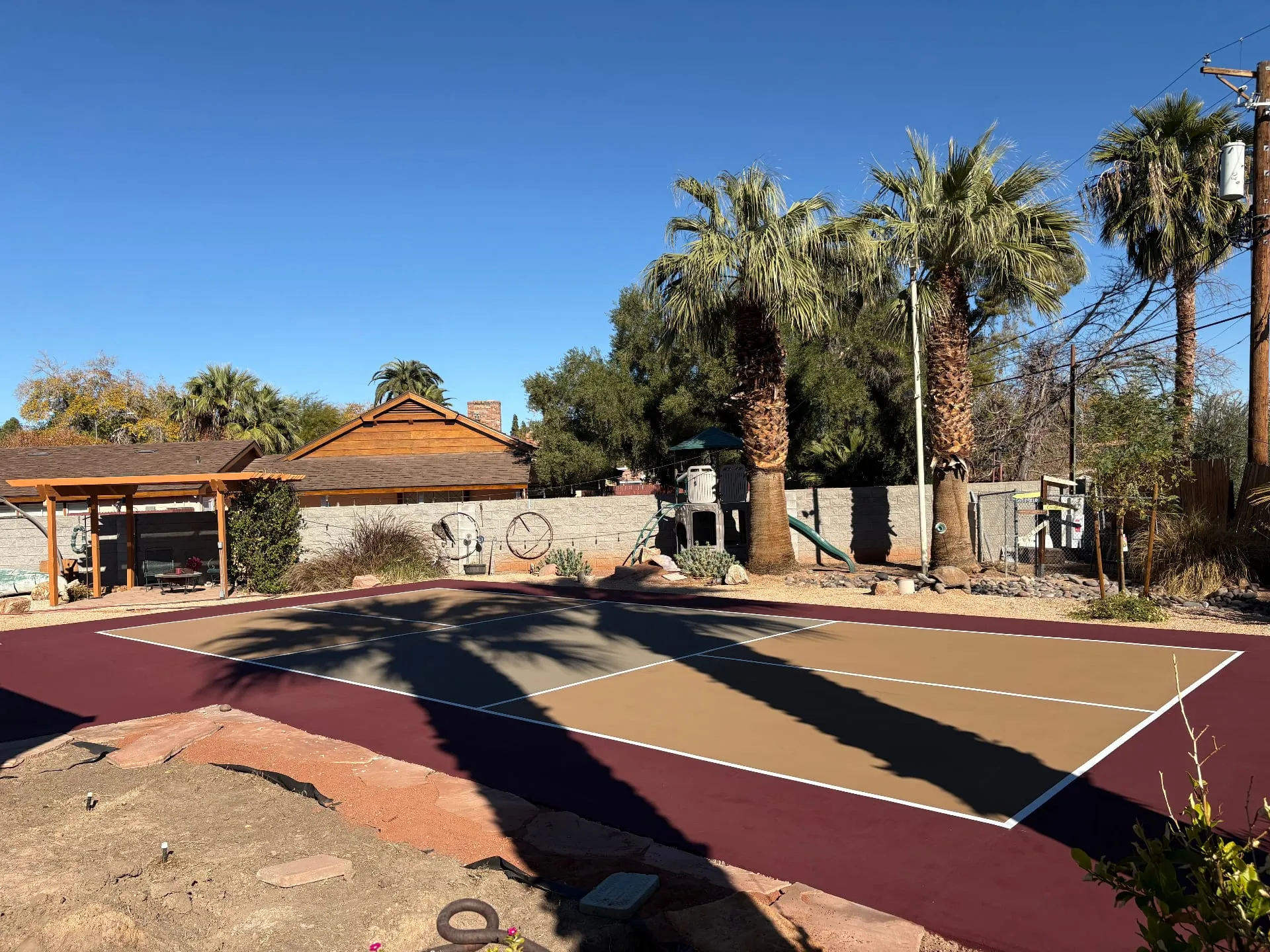
| Desert earth-tone | Sandstone, dark green or brown border | Cool, low glare | Moderate | HOA landscaping |
| Tournament high-contrast | Dark blue, red border | Heavy absorption | Maximum | Athletic facilities |
Where Glare Meets Heat
A near-white or pale yellow court throws glare that bothers players tracking a lob, while dark colors reduce glare and worsen heat. USA Pickleball and the American Sports Builders Association recommend a north-south orientation, weighing shade, lighting, and other factors for player comfort so no one is staring into a low sun.
What Pickleball Courts Are Actually Coated With
“Pickleball court paint colors” is the search term, but the real material is a 100 percent acrylic coating, a flexible emulsion loaded with silica sand for grip. Slabs here hit 140°F by mid-morning in July, and coatings can’t go down on anything hotter, so a real crew starts before 10 a.m. The full coating system built for the desert covers how these court surfaces hold up long after the color choice is made.
Will the Color Fade in the Desert Sun?
Fading speed depends on a color’s pigment chemistry. Inorganic pigments hold up for years, the iron oxides behind classic tans, browns, and earth tones, chromium-oxide green, and cobalt blue all resist UV breakdown. Organic pigments, the source of vivid reds, oranges, and purples, break down faster under UV exposure.
Custom Color Schemes, Logos, and Multi-Color Designs
A logo at center court or a custom color court looks sharp on day one, and tournament purple or maroon works well as a kitchen accent since both sit opposite optic yellow. Keep bold detail in one spot and leave other areas simple.
A shared tennis court works best with blended lines. The primary sport keeps its white lines, and pickleball gets a muted shade in the same color family, so no one calls a ball off the wrong line.
Can I Match My Patio or Pool Deck?
Yes, for many Las Vegas, Henderson, and Summerlin backyards. Gray and tan schemes sit best next to a pool deck or landscaping while meeting the ball-contrast rule, a defensible HOA pick too.
What We Build With
We work in two acrylic systems, standard and cushioned. We also pour the post-tension slabs that the local soil requires. Our concrete crew has specialized in that work for over 30 years.
Real Courts Around Las Vegas
Owner Brian Foley played number-one singles on a full-ride scholarship at Boise State. He later won a round at an early PPA event in Las Vegas, giving color decisions a player’s eye as well as a builder’s. Our local work includes Darling Tennis Center, TPC Summerlin, Dragon Ridge Country Club, and Lake Las Vegas.
It also includes Anthem Country Club, Wine Ridge RV Resort in Pahrump, the 10-court resurfacing at Lorenzi Tennis Club, and the pickleball courts at Patriot Park in Las Vegas. Backyard and HOA jobs span Green Valley, Boulder City, Mesquite, and beyond. Getting court dimensions and zone placement right matters as much as color.
⭐⭐⭐⭐⭐
“The pickleball court came out perfect. Great color and exact dimensions. I would recommend them for quality and competitive cost.”
Color Decisions at Resurfacing Time
Most color changes happen at resurfacing time, when a color change is affordable on its own. The right color is simply whichever one passes the heat and contrast tests above.
Choosing Your Color Palette: A Quick Checklist
- Confirm your ball color, yellow or neon green, and test any finalist color against it.
- Walk the court’s midday sun exposure before ruling a tone in or out.
- Decide on one, two, or three zones based on who plays there.
- Ask if a color is an inorganic or organic pigment, that answers the fading question.
We walk you through real color combinations on a finished local court. Call (702) 686-7738 for a free on-site consultation to see how they look in person.