August 18, 2026
Pickleball Court Surface: What It's Made Of and Which System Fits Your Vegas Court
What is a pickleball court surface made of? See the acrylic systems built for Las Vegas heat, soil, and play.
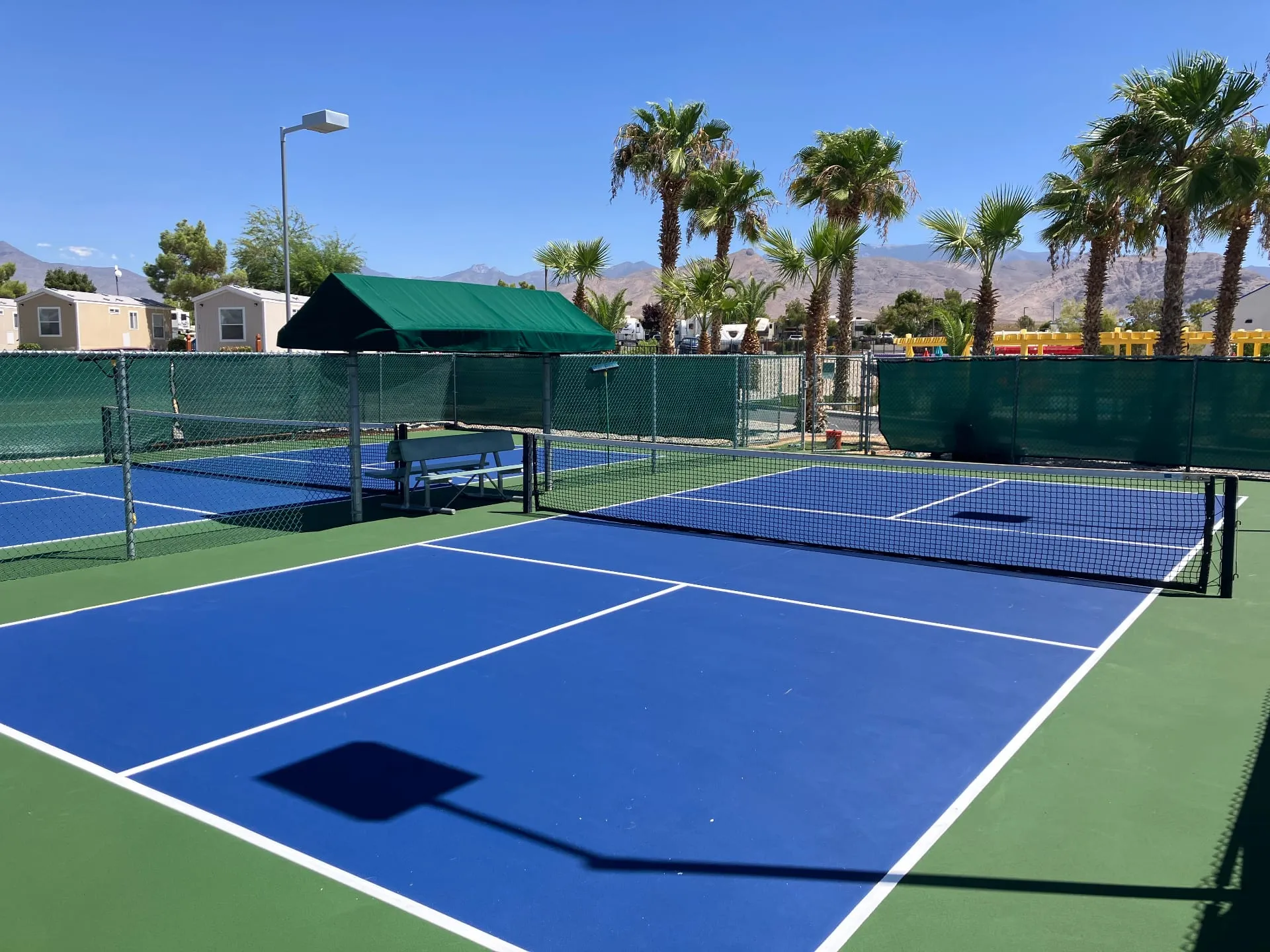
A pickleball court surface is a post-tensioned concrete slab finished with a multi-coat acrylic system: a primer and sanded resurfacer that build texture, then pigmented acrylic color coats on top. The slab and coating work as one unit.
A consistent surface keeps the ball bounce predictable and supports reliable ball control. In Las Vegas, that coating is either a standard acrylic hard court or a liquid-applied cushioned acrylic, and the right pick comes down to how often you play and how your joints handle the impact.
The slab underneath decides how long the surface lasts
The paint job is what people notice first: the color blocks, the kitchen line, the striping. Few players walk onto a court and think about the slab underneath, the part that’s really doing the work in Southern Nevada.
The valley sits on expansive desert clay and caliche, a natural, cement-like layer that’s erratic in thickness and hard to excavate evenly. Crews can’t just fill and grade around it the way they would with looser soil.
In soils common to the region, settlement risk rises when a foundation sits partly on caliche and partly on compressible clay that shifts once moisture reaches it. A standard reinforced slab cracks under that movement, and cracks telegraph straight through the acrylic. Asphalt holds up even worse, since its binder turns brittle under sustained desert heat.
On Point builds on post-tensioned concrete instead. The slab is reinforced with steel cables tensioned after the pour, held under permanent compression and extremely durable against Las Vegas heat, with no seams for a foot to catch on. Southern Nevada sites often need engineered fill under the slab before the pour even starts, especially where caliche runs inconsistently.
Even a quality coating fades fast over a slab that wasn’t built to hold up, and a well-built slab still needs a coating that can handle the sun and traffic on top of it.
The two acrylic surfaces On Point builds for outdoor courts
Acrylic hard court and cushioned acrylic are the most common surfaces for outdoor pickleball courts across the valley. They’re also the only two acrylic surfaces On Point installs here. Acrylic courts are widely used as sports surfaces across the Southwest since the coating withstands sun and abrasion far better than paint alone, and both systems sit on a post-tensioned slab textured with silica sand sized for pickleball. On Point’s own pickleball court surfacing page covers how each build gets specced for a court’s actual use.
Cushioned acrylic adds a liquid-applied layer of rubber granules suspended in acrylic binder, brushed on before the color coats go down. The rubberized layer bonds directly into the coating as it cures, instead of sitting on top like a glued mat. That matters because Las Vegas surface temperatures can climb past 150 degrees on a dark court, and that’s exactly the heat that breaks down adhesive under a prefabricated cushion mat.
| Surface System | Play Feel | Joint Impact | Best Fit |
|---|---|---|---|
| Acrylic Hard Court | Firm, with a consistent ball bounce and honest grip from rounded silica sand. | Higher impact. Force travels up through the lower body with nothing to absorb it. | Backyard courts and budget-conscious HOA builds. |
| Cushioned Acrylic | The ball bounce stays true, but the landing feels noticeably softer underfoot. | Reduced. The rubberized layer takes a portion of the shock before it reaches the joints. | Clubs and HOAs with heavy daily play. |
Clay and grass are common surfaces for racquet sports in wetter regions, but a desert climate can’t support the moisture either needs. Turf and other surfaces marketed as low-maintenance retain heat aggressively, and modular tile creates dead spots where a piece doesn’t sit flush, so a wet tile floor loses traction quickly.
Dedicated courts play better than shared tennis conversions
Adding pickleball lines to an existing tennis court is a reasonable way to try the sport, but it comes with trade-offs once you’re playing several games a week. Tennis-first surfaces use angular silica sand that grips a tennis ball’s felt, and that same texture wears down a pickleball’s smooth plastic faster than a topcoat built for it would. A dedicated build sidesteps that, sized to the regulation 20 by 44-foot playing area USA Pickleball rules specify, with a roughly 30 by 60-foot footprint for safe runoff.
If you’re comparing materials across racquet sports more broadly, this breakdown of court surfacing options covers ground this article intentionally leaves out.
Is a pickleball surface different from a tennis surface?
Yes, mainly in the sand. Tennis topcoats use angular silica sand because the sharp edges grab a felt tennis ball and slow the pace of play down.
Pickleball’s plastic ball has no felt to grip, so its topcoat calls for finer, rounded silica sand instead, usually in the 70 to 90 mesh range. That precision gives a player’s shoes enough traction for a controlled stop without sandpapering the ball into an early replacement.
Cushioned surfaces and player comfort at the kitchen line
Pickleball loads joints differently than tennis does. Most of the action happens inside the 14-foot non-volley zone, where players are split-stepping and decelerating hard in a tight space instead of covering open court.
That force travels straight up through the ankles and knees, and bare concrete has almost no give to absorb it. A cushioned acrylic system interrupts that transfer, compressing under a foot strike so a long game feels lighter on the joints.
Does a pickleball court need cushioning for recreational play?
Not every court needs it, but it earns its cost faster in pickleball than in tennis. A standard acrylic hard court is one of the harder surfaces available, trading cushioning for a firmer, truer bounce, and recreational play stays plenty fun on either system. Even a fast-paced game feels manageable on the standard hard court for casual players.
HOAs and clubs running courts every day tend to spec cushioned acrylic despite the higher upfront cost, since the two feel completely different underfoot. For a backyard build on a budget, the standard acrylic hard court is the best surface for the money.
Weather resistance for outdoor pickleball courts
Darker color combinations absorb more solar heat, raising surface temperature and making a court less comfortable on a Vegas afternoon. Lighter, reflective colors keep temperature down without changing how the acrylic performs. The full color breakdown gets its own coverage elsewhere.
The acrylic binder is weather-resistant across summer heat and occasional rain or snow at higher elevations near the valley. It’s built to perform through Southern Nevada’s toughest weather conditions without breaking down.
Courts should run north-south, so players aren’t staring into a low desert sun mid-game. Wind carries abrasive sand across the valley, so fencing protects the coating too, and drainage is crucial during the rare heavy downpours, since standing water undermines the coating faster than sun exposure does.
How often does a pickleball surface need resurfacing?
A pickleball surface generally needs resurfacing every four to eight years, and heavy daily use at a club or HOA pushes that toward the shorter end. Skipping it can lead to a dead-feeling bounce and fading color at the kitchen line, where wear and abrasion hit hardest, while resurfacing on schedule extends the life of the slab underneath.
Do outdoor courts need more maintenance than indoor courts?
Indoor courts need less frequent resurfacing since they’re never fighting UV exposure or wind-blown sand. On Point’s builds are all outdoors, so every court here faces that daily exposure and needs a coating built to maintain its grip and color through direct sun.
Pickleball also wears a coating differently than tennis does. A pickleball court concentrates four players’ movement into about 880 square feet, compared to roughly 2,800 for a tennis court. Because a post-tensioned slab rarely cracks, a recoat stays cosmetic work rather than structural repair, which keeps the job to a day or two of good weather instead of a rebuild.
Local projects and the builder-player difference
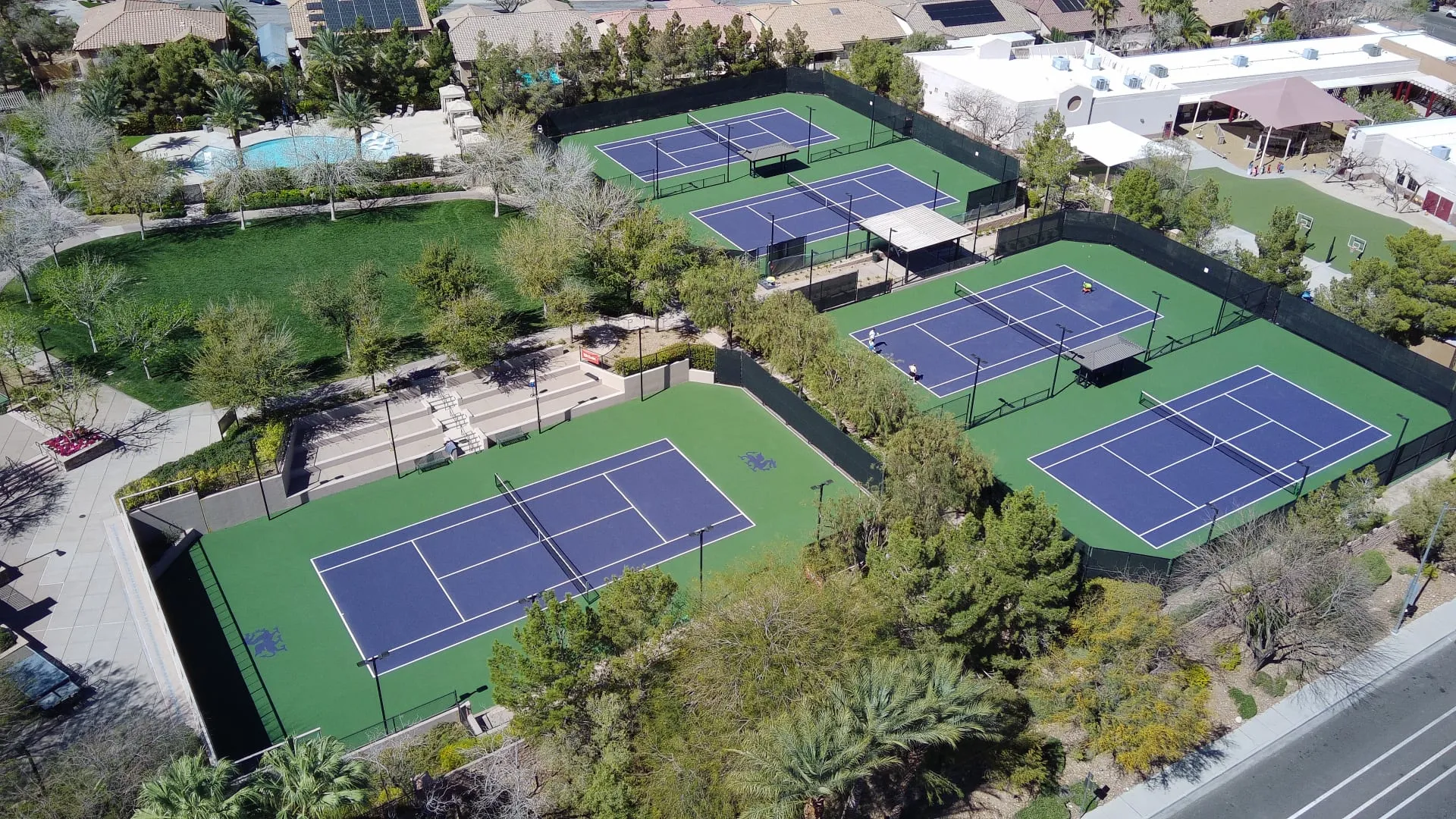
On Point has built and resurfaced courts across the valley for many years, including the multi-court complex at Wine Ridge RV Resort in Pahrump and HOA community work throughout Summerlin. Getting the sand ratio right during installation is essential to how the coating performs.
That track record shows up in the reviews too. As of August 2026, On Point held a 5.0-star rating across nine Google reviews, including one from a client whose new pickleball court On Point coated:
⭐⭐⭐⭐⭐
“Came out right away and coated our new pickleball court. Highly recommend”
Brian Foley brings two perspectives to every build: player and builder. As a former number-one college tennis player and current competitive pickleball player, he notices whether sand dosing gives honest grip without dragging on a shoe mid-lunge. As the licensed contractor holding Nevada licenses 0090686 and 0095035, and an ASBA member, he sets the sand ratios and slab specs before a crew shows up.
Surface choice affects the price of a build, since a cushioned system needs more material and labor than a standard hard court, and that math gets covered in its own pricing guide.
If you’re ready to talk through which system fits your court, call (702) 686-7738.
You can also request a quote online if that’s easier.