July 17, 2026
Tennis Court Surfaces: Every Type of Court, and the Two That Belong in Las Vegas
Tennis courts come in four surface types, but only two work outdoors in Las Vegas: acrylic hard court and cushioned acrylic. Here is why, and where every other surface belongs.
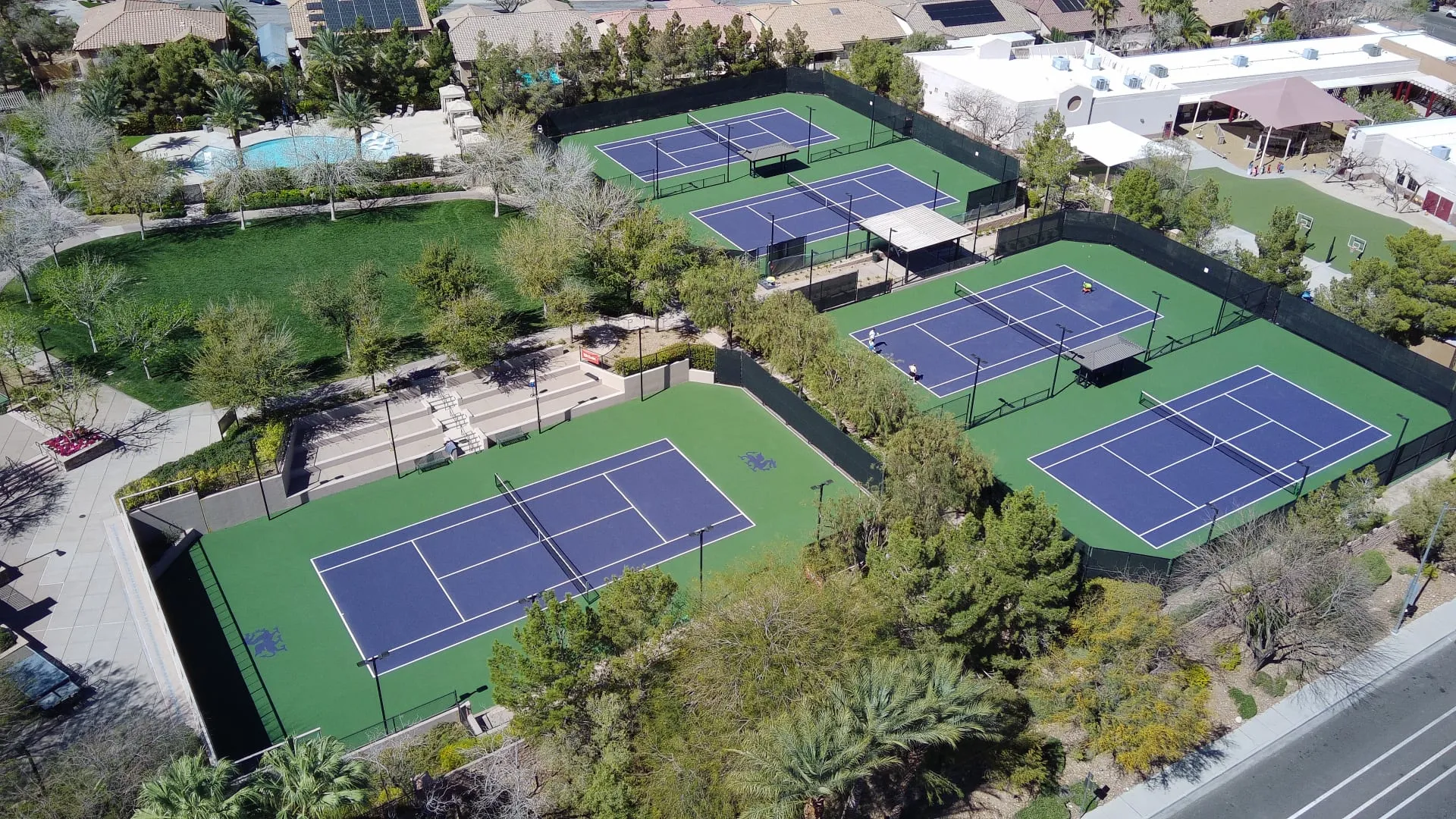
There are four main types of tennis court surfaces: hard courts, clay courts, grass courts, and artificial surfaces such as carpet and synthetic turf. In Las Vegas, only two work outdoors, an acrylic hard court or a cushioned acrylic court, because heat, UV, caliche soil, and water restrictions rule out the rest. Here is what we build and why, then where every other surface does belong.
Tennis court surfaces at a glance
| Surface | Made of | Pace | Bounce | Upkeep | Grand Slam | Works in Las Vegas? |
|---|---|---|---|---|---|---|
| Acrylic hard court | Concrete, pigmented acrylic layers, silica sand | Medium to fast | High, very consistent | Low, recoat every 5 to 8 years | US Open, Australian Open | Yes, our default |
| Cushioned acrylic | Same, plus a liquid-applied rubber and acrylic layer | Medium | Consistent, softer | Low, same cycle | Pro and club level | Yes, best for joints |
| Clay | Crushed brick, shale, or stone over a stone base | Slow | High | Very high, daily water, roll, brush | French Open | No, water and labor |
| Grass | Natural turf over compacted soil | Fastest | Low, skidding | Highest, mow, roll, reseed, irrigate | Wimbledon | No, water and heat |
| Carpet | Textile or polymeric material supplied in rolls | Fast | Low to medium | Low, indoors only | None, retired from the tours | No, indoor only |
| Synthetic turf | Polyethylene fibers, sand or rubber infill | Medium slow | Lower, less true | Medium, brushing, infill | None | No, UV and heat |
| Modular tile | Snap-together polypropylene over a slab | Medium | Less true, plastic feel | Low, but tiles move | None | No, heat expansion, UV |
Acrylic hard court, the right surface for most Las Vegas courts
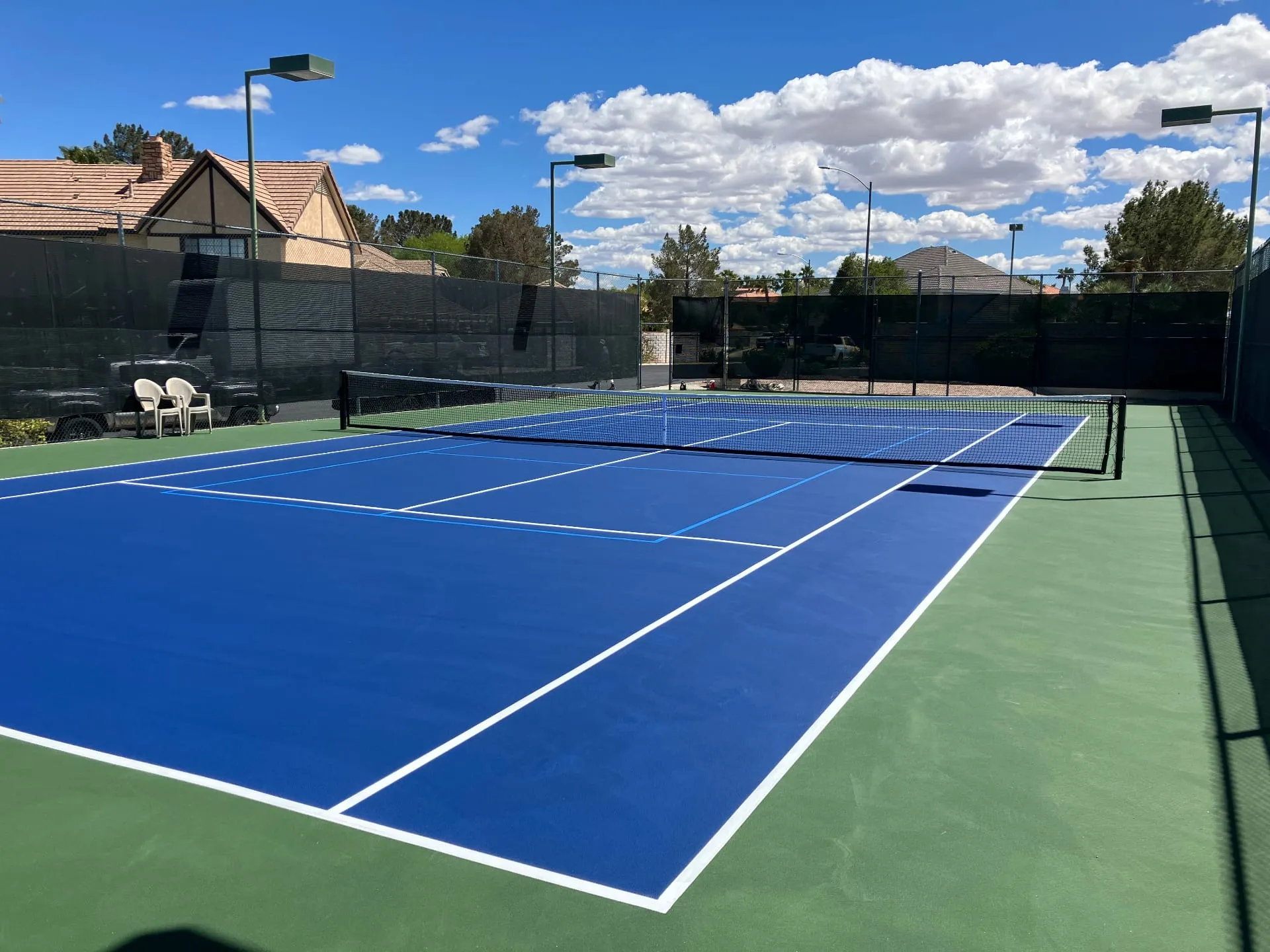
An acrylic tennis court is several thin layers of pigmented, water-based coating over concrete, with silica sand blended in for grip. You get a true, consistent bounce, the exact color you choose, and a surface that shrugs off heat and UV better than anything else. Hard courts are the most common tennis court surface in the country, and two Grand Slam tournaments, the US Open and the Australian Open, are played on them.
They are sometimes called the democratic court, because no single style owns them. Hard courts run faster than clay and slower than grass with a predictable bounce, so big serves are rewarded and so are baseline players grinding out longer rallies. On a private or community court, that neutrality is the point: one surface has to work for a competitive junior, a weekend doubles group, and the pickleball crossover crowd.
Maintenance is a wash-down now and then plus a resurface every 5 to 8 years here. The coating is a wear layer, not the structure, so a sound slab gets recoated for decades. It is the system under the courts we are known for locally, including the 10-court resurface at Lorenzi Tennis Club, work at Darling Tennis Center, and club courts at Dragon Ridge Country Club, TPC Summerlin, Anthem Country Club, and Lake Las Vegas. See our tennis court construction page for how a build runs.
Cushioned acrylic, when comfort matters
A cushioned court adds a resilient layer to the same acrylic system, under the color coats. Of the main tennis surfaces, hard courts put the highest impact load on knees, ankles, hips, and backs, so the cushion is the best upgrade available to anyone playing several times a week. Same UV and heat resistance, softer landing, higher price for the added layers.
How the cushion is built matters a great deal here. Liquid-applied cushion mixes rubber granules into acrylic binder, troweled on in layers that bond to the slab. It is monolithic, it moves with the slab, and there is no glue line to fail. Glued-down mats or rolls are prefabricated sheets adhered to the concrete, and in our heat the adhesive can soften and the sheet can bubble, lift, or delaminate. We do not build glued cushion systems outdoors in the desert.
| Acrylic hard court | Cushioned acrylic | |
|---|---|---|
| Feel underfoot | Firm, tour standard | Softer, joint-friendly |
| Cost | Lower | Higher, added layers |
| Best for | Most residential and commercial courts | Frequent players, protecting knees and backs |
The slab matters more than the surface
No coating outperforms what is under it. Post-tension concrete has steel cables tensioned inside the slab after the cure, holding it in compression, which resists the cracking that comes from caliche, expansive clay soils, and daily temperature swings. That is what we build on, with a concrete lead who has 30-plus years in post-tension court slabs. Asphalt is cheaper up front, but it softens in extreme heat, oxidizes under UV, and cracks sooner. In a climate that clears 110°F all summer, asphalt is a short-term slab.
For how the base drives the total number, see our guide to how much a pickleball court costs in Las Vegas.
Why Las Vegas narrows the field to two
- Heat. Slab temperatures can pass 140°F on a summer afternoon, which punishes adhesives, plastics, and asphalt, and rewards a monolithic acrylic system bonded to the slab.
- UV. Relentless sun oxidizes coatings and synthetic fibers. UV-stable acrylic pigments hold color far longer than turf fibers.
- Soil. Caliche and expansive clay move, so the slab has to resist that movement or the surface above it cracks.
- Water. Clay and grass are thirsty, and Southern Nevada water is expensive and restricted. Acrylic needs almost none.
The other tennis court surfaces, and where they do belong
Every one of these is excellent somewhere. None of them survives an outdoor court in the Mojave.
Clay
Clay courts are made of crushed shale, stone, or brick over a stone base, and they produce a slow, high bounce that turns points into longer rallies and rewards spin and tactical play. Red clay, the French Open surface, uses crushed brick; green clay, common in the American Southeast, uses crushed basalt and plays faster. It is the surface where players slide into shots rather than plant, and the one most tied to long dominance: Rafael Nadal has won 14 French Open titles on clay. The catch is daily watering plus rolling, brushing, and top-dressing to preserve flatness, which is difficult to justify on restricted desert water.
Grass
Grass courts are the fastest surface. The ball skids low, points end early, and big serves and serve-and-volley play win, which is why Pete Sampras and Roger Federer built their Wimbledon histories on it. Wimbledon is the only Grand Slam played on grass. Grass demands mowing, rolling, reseeding, and constant irrigation, and clubs generally require flat-soled shoes to protect the turf. Here it is a full-time landscaping project fighting the sun. For the look without the water, a green acrylic or cushioned court gets you most of the way.
Carpet
Carpet courts are textile or polymeric surfaces supplied in rolls, laid over a firm base and installed indoors. They play fast with a low bounce, and were common for indoor tournaments until the tours retired them at the end of the 2000s.
Synthetic turf
Synthetic turf plays softer and carries several sports at once, but UV degrades the fibers, infill heats up sharply in direct sun, and the ball response never matches a bonded hard court. Turf belongs on the padel side of the world, where the enclosed court and surface go together. See our padel court construction page.
Modular tile
Modular tile snaps together over an existing slab, fine for casual backyard hoops. For tennis, the foot feel and ball response fall short of bonded acrylic, the tiles expand and contract in extreme heat, and suspended plastic in desert sun ages faster than a coating engineered for UV.
How the International Tennis Federation classifies court surfaces
The International Tennis Federation is the governing body that classifies court surfaces and rates their speed. Its list covers acrylic, clay, artificial clay, grass, artificial grass, asphalt, concrete, and carpet. The ITF defines clay as unbound mineral aggregate, acrylic as a polymeric material supplied in liquid form and cured in place, and carpet as textile or polymeric material supplied in rolls or sheets. Its court pace rating runs from Category 1, slow, to Category 5, fast: clay sits at the slow end, most acrylic hard courts land in the middle, grass and fast indoor surfaces at the top.
How the surface changes the way you play
| If the surface is | The ball | Players who tend to win |
|---|---|---|
| Grass, generally faster | Skids low, points end early | Big servers, serve-and-volley |
| Carpet or fast indoor | Low and quick, no wind | Flat hitters, big serves |
| Acrylic hard court | High and predictable | All-court players, both styles |
| Cushioned acrylic | Slightly slower, still true | Frequent players, easier on joints |
| Clay, slowest | Bounces high, sits up | Spin-heavy baseline players |
If your family plays doubles matches on weekends, a medium-paced acrylic surface produces better rallies than a fast surface that ends points on the serve. If your kids compete on hard courts, practicing on the same surface family is worth real points.
Pickleball, basketball, and padel run on the same two systems
The differences between sports show up in texture, color, and line striping, not in the surface family. Pickleball is the most requested court in the valley right now and brings its own surface decisions: dedicated versus shared lines, cushion for constant lateral movement, and color. Start with our pickleball court construction page. Padel is the exception, since an enclosed padel court uses turf by design.
How often does a court need resurfacing here?
Plan on every 5 to 8 years in Southern Nevada, sooner in all-day sun with no windscreen. The tells are faded color, a slick surface where the sand has worn off, hairline cracking, and puddles that sit after a wash-down. Resurfacing is a coating job, not a rebuild. See when to resurface your court for the six signs, and our repair and resurfacing page for how the work runs.
So which surface is right for your court?
For most homeowners and nearly every commercial, HOA, club, school, or park court, a standard acrylic hard court is the answer: lowest lifetime cost, proven durability in this climate, and the game players expect. Choose cushioned acrylic when comfort matters, if you play several times a week or are building a court you plan to spend real time on. Clay, grass, turf, and tile all belong somewhere. Not in the Mojave.
Either way the court sits on a post-tension slab engineered for local soil, gets custom color, and carries regulation line striping. Our owner is a former college and pro-level player as well as the builder on site, so the recommendation comes from both sides of the net.
Request a free written quote or call (702) 686-7738, and we will help you pick the surface that fits how you play.
Common questions
What is the most common tennis court surface? Hard courts are the most common tennis court surface in the United States and worldwide for public and residential courts. They are concrete or asphalt finished with acrylic layers, they give a predictable bounce, and they need far less maintenance than clay or grass. Two of the four Grand Slam tournaments, the US Open and the Australian Open, are played on hard courts.
Which tennis court surface is easiest on your body? Clay is the gentlest traditional surface, but it is not practical here. Of the surfaces that survive the desert, a liquid-applied cushioned acrylic court is the easiest on knees, ankles, hips, and backs, because the resilient layer absorbs impact that a standard hard court transfers straight into the player.