
Tennis Court Guide
How Often Should a Tennis Court Be Resurfaced? A Las Vegas Maintenance Guide
Published September 9, 2026
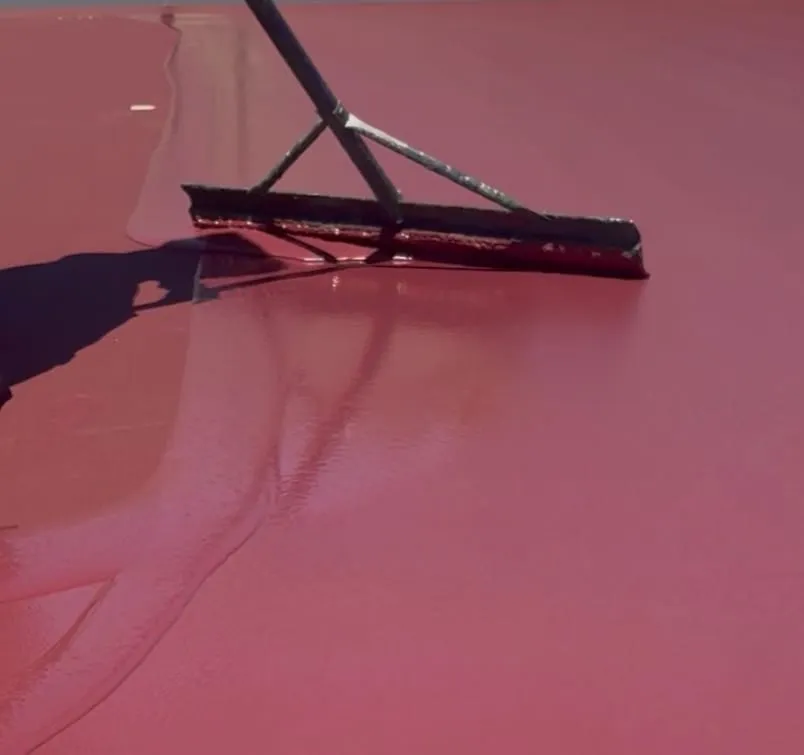
An acrylic tennis court needs resurfacing every 4 to 8 years, and On Point's own guidance for Las Vegas courts is 5 to 8. Not all tennis courts reach the far end of that range: where a court lands depends on how it was built and how well it is maintained. A post-tension concrete court kept clean and draining well stretches its surface to the upper limit, while an asphalt-based court in the same yard can crack within a few years, because asphalt flexes with the desert soil instead of resisting it. This guide covers the proper tennis court maintenance that pushes a court toward 8 years instead of 5, how to read where yours sits in its life, and when a simple crack repair beats a full tennis court resurfacing.
Why a Las Vegas Court Wears Faster Than the National Range Suggests
For outdoor courts in the desert, sun and water are a tennis court surface's two most damaging enemies, a pairing indoor courts never have to face. Las Vegas averages about 78 days a year at or above 100°F and roughly 40 at or above 105°F, per the National Weather Service 1991-2020 normals. In the summer of 2024, the Weather Service logged a record of 120°F and 11 straight days at 110°F or hotter. A dark acrylic surface sits well above air temperature under that sun, and the heat bakes the binders that hold the silica sand to the surface. Ultraviolet light does the rest, breaking down the acrylic coatings and leaving the acrylic layers brittle.
Underneath the surface, caliche is the problem. Caliche is a hard, cement-like layer of calcium carbonate soil found across the Las Vegas Valley. It swells and shrinks as moisture moves through it, and that movement cracks a flexible asphalt base far sooner than it troubles a post-tension slab, meaning concrete reinforced with steel cables that are tensioned after it cures. Monsoon storms add wind-driven silt that scours the coating like fine sandpaper. And despite the heat reputation, those same NWS normals still record about 10 nights a year at or below freezing, so water that seeps into a hairline crack can freeze overnight, expand, and cause further deterioration from the inside.
What Decides Where Your Court Lands in the Range
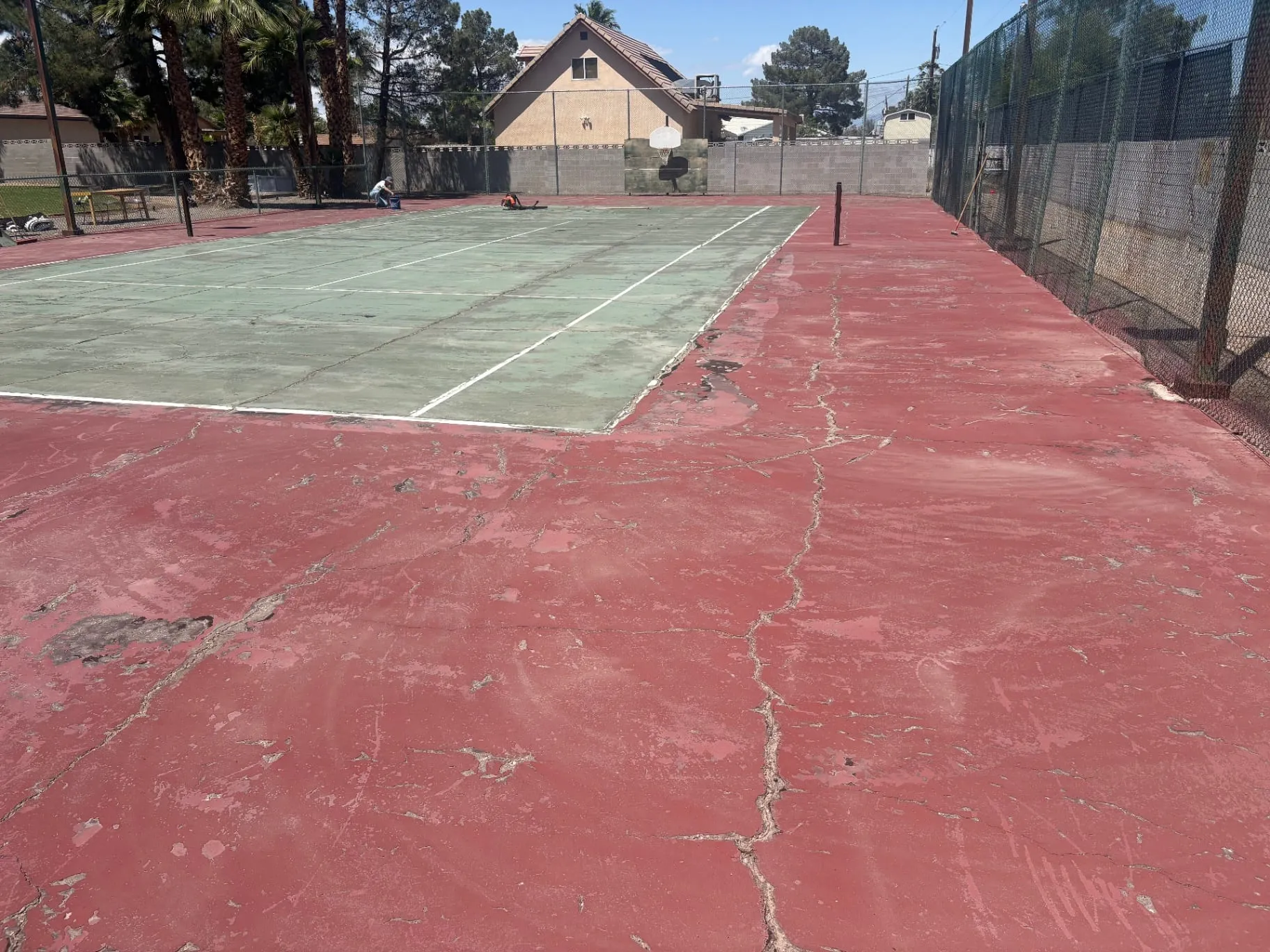
Construction is the biggest factor. A post-tension slab carries enough built-in compressive force to bridge shifting soil rather than crack over it, which is why courts built this way tend to reach the upper end of their service life. A well-maintained court gets to that far end; one that skips its upkeep heads toward premature wear. Play volume matters next: a club court under daily lessons wears its sand texture down faster than a backyard court used on weekends. Drainage carries nearly as much weight. A drainage system that is functioning properly sheds water fast, while a court that fails to maintain proper drainage lets water pool and break down the binder, so proper drainage is not optional here. Color and surface type play a smaller part, because darker resurfacing tones absorb more heat and fade sooner.
For an HOA board, club, school, or parks department running several courts at once, those factors are also what make a single maintenance and resurfacing cycle worth budgeting across the whole set. Our commercial court repair and resurfacing page walks through how that planning works for multi-court sites.
Tennis Court Maintenance Guidelines: What to Do and When
These tennis court maintenance guidelines are what separate a well-maintained tennis court from one heading toward premature wear, and none of them are complicated. Here is the routine that keeps a court playing well and draining properly between resurfacings.
| Frequency | What to do | Why it matters |
|---|---|---|
| Weekly | Keep the court free of organic debris like leaves and pine needles, especially in high-traffic areas. Remove dirt before it grinds in, and squeegee any standing water. | Organic debris traps moisture, and acrylic left sitting under water will blister. |
| Monthly | Deep clean with a mild detergent solution and a soft-bristle brush. Scrub gently at stains, and treat any mold or algae with a diluted bleach solution. | Regular cleaning keeps the court clean and stops buildup before it becomes a safety hazard. |
| Seasonally | Pressure washing tennis courts should stay at low pressure, so keep the pressure washer well back. Clear silt and vegetation from the court perimeter drains and confirm the slope still sheds water. | High pressure strips silica sand out of the coating, and a blocked drain defeats proper drainage. |
| Annually | Regularly inspect net posts, windscreens, and other tennis court accessories and permanent fixtures. Inspect the court annually, confirm regulation net height, and log minor cracks before repairing cracks with an acrylic-based filler. | Torn windscreens let silt hit the surface directly, and asphalt fillers will not bond to an acrylic court. |
A few habits do more damage than owners expect. Weed killer, chewing gum, and roller blades should never touch the playing surface. Mulching planting beds around the court perimeter and trimming back vegetation keeps roots and silt off the affected areas. And non-marking tennis shoes protect both the court's appearance and the footing, holding optimal playing conditions and a more enjoyable playing experience across the court's life. We once watched a court that skipped two seasons of drain clearance develop a persistent slick spot behind the same baseline, which cleared up only after the drains were opened again.
Reading Your Court's Surface: Early Signs and Surface Cracks
A court shows its age in a predictable order, so the early signs are worth knowing. They run from cosmetic to structural, and the further down this list your court sits, the less time you have before a repair becomes a resurface.
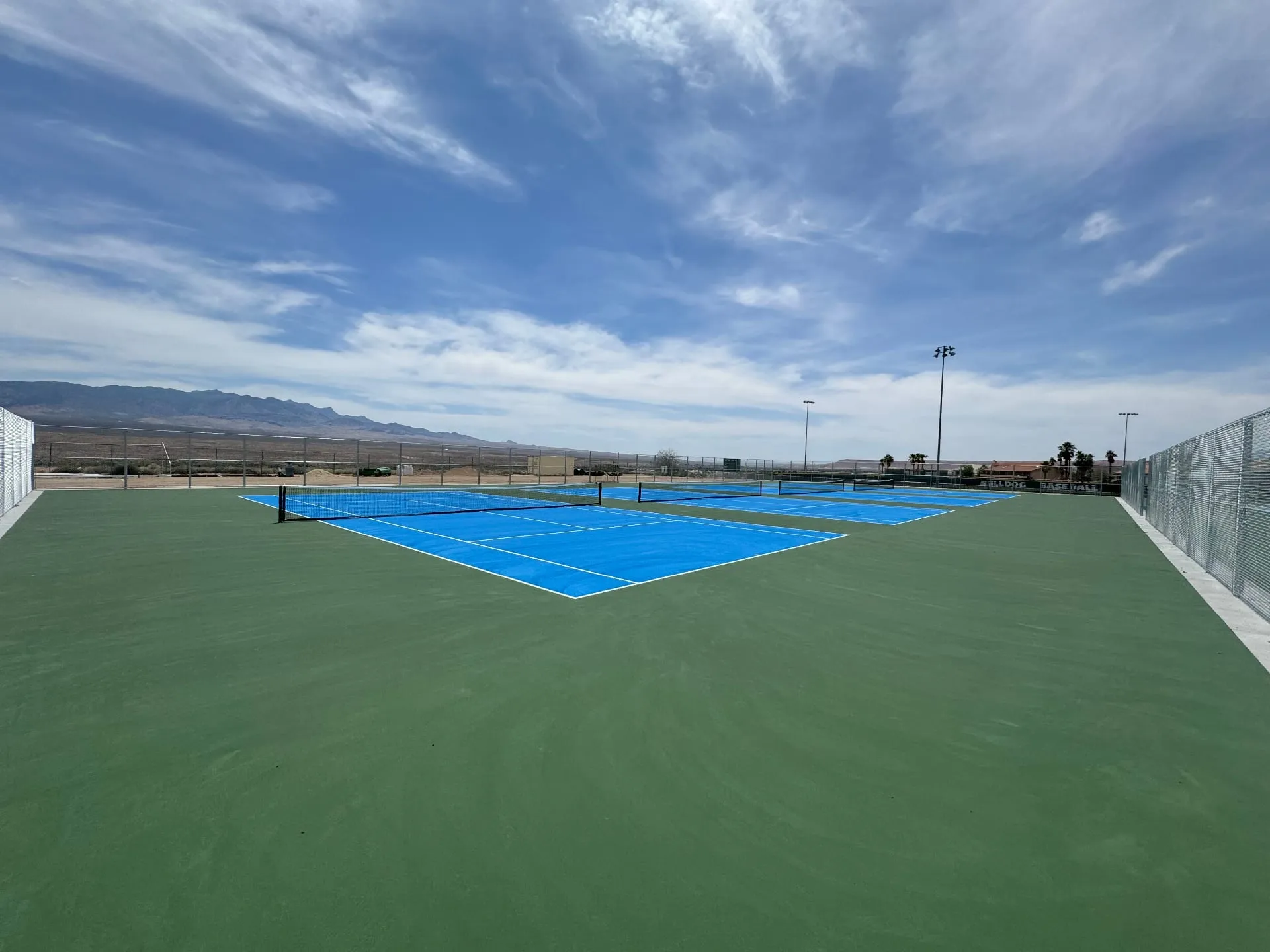
Fading and chalking arrive first, a cosmetic signal that the UV protection in the acrylic binder is starting to give out. Line fade usually shows up alongside it, since the ultraviolet light that dulls the court color also bleaches the paint. As the binder weakens, silica sand sweeps away and leaves slick, bare areas with uneven ball bounce behind the baselines and service boxes. Hairline surface cracks come next, as the brittle acrylic layers lose their flex.
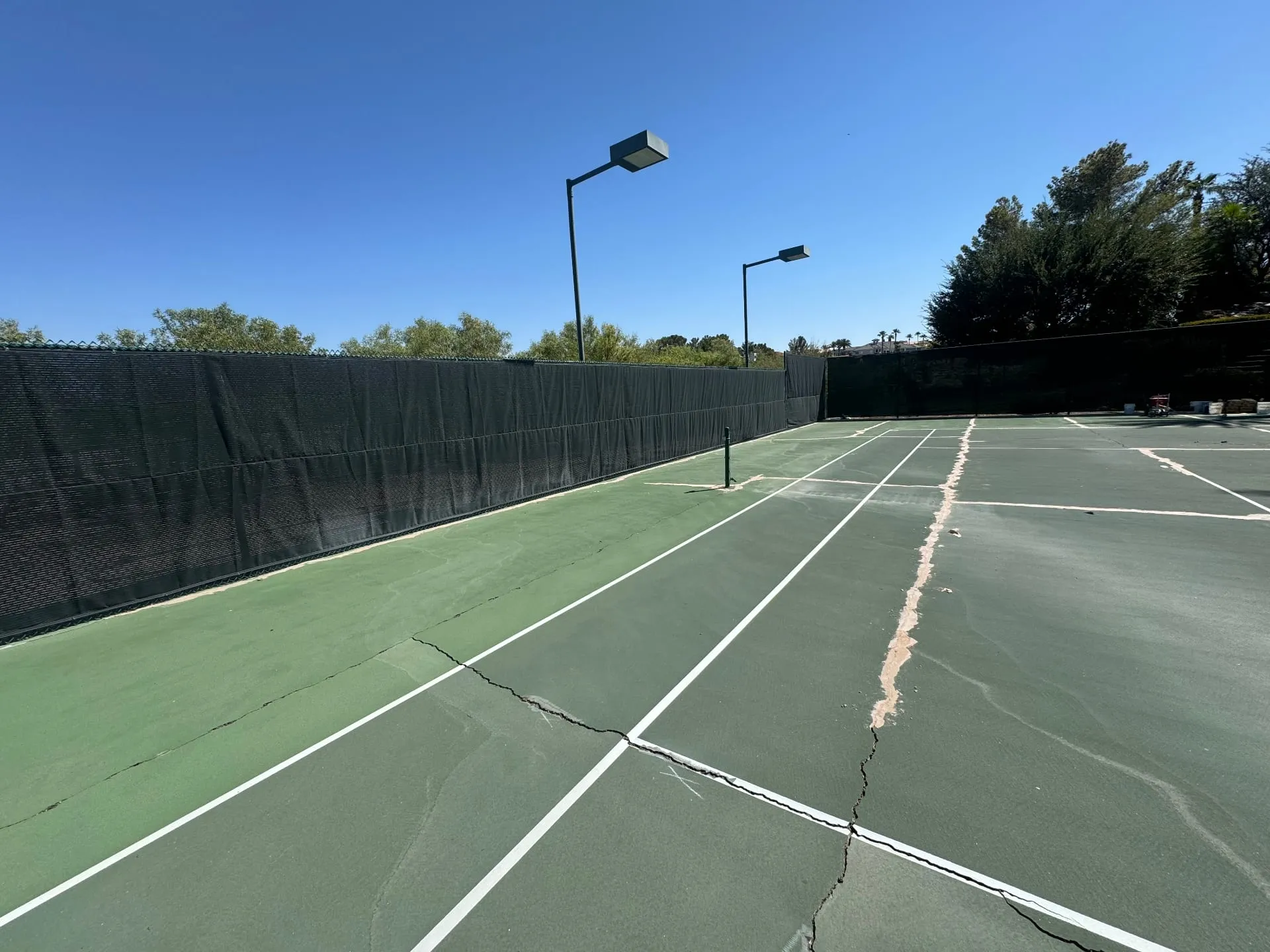
From there the problems turn structural. Unsealed micro-fissures link up into a web pattern called alligatoring, and once that sets in, the wear layer has usually reached delamination, where the top coats lose their bond and lift away from the concrete. Birdbaths are the most urgent sign of all. The American Sports Builders Association defines a birdbath as a low spot still holding water more than 1/16 inch (2 mm) deep, the depth commonly checked against a nickel, once drainage has stopped or after an hour of drying at 70°F in sunlight. One small birdbath turns up on almost any court and is not an emergency. Several of them, or a depression closer to half an inch deep, point to real settlement under the slab and call for a professional look soon.
Repair, Resurface, or Rebuild: Which One You Actually Need
These are three different jobs, at three very different price points, triggered by three different levels of damage. A repair addresses minor cracks and isolated problems on an otherwise sound surface. A resurface lays a new acrylic system, meaning fresh filler, binder, sand, and color coats, over a base that is still structurally good. A rebuild replaces the slab itself. The table sorts out which situation is which.
| Intervention | What it fixes | Typical trigger | Cost in Southern Nevada |
|---|---|---|---|
| Repair | Isolated hairline or minor cracks and a single small birdbath | A handful of surface cracks; the surface is otherwise sound | Scoped to the specific damage |
| Resurface | Widespread fading, lost texture, scattered cracking | Several signs at once; the court is near the end of its surface life | $6,000 to $15,000; a post-tension slab sits lower because it needs less crack prep |
| Rebuild | Structural failure below the coating | Cracks reaching the base, or a failed slab | $105,000 to $165,000 for new construction |
Not sure which column your court sits in? Walk the court and tally the signs you can actually see:
- Color has faded or looks chalky.
- Lines are bleaching or hard to read.
- Slick or bare areas and uneven bounce near the baselines.
- One or more hairline or minor cracks.
- A web or "alligator" pattern of surface cracks.
- Coating lifting or peeling away from the base.
- Water that pools and stays after rain.
- Cracks that feel deep or run through the slab.
The first four usually point toward a straightforward crack repair or simply staying on your maintenance schedule and checking again next season. Several at once means the surface life is ending and it is time for a resurface. Either of the last two, deep cracks or lifting coating, is structural, so get a professional assessment before spending a dollar on resurfacing, because a moving base will reopen cracks through fresh coats.
The reason the sequence matters financially is what happens once water reaches the slab through an unsealed crack. An asphalt base begins to crumble as water strips its bitumen, while a concrete base has voids washed out beneath it until the concrete flexes over the gaps and eventually snaps. Coating over a base that is already heaving just pushes those cracks straight back to the surface within weeks, which is how a modest job turns into costly repairs and a full rebuild. Catching these signs at the annual inspection and repairing cracks while they are small is what keeps the work in the repair category.
A resurface only rebuilds the playing surface, so if water is pooling, the drainage has to be corrected first. A cracked court can still be resurfaced as long as the cracks are cosmetic and hairline rather than the start of alligatoring. The work goes best outside peak summer, when the acrylic can cure evenly instead of flash-drying in the heat. Timelines vary with court size and condition, and an on-site assessment is the quickest way to get a firm one.
Cushioned Acrylic vs. Standard Hard Court Maintenance
On Point builds two systems, standard acrylic hard court and cushioned acrylic, and climate plays a real role in which court surfacing system makes sense outdoors here. Both follow the same 5-to-8-year resurfacing window, so their maintenance requirements overlap, but they are not identical. Cushioned acrylic asks for slightly closer attention at the seasonal inspection than standard hard court maintenance does, because its texture and its underlying cushioning can wear at different rates, so a surface that still looks fine can lose some of its intended give. Adhesive-bonded cushion layers also take on more heat stress in direct desert sun than a liquid-applied cushion does, which is worth weighing at the design stage. For how the surfaces themselves are built and which two suit Las Vegas, that is covered in our guide to tennis court surfaces for the desert.
Pickleball, Basketball, and Why Clay Stays Off the List
The same post-tension base and UV-stable acrylic system carry straight over to pickleball and basketball, so the maintenance and resurfacing logic in this guide applies to those courts too. That crossover is also why converting a tired tennis court into a pickleball setup has become popular with HOAs: a standard tennis court comfortably fits four pickleball footprints. If you are weighing a conversion, the current numbers are in our 2026 pickleball court cost guide, and for a fresh build from bare ground, tennis court construction in Las Vegas covers the full scope.
Clay is the useful contrast. A clay court is high maintenance by comparison, needing near-daily grooming, watering, brushing, and rolling on its own clay court maintenance cycle, which is a big part of why a hard court's multi-year cycle looks as forgiving as it does. Grass courts and synthetic grass courts carry their own upkeep too. On Point builds acrylic hard courts and cushioned acrylic only, not clay, grass, or turf, and the full run of surface types for indoor and outdoor courts alike lives in the surfaces guide linked above.
Why This Advice Comes From the Builder, Not a Supplier
On Point's owner, Brian Foley, played number-one singles tennis at Boise State and won a round at an early PPA pickleball tournament in Las Vegas, so he reads a court the way a player does: by ball bounce and coefficient of friction first, before he checks whether the base looks flat. A dead spot from a heaving slab wrecks how a match plays no matter how sharp the fresh paint looks, and a well-maintained court that plays true is worth more than one that only photographs well.
On Point also holds both Nevada licenses that this work requires, 0090686 for surfacing and fencing and 0095035 for concrete, and pours its own post-tension slabs in-house rather than subcontracting the structural work. That is why the crew can speak to what is happening below the surface, not just the coating on top. Locally, the team has resurfaced 10 courts at Lorenzi Tennis Club and worked at Darling Tennis Center, TPC Summerlin, Dragon Ridge Country Club, Anthem Country Club, and Lake Las Vegas.
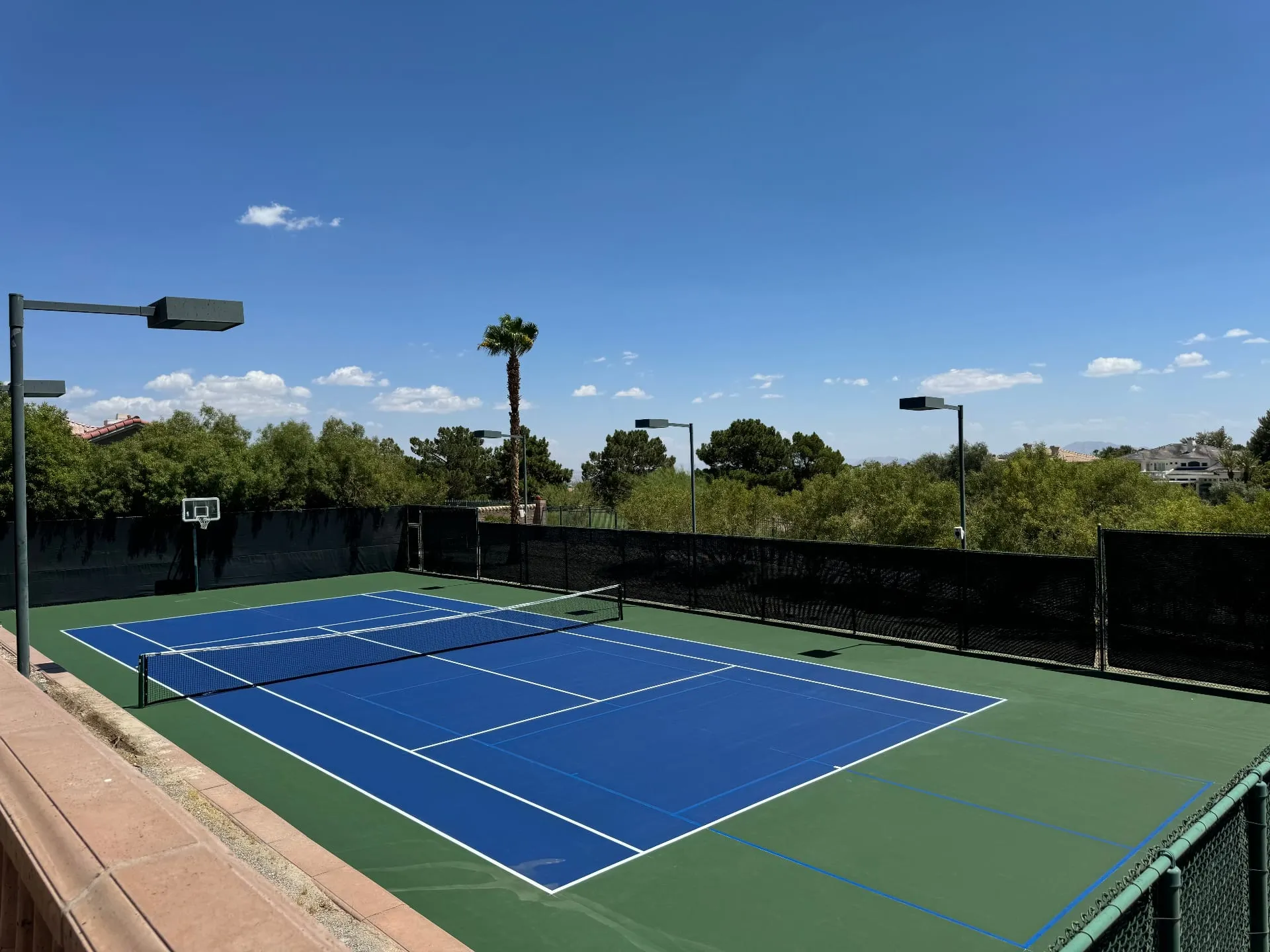
⭐⭐⭐⭐⭐
"The court we got painted was amazing and it was such an easy process with no issues at all! Very easy to work with and I highly recommend to anyone who's looking to get their sports court done!!"
Get a Free Court Assessment in Las Vegas
Whether you are keeping up a backyard court or budgeting a tennis court resurfacing cycle for an HOA, the next move depends on where your court actually stands today. On Point handles court resurfacing for residential and commercial courts alike. Call (702) 686-7738 for a free written quote and a court assessment.