
Padel Guide
Padel Court Dimensions: Full Specs, Space Needed, and Build Costs
By Brian Foley, Owner · Published
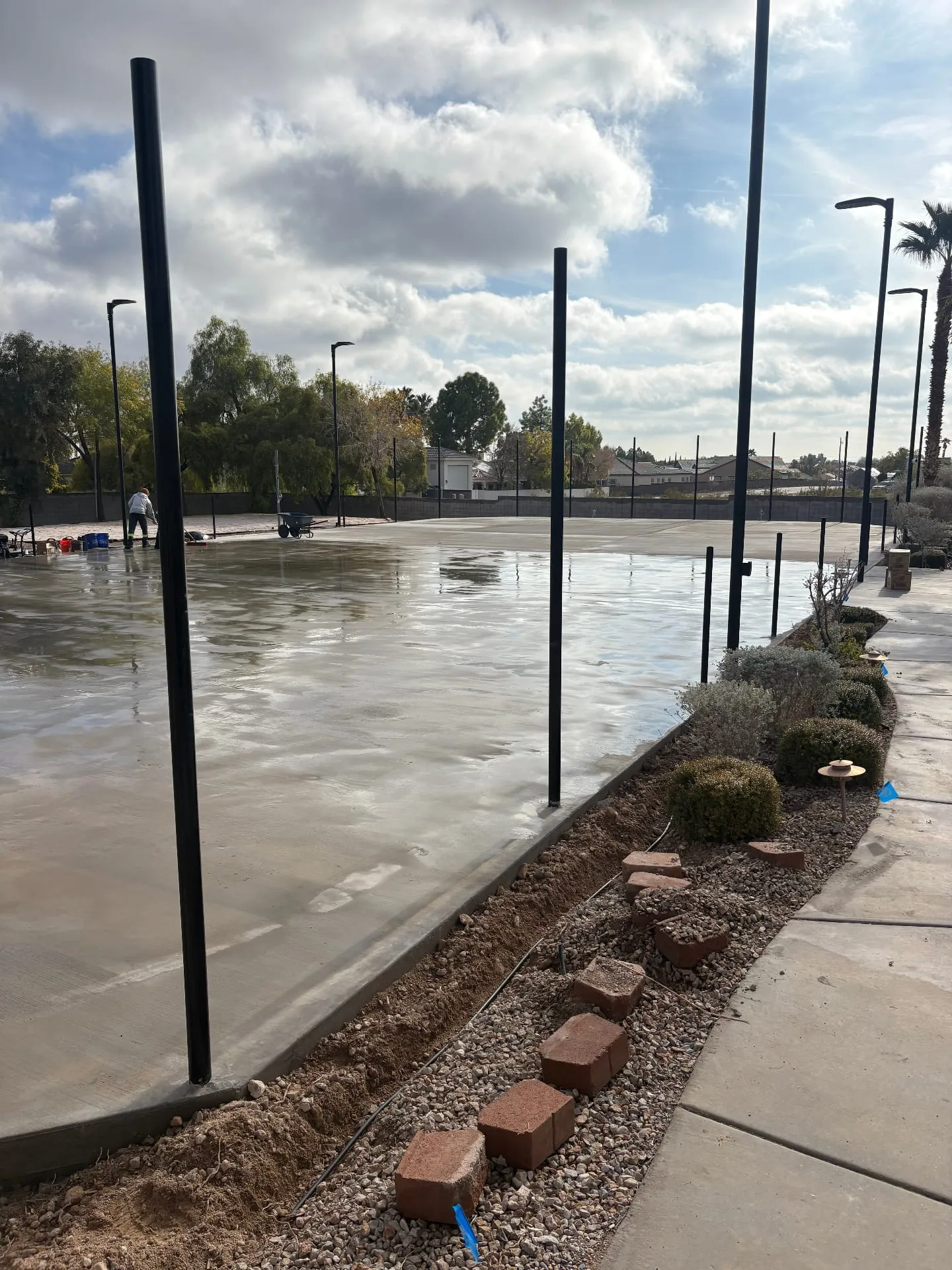
A padel court measures 20 by 10 meters inside the walls, which is 65 ft 7 in by 32 ft 10 in, usually rounded to 66 by 33 feet, for 200 square meters (2,153 square feet) of playing area. The net sits 2 ft 11 in high at the center, the back wall stands 13 ft 1 in (4 meters), and the court needs 19 ft 8 in of clear height above it.
The International Padel Federation (FIP) sets these dimensions. Below, we cover what they mean when you fit a court onto a real Las Vegas lot, and what it costs to build one.
Padel Court Dimensions and Measurements
Here are the padel court dimensions in feet and meters.
| Element | Feet and inches | Metric |
|---|---|---|
| Court length | 65 ft 7 in | 20 m |
| Court width | 32 ft 10 in | 10 m |
| Playing surface | 2,153 sq ft | 200 sq m |
| Service line from net | 22 ft 10 in | 6.95 m |
| Line width | 2 in | 5 cm |
| Net length | 32 ft 10 in | 10 m |
| Net height at center | 2 ft 11 in | 0.88 m |
| Net height at ends | 3 ft 0 in | 0.92 m |
| Back wall height | 13 ft 1 in | 4 m |
| Minimum height above court | 19 ft 8 in | 6 m |
| Recommended height for new builds | 26 ft 3 in | 8 m |
The FIP writes the rules in meters, so the metric column is the official spec. The feet-and-inches figures are conversions rounded to the nearest inch. In practice, a padel court is quoted as 66 by 33 feet.
A net divides the court into two boxes of equal size. The service line runs parallel to the net on each side, and a perpendicular line splits the service area in half. All lines are 5 cm wide, ideally white or black, whichever stands out against the court surface. The padel court size is the same worldwide, so a padel tennis court in Las Vegas plays exactly like one in Madrid.
How Much Space Do You Need for a Padel Court?
You need more ground than the court itself, and how much more depends on whether you want out-of-court play.
| What you are planning | Ground needed |
|---|---|
| The padel court and structure | 66 x 33 ft (20 x 10 m) |
| Minimum buildable footprint | 69 x 36 ft (21 x 11 m) |
| Recommended footprint | 72 x 39 ft (22 x 12 m) |
| With regulation out-of-court play | 52 to 59 ft wide (16 to 18 m) |
The out-of-court play tier is what decides whether a residential site works, and almost no guide publishes it. Padel lets a player run out through the access opening and return a ball from outside. FIP rules require two access points per side and a clear zone beside each one measuring at least 10 feet wide (13 feet recommended), 13 feet long, and 10 feet high. Plan for it or rule it out before you measure anything.
Will a padel court fit?
Enter the clear, flat space you have. We check it against the FIP figures in the table above.
Enter a length and width to check your space.
Space is the first check. Setbacks, slope, HOA rules, and the 13-foot enclosure height decide the rest. Call (702) 686-7738 and we will measure your site.
Ceiling Height Matters as Much as Ground
Padel is played upward as much as outward, so the lob and the smash both need air. Indoor courts need that 19 ft 8 in of minimum height across the entire playing surface with nothing hanging into it, and 26 feet is recommended for new builds. Outdoors, check roof lines, trees, and power lines. Many buildings that look big enough fail on this one spec.
Walls, Glass, and Materials
The walls are in play, so the enclosure doubles as the boundary. A padel court therefore needs no run-off, unlike a traditional tennis court, where clear space around the lines is part of the requirement.
The back wall is 13 feet high, made up of just under 10 feet of glass or solid material topped by a little over 3 feet of metal mesh. In the rules, those are 4 m, 3 m, and 1 m.
The side walls come in two permitted forms. On a stepped build, the solid wall is 3 meters high for the first 2 meters out from the back wall, then steps down to 2 meters high for the next 2. Mesh fills in above it, up to 4 meters high at the ends of the court and 3 meters through the middle. A panoramic build uses a single glass panel 3 meters high by 4 meters long at each end, with no step. The panels come in metric sizes, so measure your site in meters. It saves you from conversion errors when the structure goes up.
Panoramic courts give players and spectators a cleaner view and suit a club or commercial padel facility. Stepped courts cost less. Either way, the walls must give a uniform bounce, glass walls must be tempered safety glass, and every welded joint in the mesh has to be protected on both sides. Capped joints protect players, and they're one of the first places a cheap enclosure cuts corners.
Padel Court Surface: Artificial Turf or Acrylic
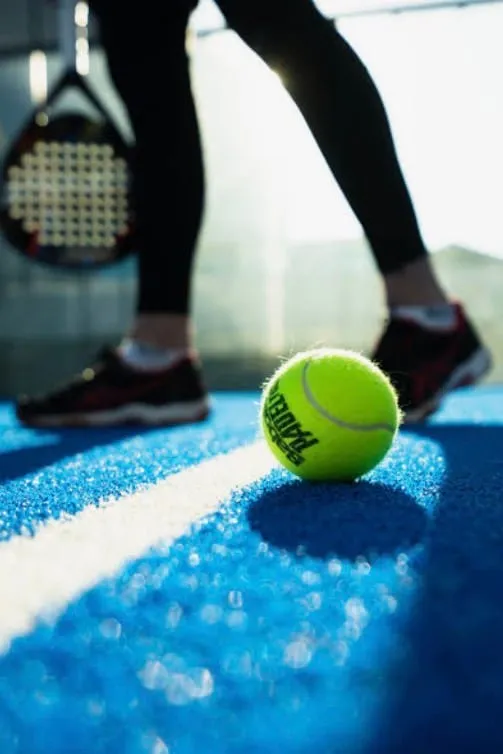
You don't need turf to play padel. The FIP rulebook allows three surfaces: cement, synthetic material, or artificial grass, in green, blue, or terracotta. So an acrylic hard court is a regulation padel surface.
Artificial Turf
Artificial turf with silica sand infill is the world standard and what the professional tour plays on. The sand lets players slide, and it gives the lower bounce the sport was built around.
Acrylic Hard Court
An acrylic hard court is built up from thin coats of pigmented acrylic mixed with silica sand for grip, which gives you a firm, true bounce, custom shades within the FIP's green, blue, and terracotta range, and very little upkeep. It stands up to desert heat and UV, which is why acrylic and cushioned acrylic are the only two surfaces we build. On a padel court, it plays faster off the bounce, and it does not let players slide into a ball.
Cushioned Acrylic
Cushioned acrylic adds a liquid-applied cushion layer before the color coats. It is easier on knees, ankles, and backs, with the same heat and UV resistance. Padel players are moving side to side on almost every point, so if your court gets played every day, the cushion pays for itself.
We build acrylic and cushioned acrylic, not turf. Turf is what the tour plays on, so if you want a court that plays like the pros' courts, that is the surface to buy. If heat tolerance and low maintenance matter more, acrylic is a regulation choice, and it's the one we'd put down in the desert. Our guide to court surfaces in Las Vegas covers the same trade-off across other racquet sports.
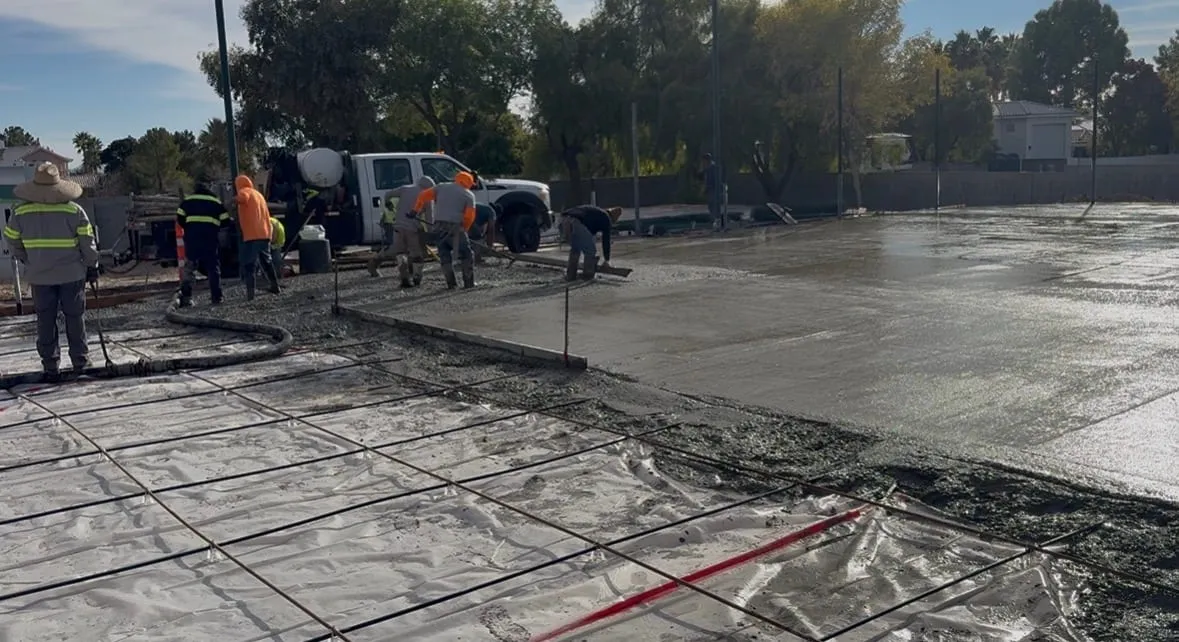
Whichever surface goes down, the slab tolerance is crucial: under 3 mm of variation under a 3-meter straightedge, which works out to roughly 1/8 inch over 10 feet, and no more than a 1% slope on a court without drainage. Hitting that consistently takes a crew that pours court slabs for a living.
Padel Court vs Tennis Court
| Padel | Tennis (doubles) | Pickleball | |
|---|---|---|---|
| Playing surface | 66 x 33 ft | 78 x 36 ft | 20 x 44 ft |
| Total area | 2,153 sq ft | 2,808 sq ft | 880 sq ft |
| Fenced footprint | 72 x 39 ft | 60 x 120 ft | 30 x 60 ft |
| Boundary | Walls, in play | Run-off, out of play | Run-off, out of play |
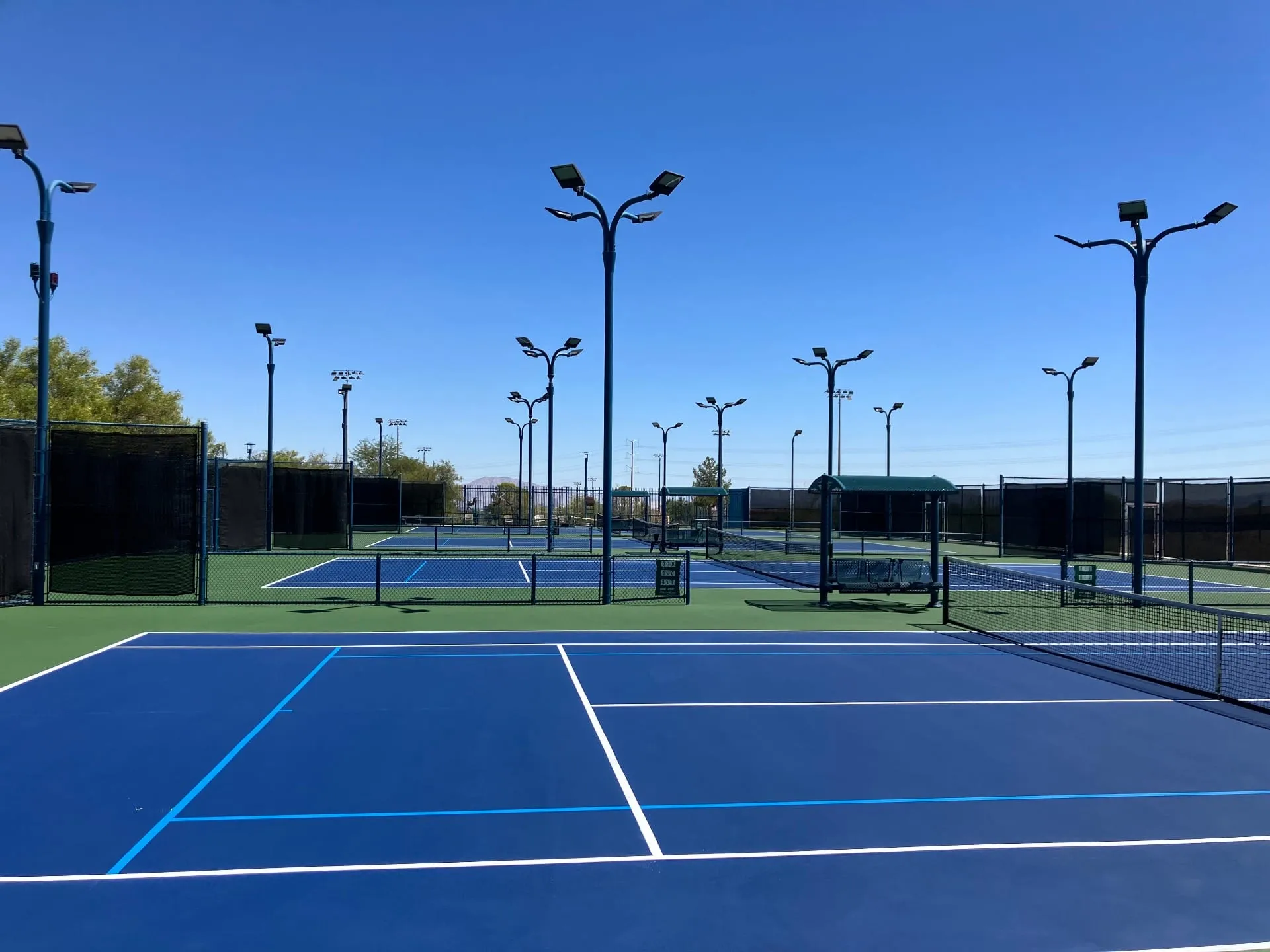
A padel court is 23 percent smaller than a doubles tennis court in playing area, which leads to a widely repeated claim that three padel courts fit inside one tennis court footprint. The arithmetic says otherwise.
A fenced tennis court measures 60 by 120 feet (our guide to tennis court dimensions explains where those figures come from). A padel court needs a 72 by 39 foot footprint, and 72 feet won't fit across a 60-foot width, so the court has to run lengthwise. That leaves 48 feet after the first one, well short of the 72 a second would need. One padel court per tennis court. Two tennis courts side by side give you 120 feet of width, and three padel footprints side by side need 117, so three fit across a pair.
You can restripe a tennis court for pickleball with paint. You cannot do that here, because padel construction means building a structure. If pickleball is the comparison, see pickleball court dimensions.
Padel Court Cost: Kit vs Full Build
The manufactured court package, meaning the steel frame, glass, mesh, net, and usually turf, runs about $30,000 to $60,000 in the US, and a finished outdoor court about $65,000 to $120,000, according to one manufacturer's 2026 US pricing guide. The package is only part of the build. Full construction also includes:
- Site work, excavation, and grading
- Concrete slab and engineered footings
- Playing surface
- Lighting and electrical
- Permits, engineering, and inspection
- Freight, since many court systems are made overseas
Treat single headline numbers with suspicion, especially European figures, which carry very different labor and freight costs from a Nevada build. For scale against other courts, see what a pickleball court costs and what it costs to build a tennis court. Every site prices differently, and our padel court construction page covers what a turnkey build includes.
Building a Padel Facility in Southern Nevada
Padel passed one million U.S. players in 2025, according to the Sports & Fitness Industry Association. As of April 2026, USA Padel counted just over 1,000 courts across 31 states, and Florida has about 40 percent of them. Nevada is still early to the sport. That's the opportunity, but it also means few local builders have actually put up a padel court.
Heat and UV
Summer days past 110 degrees age turf fiber and infill fast. Acrylic holds its color under that exposure. Specify carefully rather than buying on price.
Orientation
FIP recommends the long axis of outdoor courts run north to south. In the Las Vegas valley that is close to mandatory, because glass at a low sun angle throws light straight into a player's eyes.
Wind
A padel enclosure is 13 feet of glass standing in the open, and it behaves like a sail. March through June are typically the windiest months in the valley, according to the City of Las Vegas. Those loads land in the footings, so structural engineering carries far more weight on a Las Vegas build than it would in a sheltered climate.
Soil
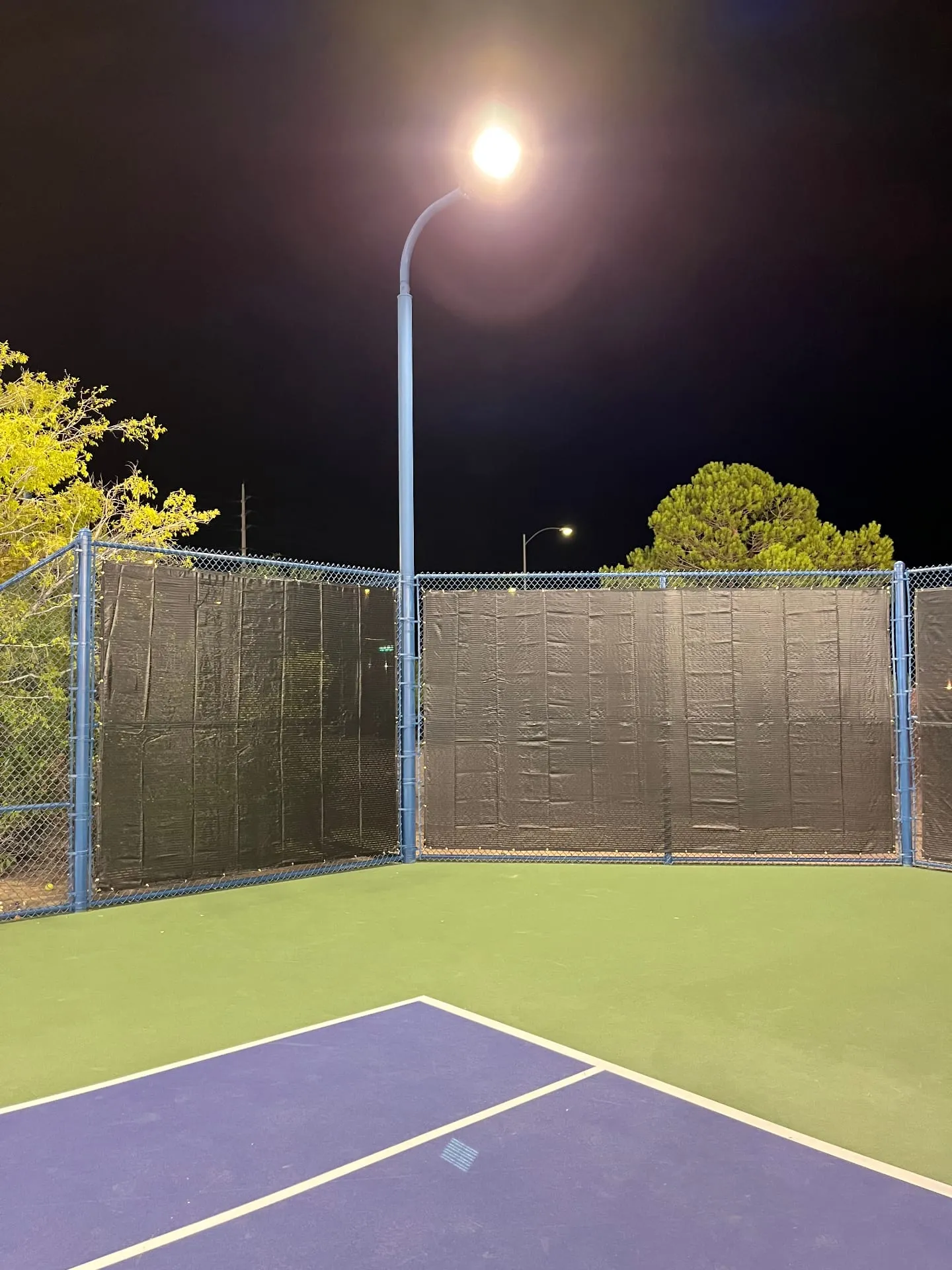
Caliche and expansive desert soils move. We build post-tensioned slabs of at least 4 inches of 4,500 psi concrete, and our concrete lead has over 30 years of experience on post-tension court slabs. A padel court adds point loads from the structure, so the slab design matters even more than it does on an open court.
Permits and Approvals
A tennis court is essentially a slab and a fence. A padel court is a structure, 13 feet of glass and steel on engineered footings, and each local jurisdiction treats that height differently.
If you live in MacDonald Highlands or elsewhere in Henderson, Henderson Development Code 19.10.6.C.3 lets a sport court fence or structure reach 12 feet on lots of 10,000 square feet or more, as long as everything above 6 feet stays open. A padel enclosure is taller than that and solid glass to almost 10 feet, so talk to the city before you plan a layout. MacDonald Highlands adds its own review on top, with design guidelines the community calls more stringent than the City's.
In Peccole Ranch and the rest of the City of Las Vegas, a flat slab on grade doesn't need a building permit, but the city's homeowner permit guide requires one for an iron or wood fence over 7 feet, and a padel enclosure is nearly twice that height.
In Southern Highlands and the rest of unincorporated Clark County, every fence over 6 feet needs a building permit.
HOA height limits sit on top of all three. Confirm your parcel before you plan a layout.
Quick Answers
Is a Padel Court Bigger Than a Pickleball Court?
Yes. 2,153 square feet against 880, so two and a half times the size.
What Is the 40-40 Rule in Padel?
At 40-40, what happens next depends on the scoring option the match uses, and the FIP rules allow three. Under advantage scoring, play goes on until one pair wins two points in a row. Under golden point, a single deciding point settles the game, and the receiving pair picks which side receives and can't swap positions. Under Star Point, a pair gets up to two advantages, and if the game is still tied, one deciding point ends it. The pro tours switched to Star Point in 2026.
How High Does the Ceiling Need to Be?
19 ft 8 in minimum over the whole court, and 26 feet recommended for new builds.
Can You Build a Padel Court Indoors?
Yes, as long as the building has the height. The court needs that 19 ft 8 in of clear height over the entire playing surface, and the ceiling is usually the spec that decides whether a given building works.
Get Your Site Assessed
On Point Court Surfacing works across the Las Vegas valley, holding Nevada licenses for surfacing and fencing (#0090686) and concrete (#0095035), with ASBA membership behind the work. Owner Brian Foley played number one singles on a full scholarship at Boise State and competed briefly on the pro pickleball tour, so the advice you get accounts for how a court plays, not just how it is built.
We will measure your site, tell you honestly whether a padel court fits, and walk you through the surface decision. Call (702) 686-7738 or see our padel court construction page.