
Pickleball Guide
How to Build a Pickleball Court in Las Vegas: The Build Sequence, Step by Step
By Brian Foley, Owner · Published
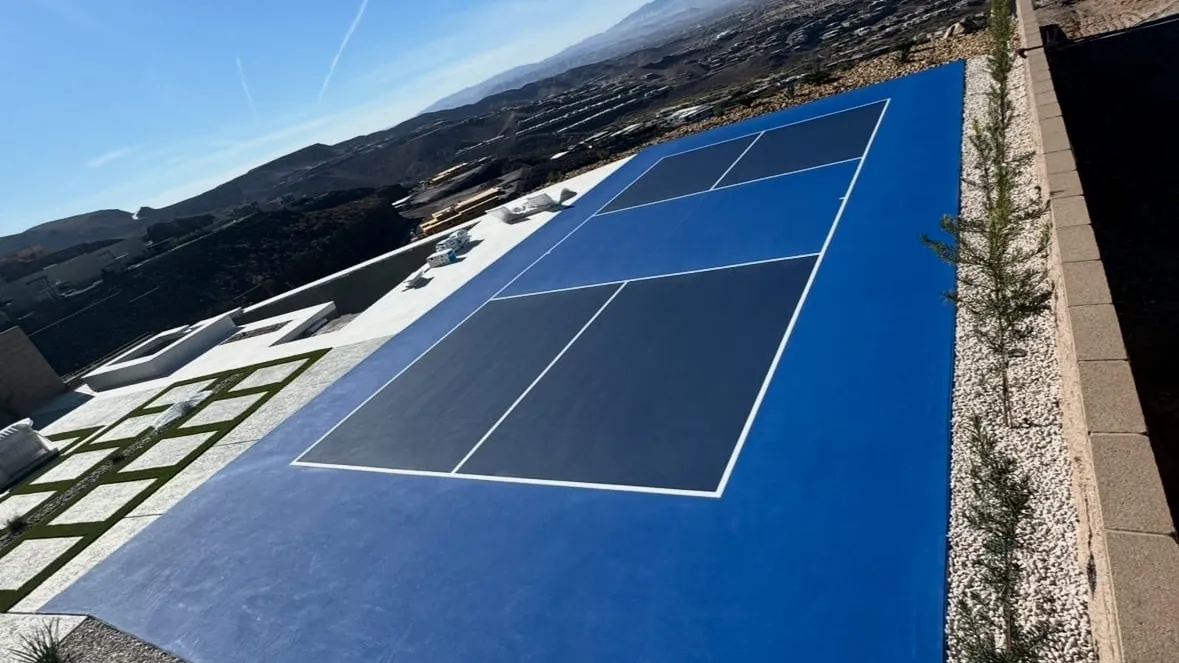
The lines and the color are the parts everyone pictures, and they are the last things to go on. Here is how to build a pickleball court in Las Vegas, in order. Planning comes first: a site visit and written quote, then a signed contract. Permitting and HOA approval come next. Then the slab goes in, and it has to cure before the acrylic color system goes on. Line striping finishes the job.
This guide walks through each stage in sequence, so you can judge any quote you are comparing against the real build order.
The Pickleball Court Building Sequence at a Glance
The construction process runs in seven stages for backyard and public courts alike, and each one sets up the next.
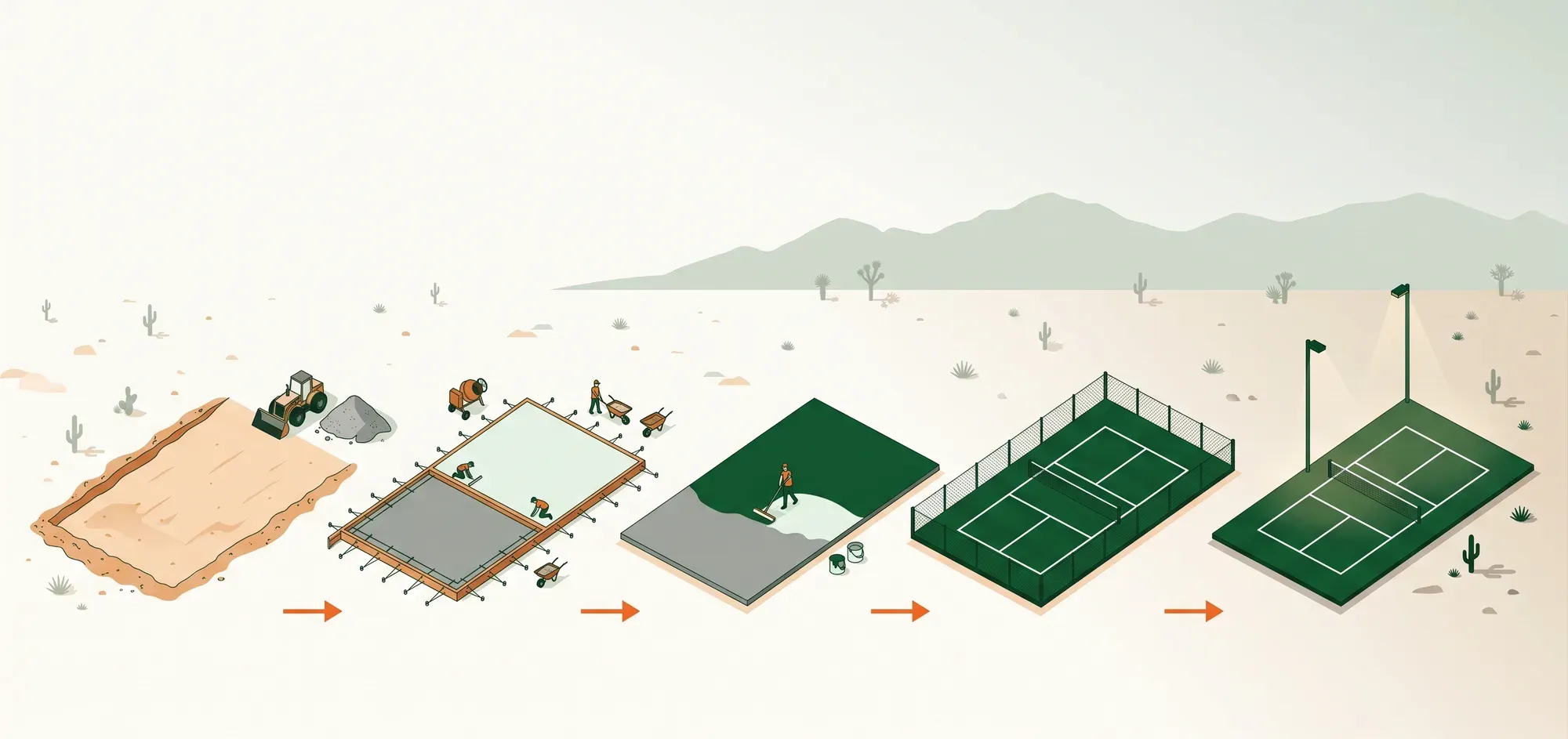
 From a graded desert lot to a finished, lit court.
Site visit and quote
We check the site, then quote in writing.
Prevents surprise change orders
Design and contract
Layout, materials, and price, all signed.
Prevents vague specs
Permitting and HOA
Approvals land before anyone digs.
Prevents stop-work orders
Slab
Grade, lay cables, pour, and tension.
Prevents cracks and uneven settling
Cure
The slab dries until it can bond.
Prevents blisters and peeling
Acrylic color
Resurfacer first, then color coats.
Prevents early wear and UV damage
Line striping
White lines and the non-volley zone.
Prevents off-spec lines
Plan the Court: Dimensions and Site Check
Site preparation starts before anyone digs. Our team assesses the yard: slope, access, water flow, and buried utilities. We also look for caliche (a rock-hard, cement-like soil layer, common just inches down across the valley, that slows grading). Our pickleball court construction work begins with that site visit.
A standard pickleball court measures 20 feet wide by 44 feet long. USA Pickleball's 2026 rulebook sets the net at 36 inches on the sidelines and 34 inches at the center.
Where the yard allows, run the long axis north to south to cut sun glare and support safe play. For the runoff space around the court lines, see the full footprint breakdown.
How Big a Yard Do You Need for a Backyard Court?
Plan on a flat surface cleared to at least 30 by 60 feet. USA Pickleball sets that 30-by-60 footprint as the minimum and recommends 34 by 64 feet for new construction. Before you commit, pace out the space with a tape measure to decide whether it fits.
Do You Need a Permit to Build a Pickleball Court in Las Vegas?
You will permit a permanent court through the building department that covers your address. Clark County and each city set their own setbacks from your property line and their own lot-coverage limits. Planned communities such as Summerlin and Anthem add an HOA review first.
Clark County adopted the 2024 International Building Codes effective January 11, 2026. Permit applications filed since then must follow them, with the exception of standard plans.
Why Post-Tension Concrete Matters on Las Vegas Soil
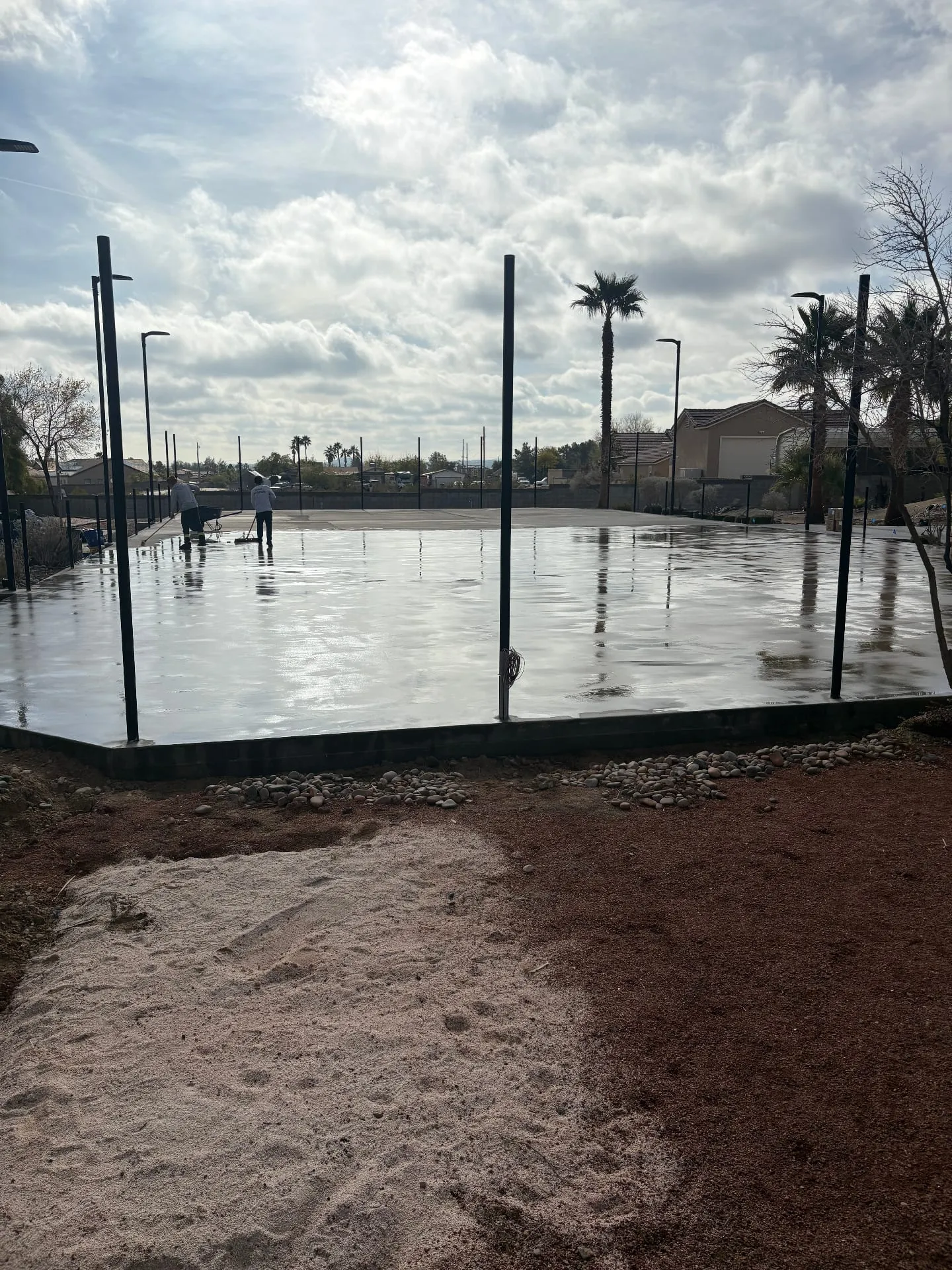
On Las Vegas soil, the best foundation is a post-tension concrete slab, not asphalt. We build it at least 4 inches thick in concrete rated at 4,500 psi, the compressive force the cured mix can withstand. But a slab is only as stable as the ground under it, and the desert soils here move. Expansive soil across the valley swells with monsoon moisture and shrinks in the summer heat, so the ground never truly holds still.
Saw-cut slabs rely on control joints that tell the concrete where to crack. When the ground heaves, those panels move independently, leaving uneven edges and cracks that tear the coating. Post-tension works differently: steel cables tensioned after the pour keep the whole slab under compression, so it moves as one piece. That protects the color coat, gives the surface long-term durability, and extends the life of the acrylic.
We handle our own concrete in-house. Recent work includes DragonRidge Country Club in Henderson.
How Slope and Drainage Keep Water Off the Court
The finished slab needs a built-in fall in a single plane, so rain runs off one edge instead of pooling in the middle. Good drainage comes down to creating that fall during grading. The American Sports Builders Association (ASBA), which we belong to, publishes a construction manual with USA Pickleball that sets recommended slope and drainage specs. Ask any builder to name their slope figure, and whether they flood the slab to find low spots before coating.
Why the Slab Has to Cure Before Color
Acrylic sealed over a damp slab traps moisture until the coating blisters and peels. Curing is the slab hardening and releasing that moisture, and it has to be fully cured before anyone applies color. Waiting on a slab that already looks done is the hard part, especially after the permitting grind, but that wait is what keeps the color on the court.
Fencing, Lighting, and Night Play
Net posts and light locations go in at the finishing stage. Fence footings run deep because Las Vegas wind pushes hard on them. Lighting opens up night play, valuable in a climate where the normal early-August high is 104 degrees and the cooler hours fall after sunset.
The Acrylic Color System
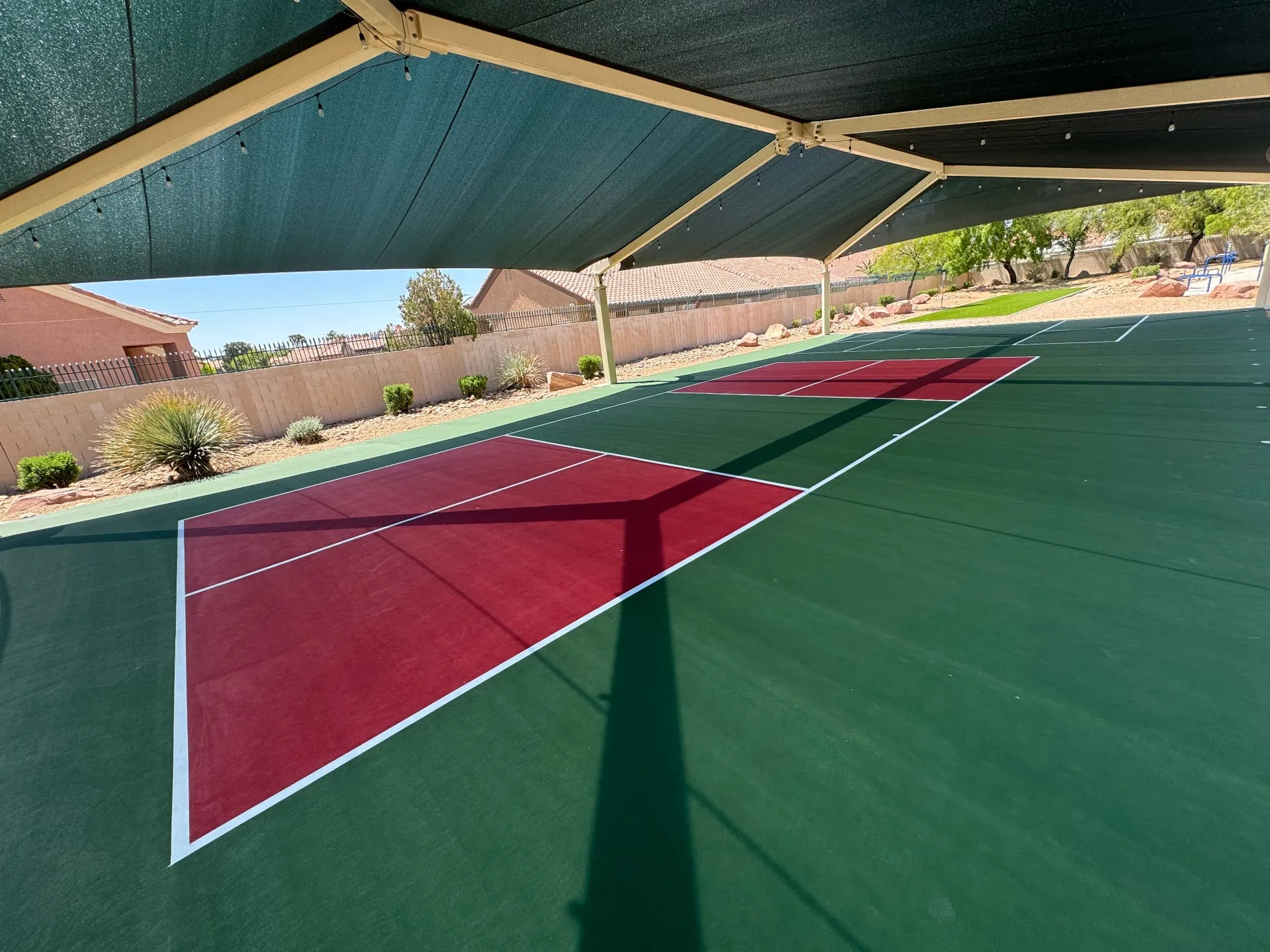
We build only acrylic hard courts and cushioned acrylic systems, because Las Vegas heat and UV break down other surfaces on an outdoor court. First comes a gritty base coat called a resurfacer. Squeegeed color coats follow: they set the base color, then build the grip and bounce. The finished playing surface is durable and low-maintenance. Hard court and cushioned acrylic differ mainly in feel underfoot and joint impact.
Clay and grass do not suit the desert, and synthetic turf fares no better. Some guides push snap-together tile for backyard courts; we do not install it here.
Striping the Lines, the Last Step Before Doubles Play
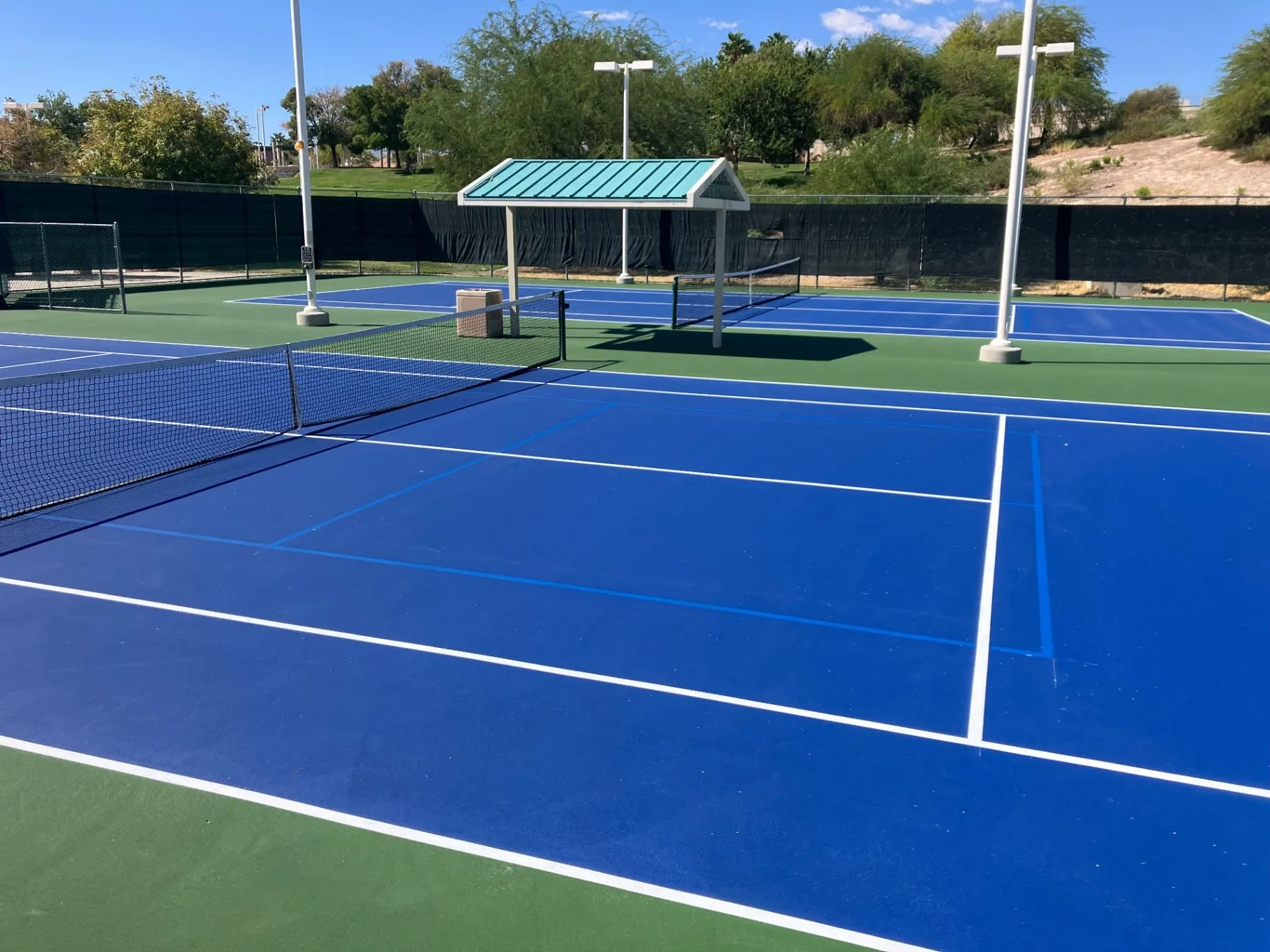
White acrylic line striping marks the boundaries and the 7-foot non-volley zone, the "kitchen," where players cannot volley the ball out of the air while standing inside it. Want basketball or tennis lines on the same slab? That comes down to how the layouts overlap.
Can You Build a Pickleball Court Yourself?
Full DIY does not hold up on a Las Vegas slab. Grading a true slope and building a slab that survives soil movement take professional equipment and crews. That said, a portable net and taped temporary lines work fine on a sound existing patio or driveway.
Build Time and What Shapes the Budget
Build time depends on court size, site conditions, permitting speed, and weather, so we set the project schedule after the site visit. Plan for an investment of $16,000 to $35,000 in a new court. Fencing or lighting can add up to $25,000 more, depending on scope. Slab type and site soil drive the cost and where a quote lands inside that range.
⭐⭐⭐⭐⭐
"I had a great experience working with On Point Court Surfacing on our backyard Pickleball court. Brian communicated well and did what he said he would do. I would highly recommend On Point Court Surfacing to anyone."
Ready to Walk Your Yard?
Call (702) 686-7738 to book a free site visit and written quote.
To start online, request a quote for your court. Send any questions through the contact page.
Brian Foley, owner of On Point Court Surfacing, played number-one singles at Boise State and has competed in pro pickleball. On Point holds Nevada contractor licenses #0090686 (Surfacing & Fencing) and #0095035 (Concrete) and belongs to the ASBA.