
Basketball Guide
Half Court Basketball Dimensions: Backyard Sizes and What Fits
By Brian Foley, Owner · Published · Updated
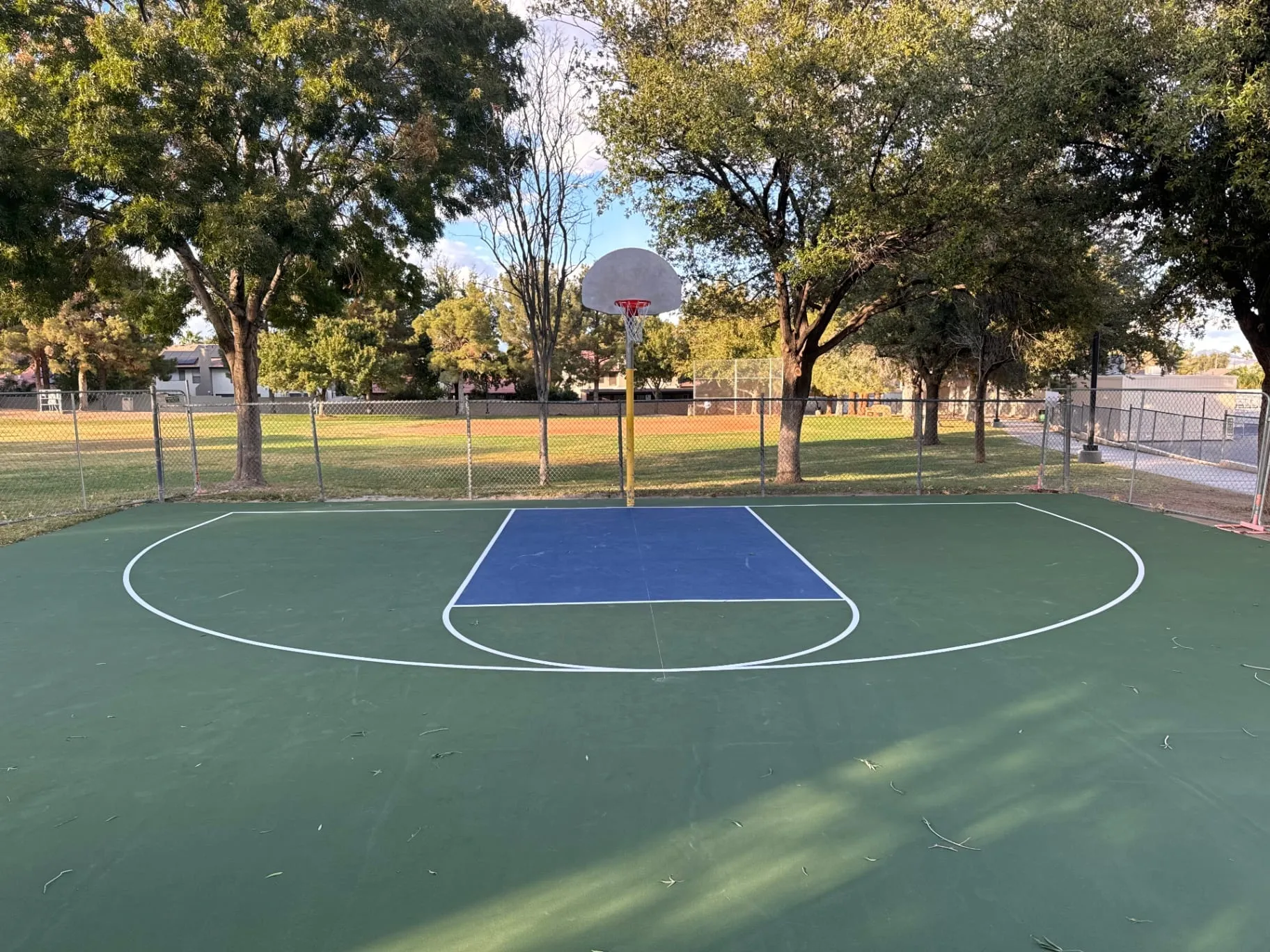
A half court in Henderson with a full three-point arc.
Regulation half-court basketball dimensions are 47 feet long and 50 feet wide at the NBA and NCAA levels. High school half courts stay at the same 50-foot width but drop to 42 feet in length. The three-point arc you want is the measurement that decides whether a court fits the space you can pour.
We build acrylic and cushioned acrylic courts across Las Vegas, Henderson, and Summerlin, and this guide covers the official court dimensions, the arc math, and what a Southern Nevada lot adds. We pour those same full-size markings on our basketball court construction projects.
How Big Is a Half Court Basketball Court?
A half court is a full court cut at the midline: one basket, one three-point arc, one free-throw line, a half-court line, and half of the center circle marking where the cut falls.
| Level of Play | Basketball Half-Court Dimensions | Square Footage |
|---|---|---|
| NBA and NCAA courts | 47 ft x 50 ft | 2,350 sq ft |
| High school basketball (NFHS) | 42 ft x 50 ft | 2,100 sq ft |
| International basketball (FIBA) | about 45.9 ft x 49.2 ft (14 m x 15 m) | about 2,260 sq ft |
| Junior high | 37 ft x 42 ft | 1,554 sq ft |
High school courts run 5 feet shorter than an NBA or NCAA half court, since the full-court length itself is shorter: 84 feet against 94 feet. Width holds steady at 50 feet across the NBA, NCAA, and NFHS levels; FIBA and junior high run narrower, as the table shows. Our basketball court dimensions guide covers full courts and every marking by level. We check these figures against the current NBA (Rule 1), NFHS (basketball rules), and FIBA rulebooks before every install.
What Court Markings Decide What Fits?
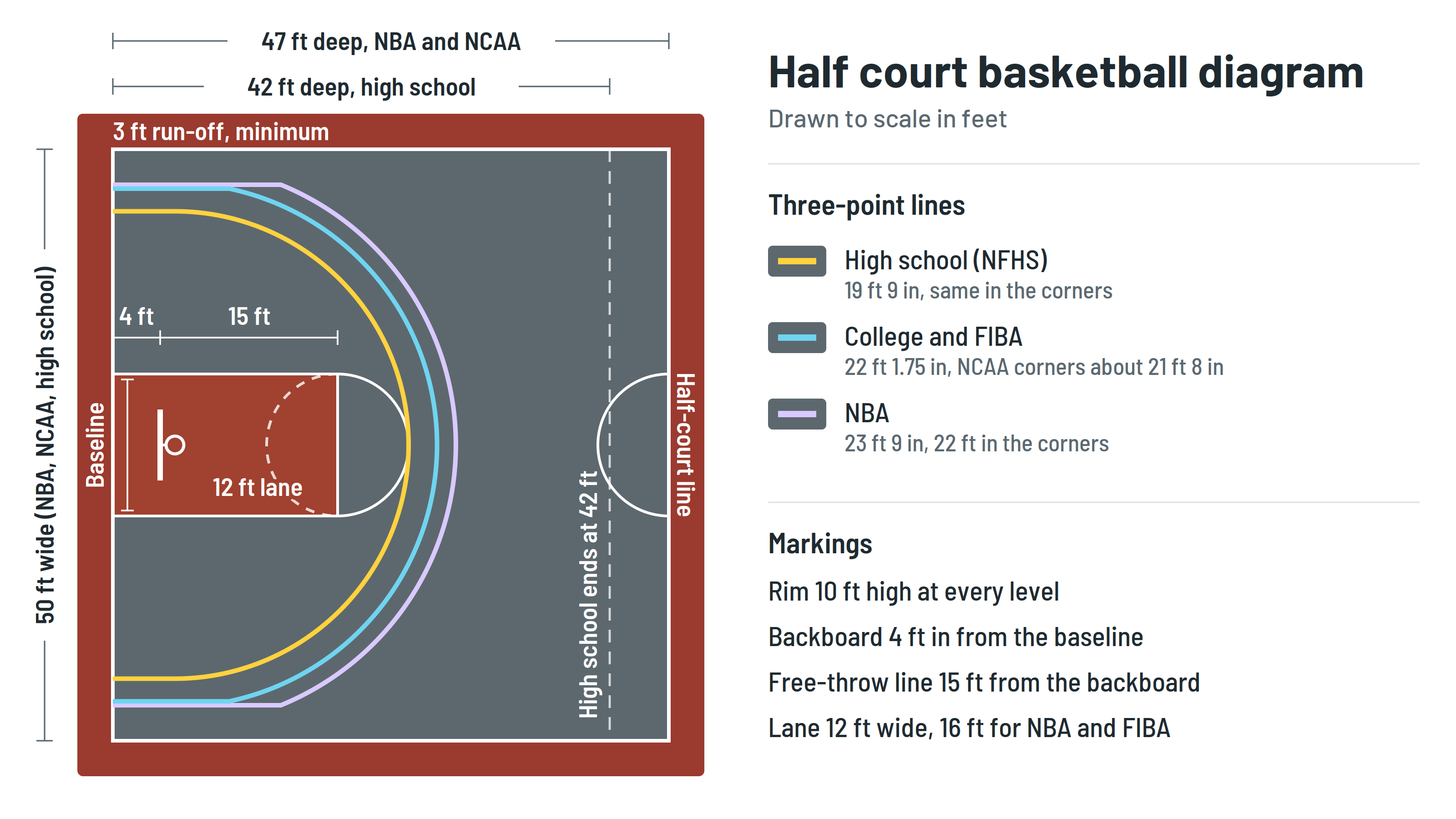
Regulation rim height is 10 feet at every level, and it doesn't change with court size. The backboard face sits 4 feet in from the baseline, and the rim's center lands about 5 feet 3 inches from the baseline once you add how far the rim extends from that face.
On a home basketball court, the rim's distance from the baseline is set by the hoop's overhang instead: how far the backboard extends past its support pole. We build a 3-foot minimum overhang on half courts 30 by 30 feet and larger, and push to 4 feet for competitive play. Skimp on overhang, and players clip the pole on drives to the basket. The free-throw line (the foul line) stays 15 feet from the backboard face at every level, and free-throw lane width splits NBA and FIBA (16 feet wide) from NCAA and NFHS (12 feet).
| Level | Three-Point Line Distance |
|---|---|
| NBA | 23 ft 9 in (22 ft at the corners) |
| NCAA (men's and women's) and FIBA | 22 ft 1.75 in (about 21 ft 8 in at the corners) |
| High school (NFHS) | 19 ft 9 in |
Overhang and rim position are the safety items we check first on every site visit, before we ever measure the arc.
Will a Three-Point Arc Fit in My Backyard?
This is the real question, and the three-point line sets your slab's minimum size: the lane and free-throw line both follow from it. Because the arc radiates out from the rim, the depth has to cover the baseline-to-rim distance plus its radius, and the width is about double that radius.
| Level | Distance from Rim | Slab Depth Needed | Slab Width Needed |
|---|---|---|---|
| High school (NFHS) | 19 ft 9 in | about 25 ft | about 39.5 ft |
| NCAA and FIBA | 22 ft 1.75 in | about 27.5 ft | about 44 ft |
| NBA | 23 ft 9 in (22 ft corners) | about 29 ft | 44 ft at the corner lines |
A continuous 23-foot-9-inch NBA arc would come within about 1 foot 3 inches of each sideline on a 50-foot court, leaving no room to stand in the corners. So the NBA line runs straight 3 feet off each sideline, which shortens the corner shot to 22 feet.
Build for the arc your player is working toward. A high schooler needs the high school line. Someone chasing a college roster needs the deeper NCAA line. A full NBA arc needs a near-regulation court. Painting the high school and college arcs on one slab in contrasting colors works well when players at different stages share a court.
A 30-foot-wide court cannot hold a full arc at any level. The narrowest one, high school, still needs 39.5 feet of width, so a 30-by-30 court works only as a key and free-throw court for pickup games that stay inside the line.
Backyard Basketball Court Dimensions, Small to Full
| Tier | Typical Size (depth × width) | What It's Good For |
|---|---|---|
| Shooting pad | 20 × 24 ft to 26 × 26 ft | Free-throw practice and close shooting drills, no room for an arc |
| Compact half court | 30 × 30 ft | Key and free-throw play, pickup games inside the arc |
| Extended half court | 30 ft deep × 50 ft wide, or 37 ft deep × 42 ft wide (tight corners) | Full high school arc; the 50-ft-wide layout also clears the college arc |
| Near-regulation half court | 42 ft deep × 50 ft wide to 47 ft deep × 50 ft wide | Full high school layout up to full NBA and college arc with corners |
| Full backyard court | 78 × 46 ft up to 110 × 60 ft | Full-court transition play and fast breaks |
A shooting pad gives a player free-throw and close-range reps and nothing else. A compact half court adds real key play, though still no three-point shot. The extended tier is where a full high school arc first becomes possible, and it's where many clients land once they measure their space. Near-regulation sizing goes further, clearing a full college or NBA arc.
What's the Smallest Backyard Basketball Court Worth Building?
Even a court that gives up the three-point arc entirely still has to get the hoop position and overhang right. In a narrow side yard or corner lot, we build in order: those two first for safety, then the lane and free-throw line, then as much arc as the available space allows.
We've measured Las Vegas side yards that looked wide enough until the block wall footing and a 5-foot setback ate into them. Lot shape does more damage to the buildable area than square footage does.
How Much Space Do You Need Beyond the Lines?
The painted lines are only part of the footprint. Run-off, the open out-of-bounds space between those lines and any fence or wall, is the other part: plan for at least 3 feet of it for casual play, and 10 feet or more for competitive use, with fencing, lighting poles, and windscreens sitting outside that boundary.
A 30-by-50-foot extended half court with a 3-foot buffer grows to 36 by 56 feet, or 2,016 square feet, 516 square feet more than the 1,500 square feet the painted lines alone suggest. That's the number to measure your yard against.
Can I Put Pickleball Lines on a Basketball Court?
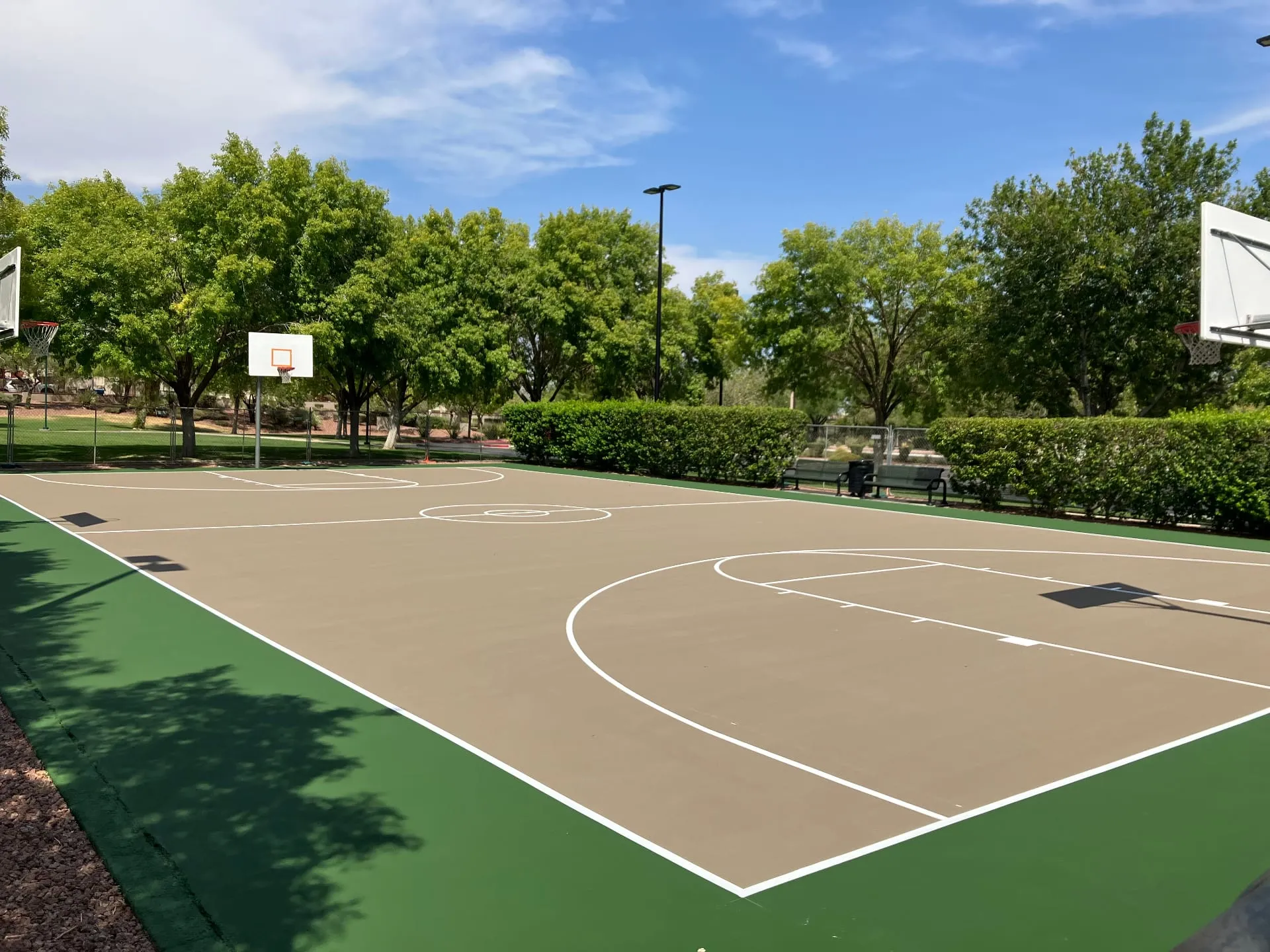
Yes, a properly sized basketball slab carries pickleball lines in a second color, so both sets of lines stay readable. Pickleball lines measure 20 by 44 feet, fitting inside a near-regulation half court or a well-buffered extended half court. The full pickleball layout lives in our pickleball court dimensions guide.
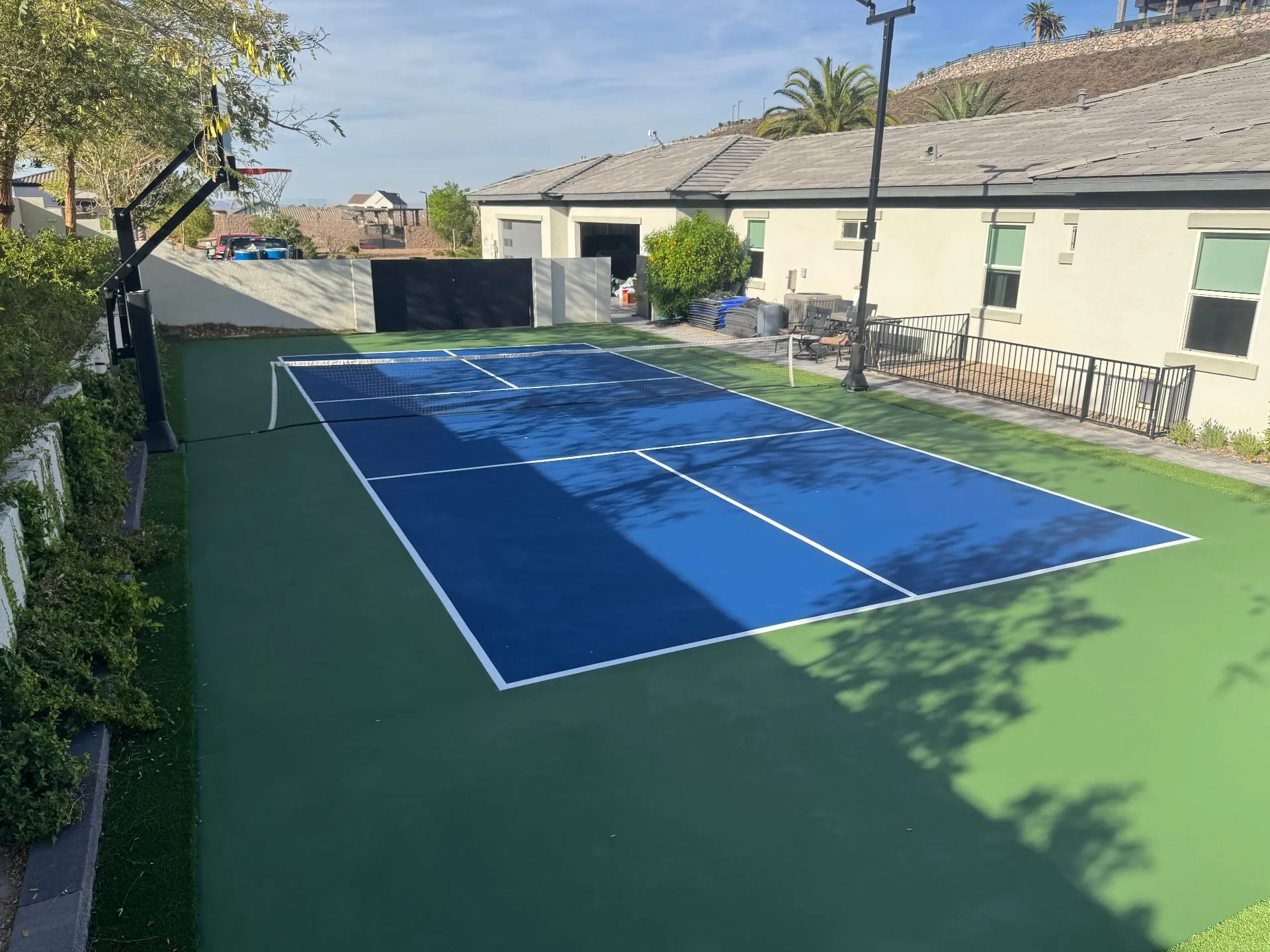
Other backyard basketball court ideas we get asked about include custom color blocking and logos, and hoop systems and other accessories like fencing and windscreens. Cushioned acrylic is a common add-on for players who take hard falls, and evening court lighting rounds out the list. We don't build modular tile or turf courts, and we don't build indoor courts.
What Does Las Vegas Add to the Footprint?
A tape measure tells you what's physically in your yard, not what you're allowed to build on. In Henderson, the zoning code sets a home's minimum interior side setback at 10 feet in RS-1 and RS-2 districts and 5 feet in RS-4, RS-6, and RS-8 (Henderson Development Code, Table 19.2.2-1). Courts, fencing, and light poles can fall under separate accessory and fence rules, and Clark County, Las Vegas, and HOA boards add their own. Buildable area is almost always smaller than the fence-to-fence footage a homeowner starts with, so we confirm exactly what applies to your lot during the site visit.
We build courts running north to south wherever the lot allows it. An east-west layout points the baskets into the low afternoon sun, putting glare straight in a shooter's eyes; a north-south court takes that same sun across the court sideways instead. Spring winds are the other local factor, which is why the windscreens on our fencing aren't cosmetic.
Southern Nevada's expansive clay swells when it gets wet and shrinks as it dries, and caliche, a rock-hard cemented layer, varies in depth from one part of a lot to the next, so a driveway-grade slab can move unevenly and crack. A University of Nevada, Las Vegas study on expansive soils in the valley maps where that clay shows up across the region. That's why we pour post-tension slabs: concrete reinforced with steel cables that are tensioned after the pour, holding the slab together against the soil movement that would crack a standard pour. We use at least 4 inches of 4,500 psi concrete. Our monsoon season also drops heavy rain in short bursts onto ground that barely absorbs it, so we pitch every slab slightly to shed water to one side instead of letting it pool on the surface or sit against the edge.
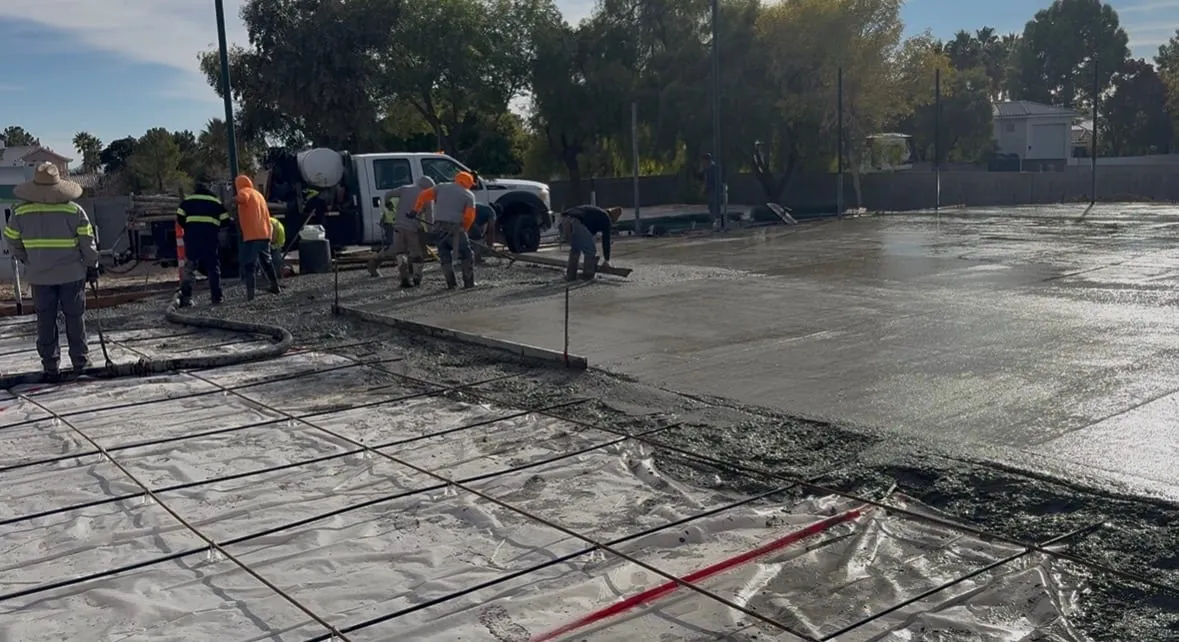
Las Vegas hit an all-time record high of 120°F on July 7, 2024, confirmed by the National Weather Service's Las Vegas office. A caliche-ready post-tension slab costs more up front than a standard pour, but a standard slab that cracks under a Las Vegas summer means redoing the acrylic coating years sooner.
What Does a Backyard Half Court Cost?
Backyard basketball court size is the biggest driver of price. Half courts run $12,000 to $35,000, with shooting pads and compact half courts at the lower end and near-regulation courts at the top. A full backyard court, 78 by 46 feet and larger, prices in tennis court territory at $105,000 to $165,000. Our basketball court installation cost guide breaks down what moves the number.
Courts We've Built in the Valley
A few recent projects show how this plays out on an actual lot:
- A post-tension basketball court in Henderson, built for the caliche and heat conditions above
- A two-court commercial build in Summerlin
- A concrete basketball court in Henderson
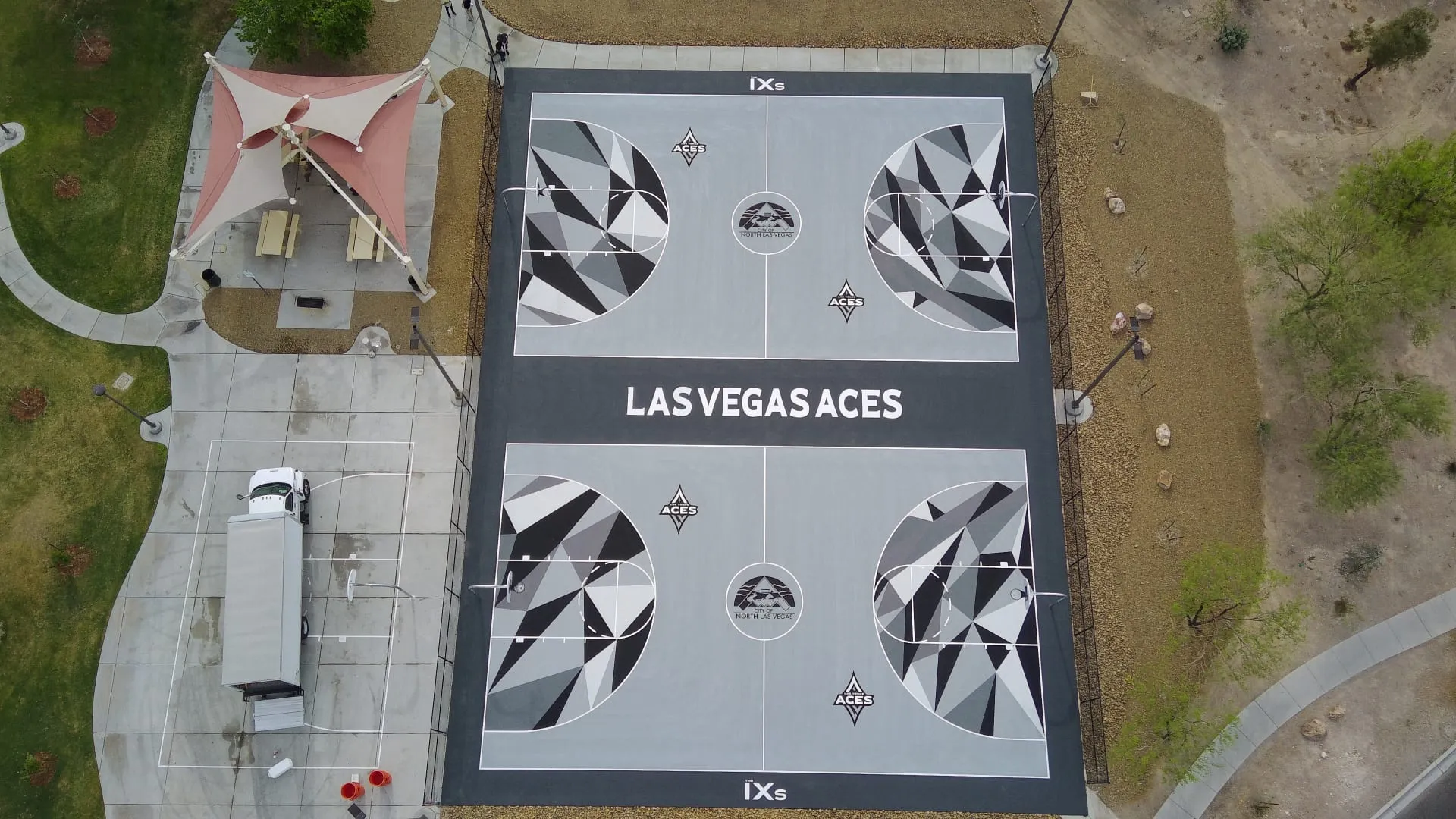
- The Las Vegas Aces' branded courts at Desert Horizon Park in North Las Vegas
⭐⭐⭐⭐⭐
"The court they painted for us was amazing and came out better than we could've imagined. 10/10 highly recommend them. Thank you Brian you made the whole process so easy for us."
Ready to Measure Your Yard?
Send us your backyard basketball court measurements, and we'll tell you what fits, from a shooting pad up to a full three-point arc. Call (702) 686-7738 or request a free quote, and we'll walk you through which tier makes sense before you commit to a slab size.
On Point holds Nevada contractor licenses #0090686 (Surfacing & Fencing) and #0095035 (Concrete) and is an ASBA member.