August 26, 2026
Basketball Court Dimensions: NBA to Backyard Sizes
Basketball court dimensions from NBA to backyard half-courts, plus sizing tiers and Las Vegas climate guidance for your build.
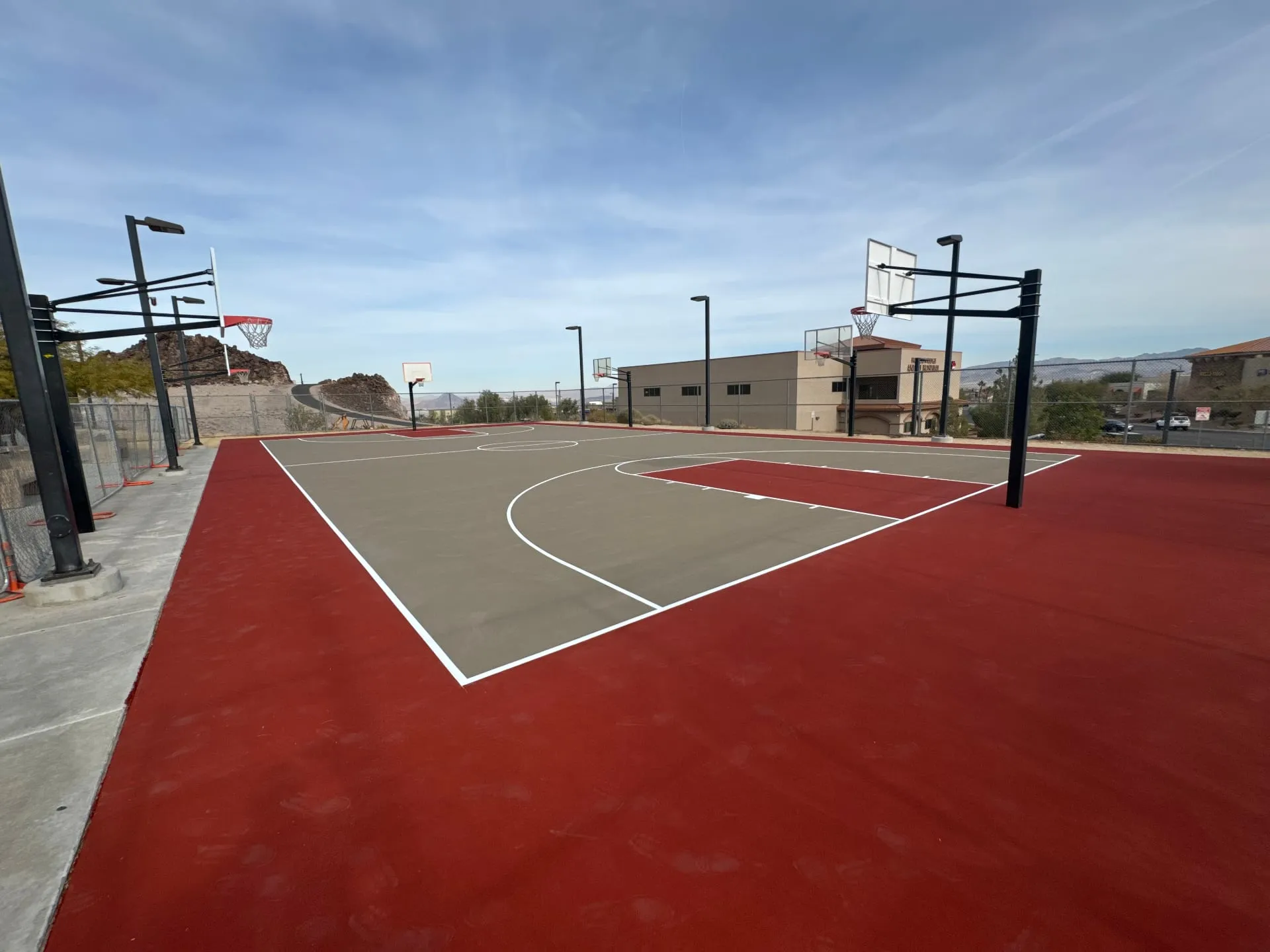
A regulation basketball court measures 94 feet by 50 feet at the NBA and NCAA levels, with different dimensions for FIBA, high school, and backyard builds. On Point Court Surfacing builds custom courts across Las Vegas, and the sizing guidance below reflects what actually fits real yards here.
Basketball Court Dimensions by Level
Court Sizes by Level
An NBA court and an NCAA court share the same footprint, 94 by 50 feet. WNBA courts match it too.
FIBA governs international basketball with a slightly smaller court, 91.9 by 49.2 feet, about two feet shorter than an NBA basketball court. That figure comes straight from FIBA’s official rulebook.
A high school basketball court runs 84 feet by 50 feet under NFHS rules, and junior high courts typically run 74 feet by 42 feet.
| Level | Length | Width |
|---|---|---|
| NBA / NCAA | 94 ft | 50 ft |
| FIBA (International) | 91.9 ft | 49.2 ft |
| High School (NFHS) | 84 ft | 50 ft |
| Junior High | 74 ft | 42 ft |
How Big Is a Basketball Court?
A full-size court covers 4,700 square feet of playing surface at the NBA and NCAA levels, a ceiling few Las Vegas or Henderson lots can reach. Smaller courts still play well; the tiers below show what fits a typical backyard.
Key Zones on a Basketball Court
An NBA half-court measures 47 feet by 50 feet, half of the full court. The half-court line splits the floor at the midpoint. The free-throw lane, often called the key or the paint area, measures 16 feet wide in the NBA and FIBA, and 12 feet wide in the NCAA and high school. The free-throw line stays 15 feet from the backboard at every level, the same distance whether the surface is an NBA hardwood floor or a driveway pad.
The free-throw circle and the center circle (where the opening jump ball takes place) both run 12 feet across in the NBA and NCAA, just under that at FIBA’s 3.6-meter standard. The restricted area, the semi-circle under the basket, marks where a defender near the rim can’t draw a charging foul against a driving player.
Three-point line placement changes the most by level. The NBA line combines two lines and a curve, straight at 22 feet in the corners before bending to 23 feet 9 inches at the top, measured from a point below the center of the basket. The NCAA line matches FIBA at 22 feet 1.75 inches.
Do You Need a Full Three-Point Line at Home?
Many backyard players don’t need the full NBA arc; the shorter 19-foot 9-inch high school distance already works for building form. A homeowner with a high school or college player can have both arcs painted on one slab. Rim height is 10 feet on any basketball hoop, pole-mounted or in-ground. Indoor basketball courts also add court markings like hash marks and a coaching box for organized play.
Backyard Basketball Court Sizes: From Shooting Pads to a Full Court
Few backyards fit a full-size playing court. A shooting pad tucks into a side yard or driveway extension, ideal for shooting practice, while a full court, once competitive buffers are added, needs close to a quarter acre. The sizes in between break down as follows.
| Tier | Common Dimensions | Best For |
|---|---|---|
| Shooting Pad | 20 ft x 24 ft to 26 ft x 26 ft | Free-throw and shooting drills |
| Compact Half-Court | 30 ft x 30 ft | Pickup games with one three-point arc |
| Extended Half-Court | 30 ft x 50 ft or 42 ft x 37 ft | Full three-point practice on both sides |
| Full Backyard Court | 46 ft x 78 ft up to 60 ft x 110 ft | Full-court transition play |
What Size Is a Backyard Half-Court?
A backyard half-court typically lands between 30 by 30 feet and 30 by 50 feet, depending on how much three-point range you want on each side. A wider 42-by-37 layout gives near-symmetrical range on both wings if you have the room.
Backboard overhang (how far the backboard extends past the baseline) scales with court size. A 2-foot overhang works for compact 20-by-24 pads; half-courts at 30-by-30 and larger need at least 3 feet, and 4 feet is the safer choice for aggressive play. During site visits in Henderson and Summerlin, overhang and buffer space surprise homeowners more than court size itself.
Picking the Right Size for Your Court
When On Point sizes a court, three things drive the decision before budget: the usable space after setbacks, who’s actually playing, and whether the slab needs to do double duty for another sport. How much space do you have in your yard once setbacks and landscaping are subtracted? Who’s the primary player, a casual family or a serious prospect building game-ready form? Is this single-sport, or should the slab double for pickleball or padel? Budget and Henderson or Summerlin HOA rules on fence height and court color round out the decision.
Safety Buffers and the Desert Wind
Casual play requires a minimum of 3 feet of open space beyond every boundary line. Competitive, high-speed play calls for 10 feet or more of buffer, so a hard drive doesn’t end at a fence post. We’ve seen backyard games cut short by Nevada’s spring winds, which is why heavy-duty fencing and windscreens go on most of our installations.
Built for Desert Heat: Surface and Slab Considerations
Standard asphalt breaks down fast under the Nevada sun’s UV rays, typically lasting 10 to 15 years, with resurfacing needed every 5 to 10 years. Concrete with an acrylic coating system holds up far longer, often 15 to 20 years with minimal upkeep.
Part of the problem is what’s underneath. Caliche, a rock-like layer formed when calcium carbonate cements soil particles together, varies in thickness across the valley, per geotechnical research from the University of Nevada, Las Vegas. A foundation sitting partly on caliche and partly on softer soil can suffer differential settlement, causing one section of the slab to sink faster than the rest.
On Point recommends a post-tensioned concrete slab on most builds for this reason. Steel cables run through the concrete and get tensioned after the pour, limiting the cracking that differential settlement can cause. That construction held up at Lorenzi Tennis Club and sits under the Aces-themed courts at Desert Horizon Park. On Point holds Nevada contractor licenses #0090686 and #0095035.
Multi-Sport Value: Sharing Your Court with Pickleball and Padel
A basketball footprint overlaps with pickleball and padel more than most homeowners expect, often letting one slab serve two sports. A pickleball court needs 20 feet by 44 feet, with 30 feet by 60 feet recommended once buffers are added, and a 30-by-60 slab can stripe pickleball and a basketball key on one shared pour. Padel needs an enclosed structure measuring 32 feet 10 inches by 65 feet 7 inches. On Point’s multi-sport line striping service covers this layout work.
What Affects the Cost of a Backyard Court
Cost varies by court size, surface system, lighting, and fencing, so a flat rate per square foot rarely applies. A new post-tensioned slab with surfacing generally runs $16,000 to $35,000, and accessories like hoops and lighting can add up to $25,000 more. Acrylic resurfacing on a sound slab typically runs $4,000 to $8,500.
⭐⭐⭐⭐⭐
“Very knowledgeable, great staff and love the result.”
Ready to Build Your Home Court?
On Point Court Surfacing designs and pours basketball courts matched to how each household plays, from a compact shooting pad to a full multi-sport slab across Las Vegas, Henderson, and Summerlin. Request a free court design consultation, call (702) 686-7738, or see how On Point builds these courts, which walks through material options and pour day.