
Tennis Guide
Backyard Tennis Court in Las Vegas: Will It Fit Your Lot?
By Brian Foley, Owner · Published
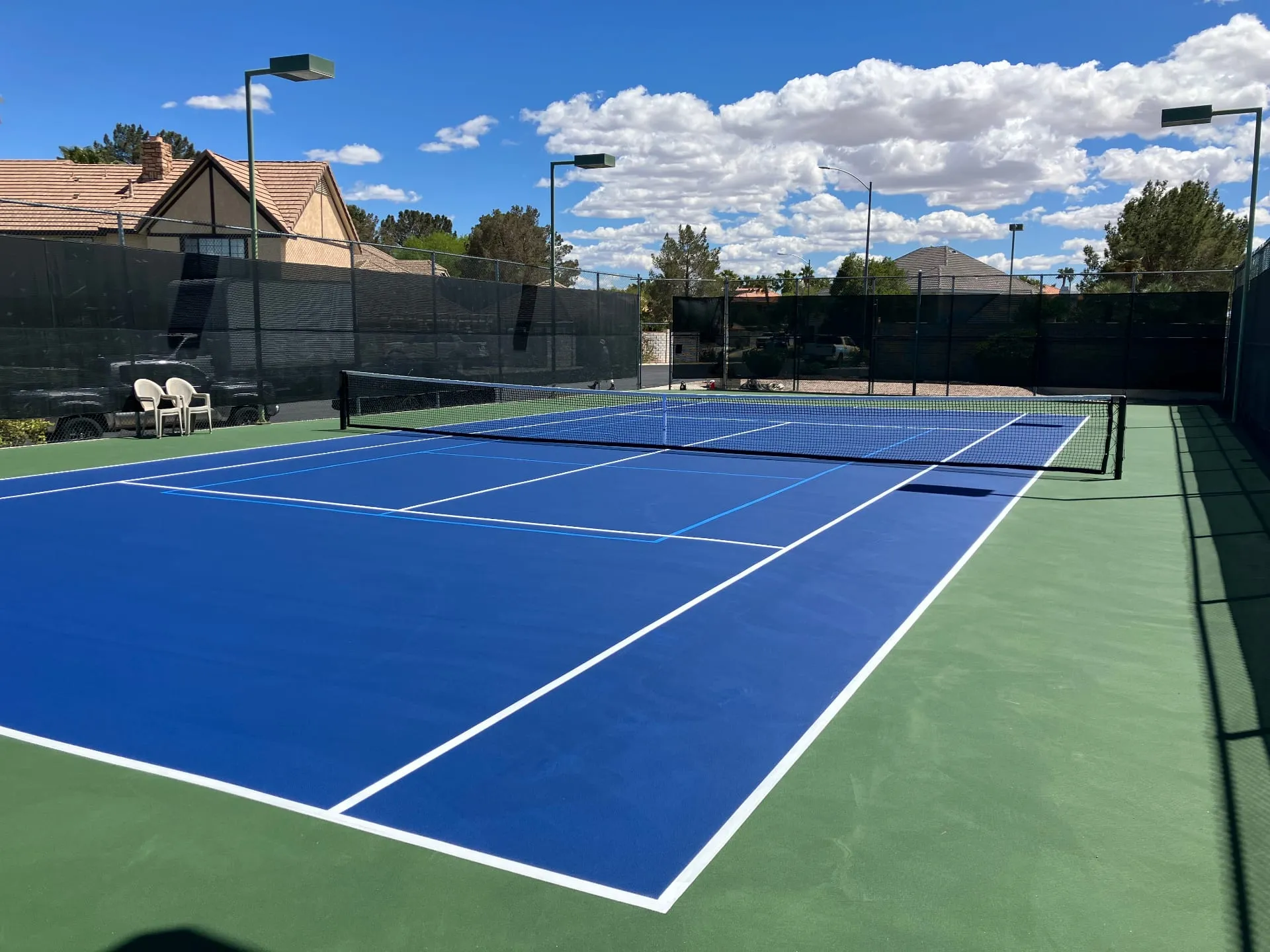
Run a string line 114 feet across your backyard and watch how much of the yard it swallows. A 114-by-56-ft pad (6,384 square feet) is the smallest footprint a backyard tennis court needs at the club and recreational level. Setbacks, the required gap between the court and your property lines, add more on top.
Footprint and setbacks are the two factors that decide whether the court physically fits, and your homeowners association (HOA) then decides whether it gets built. If you want to build a tennis court on a larger lot in Anthem Highlands, Lake Las Vegas, Spanish Trail, or a Summerlin custom parcel, start here. The numbers below show where you stand before you commit to your own court.
How Much Space Do You Need for a Backyard Tennis Court?
Plan on 6,384 square feet for a recreational court and 7,200 for one built to international standards. Only 78 by 36 ft of that is painted lines. The rest is run-off, the open space the International Tennis Federation (ITF) recommends around the doubles court.
For recreational play, Appendix X of the 2026 ITF Rules of Tennis recommends at least 18 ft behind each baseline and 10 ft beside each sideline. That makes a 114 by 56 ft pad. For international competition, the ITF recommends at least 21 ft behind the baselines and 12 ft at the sides, which makes a 120 by 60 ft pad.
Allowing for a 5 ft setback on all four sides, the recreational pad grows to 124 by 66 ft and the international pad to 130 by 70 ft. For net height and markings, see our guide to line-by-line court specs.
| Layout | Size | Area |
|---|---|---|
| Painted doubles court | 78 by 36 ft | 2,808 sq ft |
| Recreational pad with run-off | 114 by 56 ft | 6,384 sq ft |
| Recreational pad plus 5 ft setbacks | 124 by 66 ft | 8,184 sq ft |
| ITF-recommended pad for international play | 120 by 60 ft | 7,200 sq ft |
| ITF-recommended pad plus 5 ft setbacks | 130 by 70 ft | 9,100 sq ft |
The U.S. Census Bureau's 2025 Characteristics of New Housing report states that 41% of new single-family homes built for sale and completed in 2025 sat on lots under 7,000 square feet. A lot that small cannot hold a recreational court once setbacks are added.
Which Way Should a Backyard Tennis Court Face?
Point the long axis north to south so the low sun stays out of players' eyes. That makes lot shape as important as size, because a lot with enough square footage still fails if its shape forces the court to run east to west.
Does a Backyard Tennis Court Need HOA Approval?
Yes, if your community has design guidelines, as Summerlin West does. There, a design committee reviews court plans before you build. City or county permits run on a separate track, and the rules below come from different offices, so confirm which one covers your address.
If You Live in Anthem Highlands (Henderson)
Henderson's development code allows court fencing in a rear or side yard on single-family lots of 10,000 square feet or more. The fence sits at least 5 ft off the side and rear property lines.
Add 5 ft on all four sides, and a 6,384 sq ft recreational pad takes 8,184 sq ft of land. On a minimum-size lot, that leaves 1,816 sq ft, less than a fifth of the land, for the house and any pool. The lot qualifies on paper but leaves too little room for a home, so a workable court needs well over the minimum.
If You Live in Summerlin West (City of Las Vegas)
The design committee considers sport courts for rear yards only, at least 5 ft from all property walls. It can require evergreen screening to hold down noise. Under the Summerlin West design guidelines, a complete submittal needs a site plan showing the court's location and dimensions, along with any lighting and the color and material choices.
If You Live in Summerlin South (Clark County)
A Summerlin address does not tell homeowners which office issues the permit. Summerlin South is unincorporated Clark County, so it answers to a different office than Summerlin West. In Clark County, Title 30 caps fences in residential setbacks at 6 ft unless a waiver of development standards is approved. Court fencing stands taller than that cap, and any fence over 6 ft needs a building permit.
Sloped Lots: Why Hillside Backyard Courts Cost More
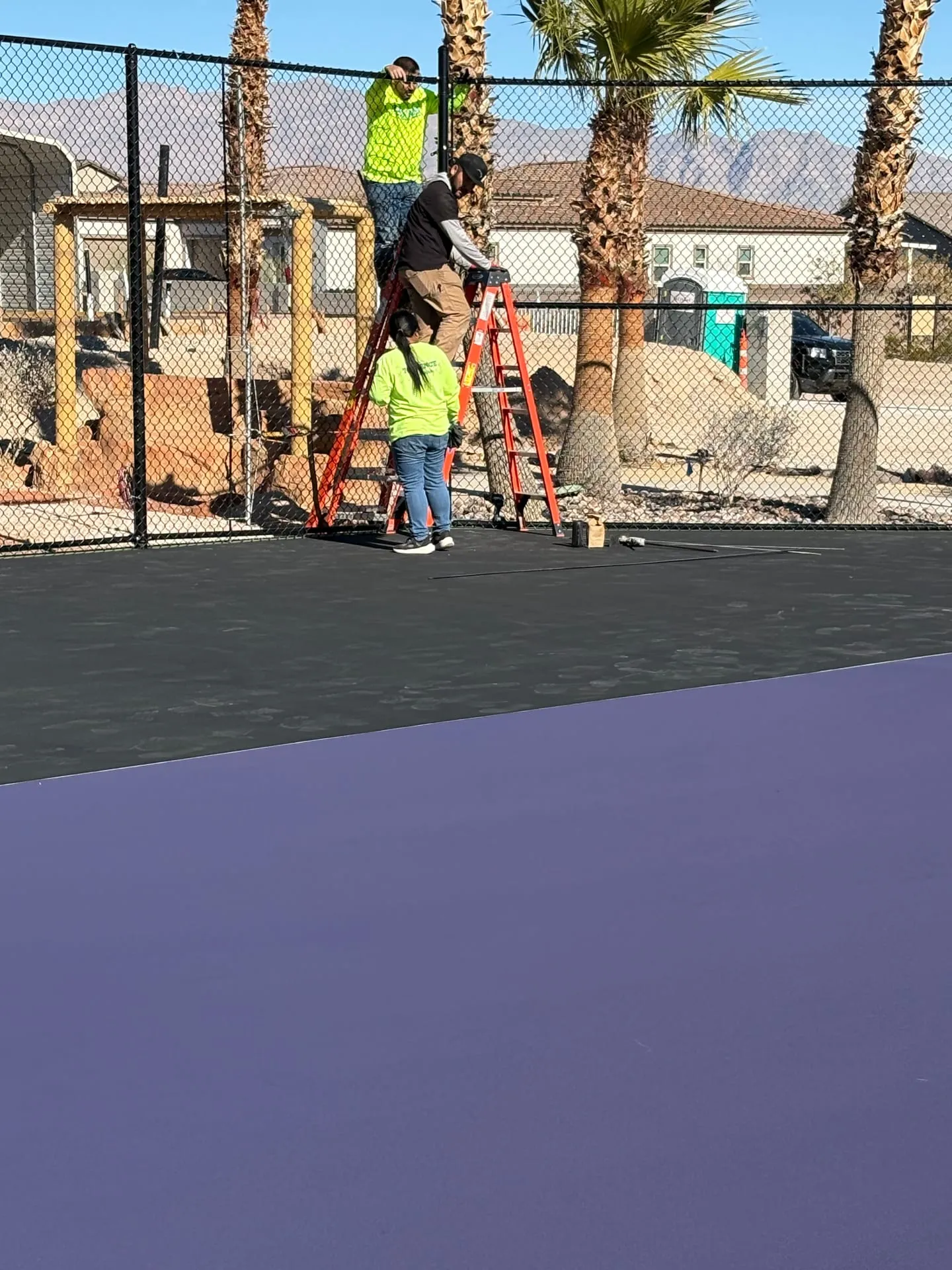
A sloped lot needs a flat pad, and cut and fill sets the grade. Soil comes out of the high side and builds up the low side. Retaining walls then hold the soil back. Each step adds excavation and wall work that a level lot does not need, which is where hillside construction costs climb. Even the finished pad keeps a slight slope, so rain from a summer monsoon storm runs off instead of pooling.
Can You Build a Smaller Backyard Tennis Court?
You can, but only by cutting into the run-off the ITF recommends, and that space is what lets players chase down wide and deep shots. On a tight lot, a different court is often the better call. A pickleball court fits on a 30 by 60 ft slab of 1,800 square feet at minimum, less than a third of the recreational tennis pad. Weighing pickleball against tennis shows how the two games compare in the same space.
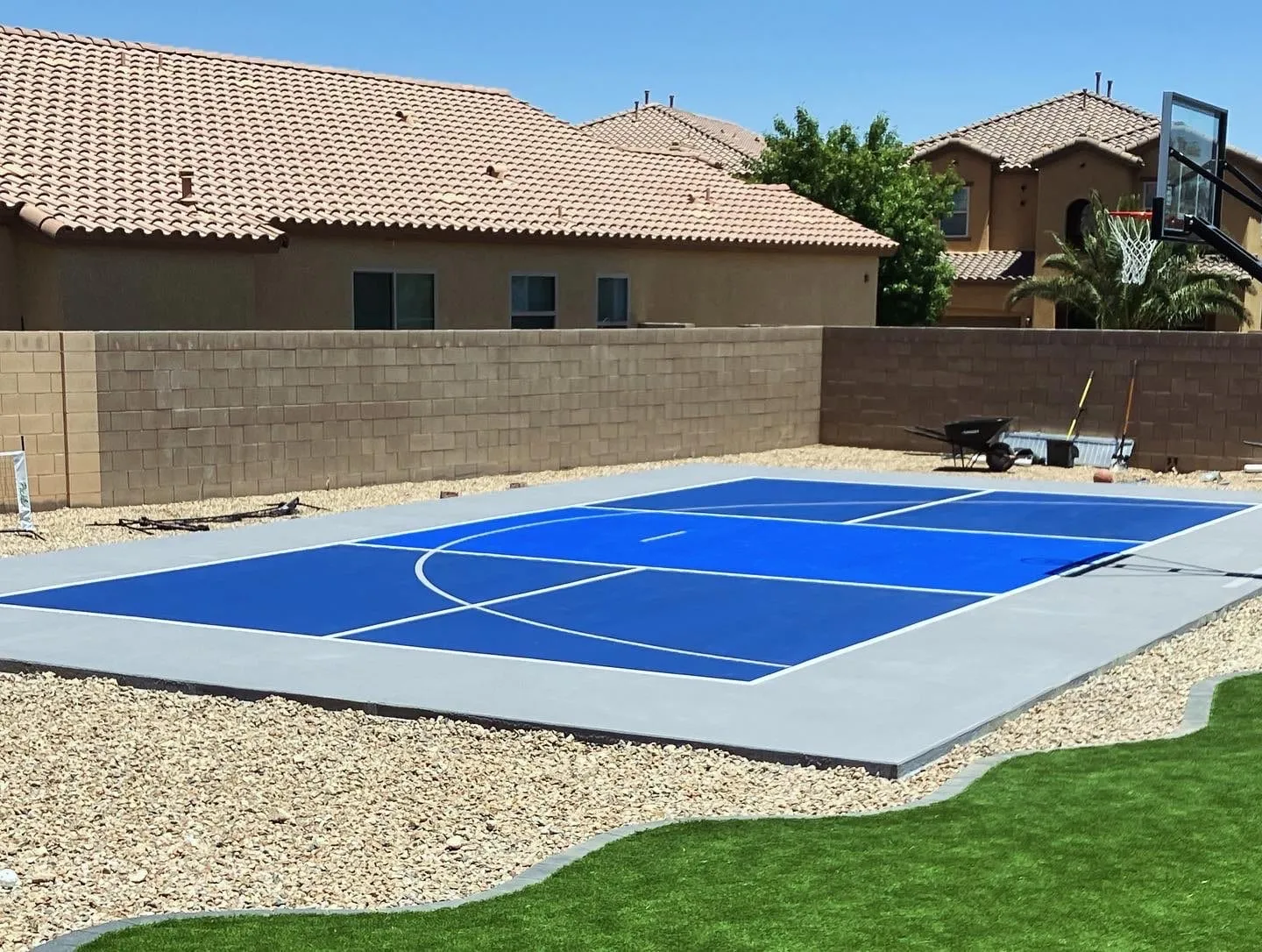
A multi-sport layout is the other route when tennis won't fit. It lets basketball and pickleball share one slab, turning a yard too small for tennis into usable space for practice and play.
⭐⭐⭐⭐⭐
"I had a great experience working with On Point Court Surfacing on our backyard Pickleball court. Brian communicated well and did what he said he would do. I would highly recommend On Point Court Surfacing to anyone. Dennis"
How Much Does It Cost to Build a Tennis Court in Your Backyard?
A full-size backyard tennis court costs $105,000 to $165,000 on a post-tension slab, with site work and fencing included. Where a build lands in that range moves with site prep and fence height. We pour post-tension slabs, where steel cables pulled tight keep the concrete under compression and limit cracking on the valley's expansive desert soil. A court built this way is durable and needs little maintenance beyond cleaning and a resurface every 5 to 8 years. We finish the slab with acrylic or cushioned acrylic, the two surfaces we build. Online averages near $15,000 to $30,000 describe smaller jobs, and some national guides assume a tile court or a thinner base. A new court takes 4 to 8 weeks from groundbreaking to final line striping, once permits and HOA approval are complete.
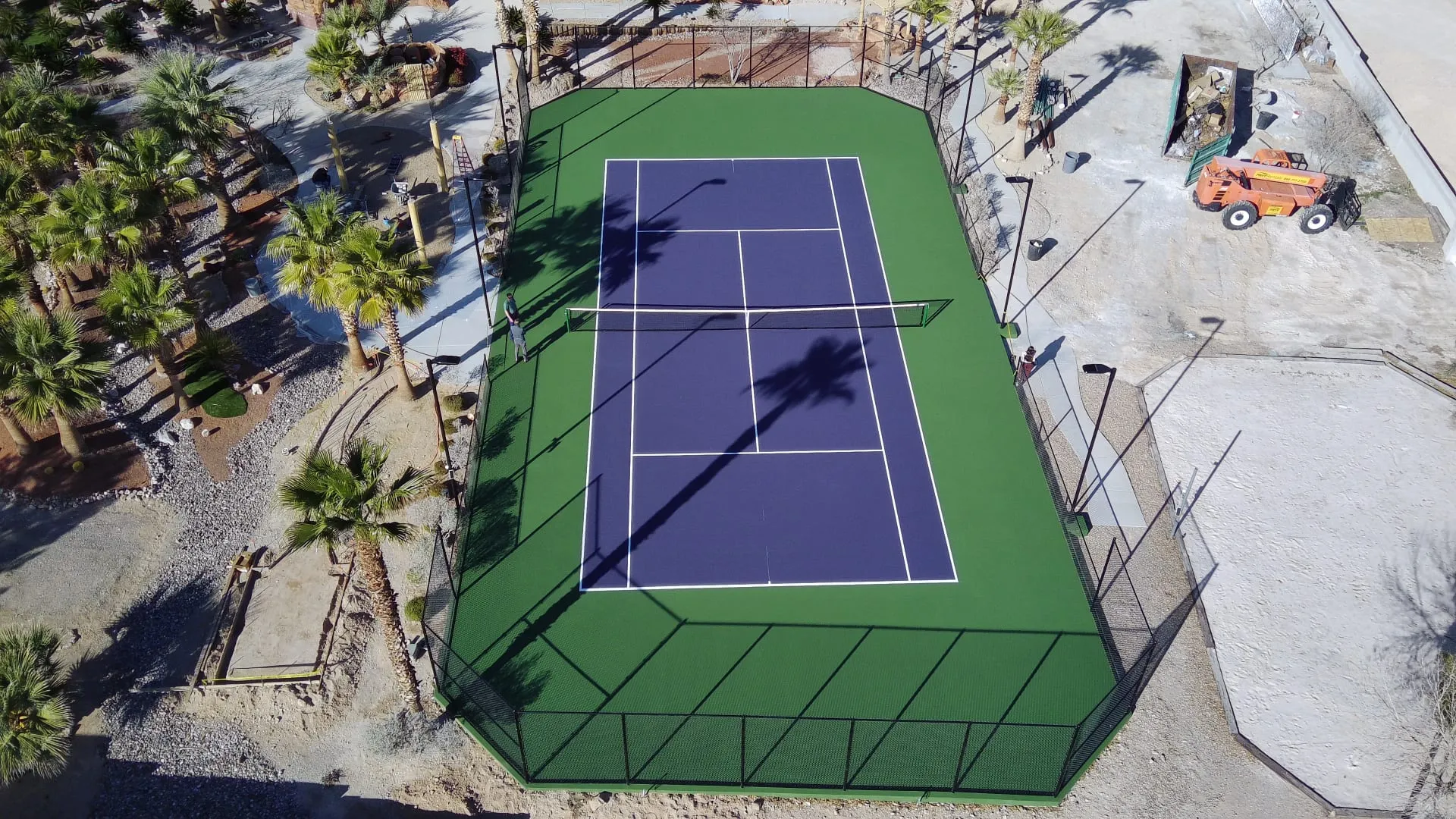
Book a Site Visit Before You Sign Anything
We measure the lot before you pay for anything. Book a site visit, and we will check your footprint and setbacks against the rules that cover your address.
If your lot fits a full-size court, we walk you through backyard tennis court construction from there.
Or call (702) 686-7738.
On Point holds Nevada contractor licenses #0090686 (Surfacing & Fencing) and #0095035 (Concrete) and is a member of the American Sports Builders Association.