September 12, 2026
Pickleball vs Tennis: Every Difference That Matters to a Court Owner
Pickleball and tennis differ in court size, net height, and scoring. Here's what that means if you own a court in Las Vegas or Henderson.
How Is Pickleball Different From Tennis?
Pickleball and tennis differ significantly in court size, net height, equipment, serve, and scoring, plus one rule tennis doesn’t have at all: the non-volley zone. Those major differences between tennis and pickleball decide what you do with a court you already own.
A pickleball court runs 20 by 44 feet, less than half the size of a tennis court. Tennis relies on an overhand serve, the format set out in the ITF Rules of Tennis. Pickleball uses an underhand serving style instead, along with a two-bounce rule that keeps early points from ending at the net. Tennis and pickleball are both racket sports, but the gap between them is bigger than new players expect, and net height is the first noticeable difference they feel once they’re on the court.
Court Size, Net Height, and the Non-Volley Zone
Every number below comes straight from each sport’s own rulebook.
| Feature | Pickleball | Tennis |
|---|---|---|
| Court size | 20 ft x 44 ft, same for singles and doubles | 78 ft long, 27 ft wide singles, 36 ft doubles |
| Total playing area | 880 sq ft | 2,106 sq ft singles, 2,808 sq ft doubles |
| Net height, posts | 36 in | 42 in |
| Net height, center | 34 in | 36 in |
| Non-volley zone | 7 ft from the net on each side | Does not exist |
| Ball | Hard plastic, perforated, 0.78 to 0.935 oz | Felt-covered rubber, 1.975 to 2.095 oz |
| Serve | Underhand, diagonal | Overhand, two attempts |
| Scoring | Games to 11, win by two points | Games to 4 points, sets to six games |
| Who scores | Only the serving team, under side-out rules | Either side, on any point |
USA Pickleball’s official rulebook sets the non-volley zone, known as the kitchen, at seven feet from the net. The non-volley zone is the single biggest rule tennis players have to unlearn. The two scoring systems part ways here too: tennis matches let either side score on any point, while pickleball uses side-out scoring, so only one team, the server, adds points and the winning team still needs 11 by a two-point margin. In singles matches, a tennis player covers the entire width alone, while a pickleball court fits inside a fraction of that footprint.
Pickleball Equipment vs Tennis Equipment
The equipment differences are just as clear. Pickleball paddles are solid composite, paired with a plastic ball that looks more like a whiffle ball than a tennis ball, closer to ping pong than tennis in feel. A paddle and pickleballs cost less to start with than a tennis racket and a can of balls.
Both tennis and pickleball play on the same acrylic hard courts we build across the valley, not clay courts or turf, so the surface question is already settled before you choose a sport.
Can You Play Pickleball on a Tennis Court?
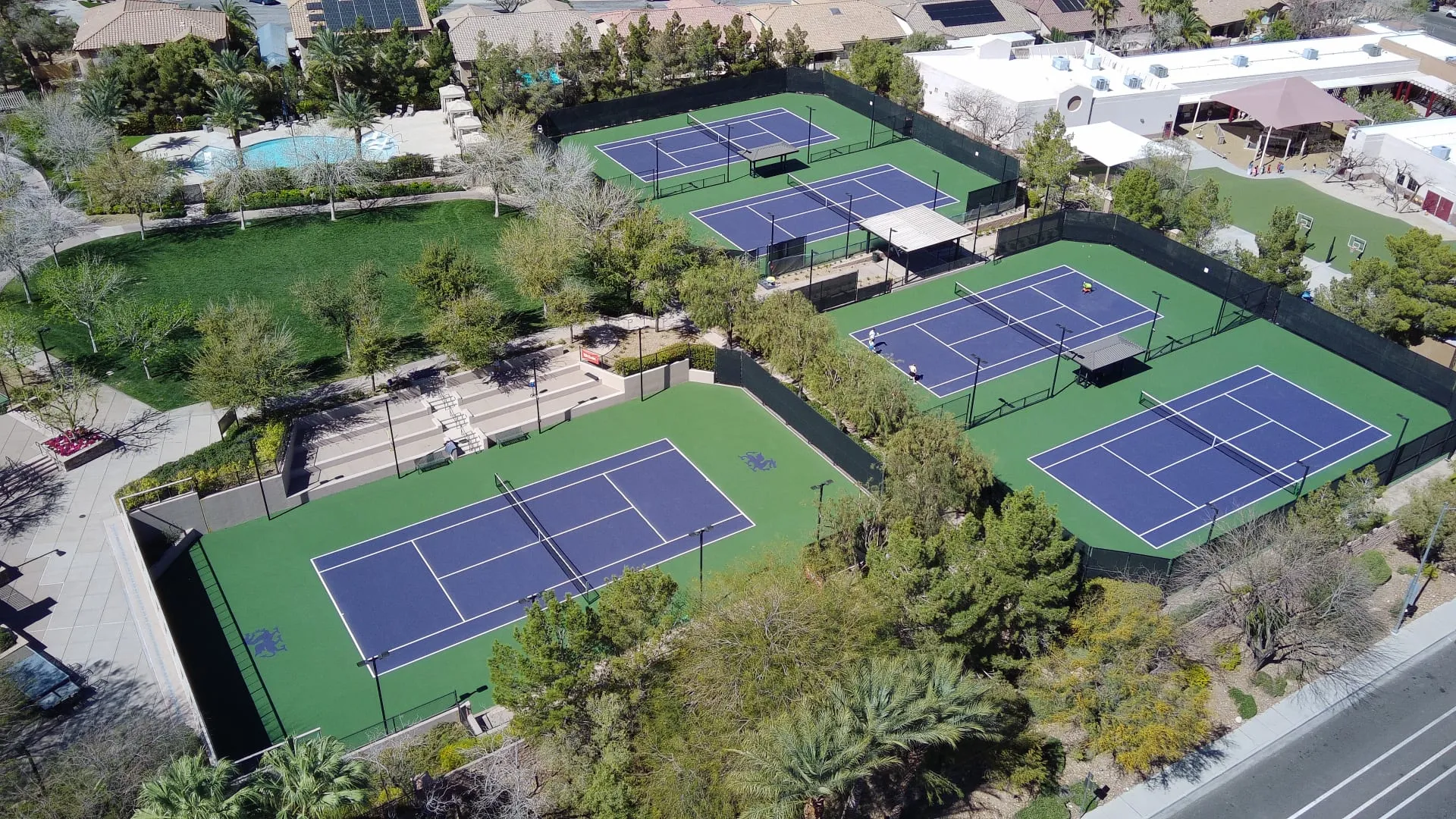
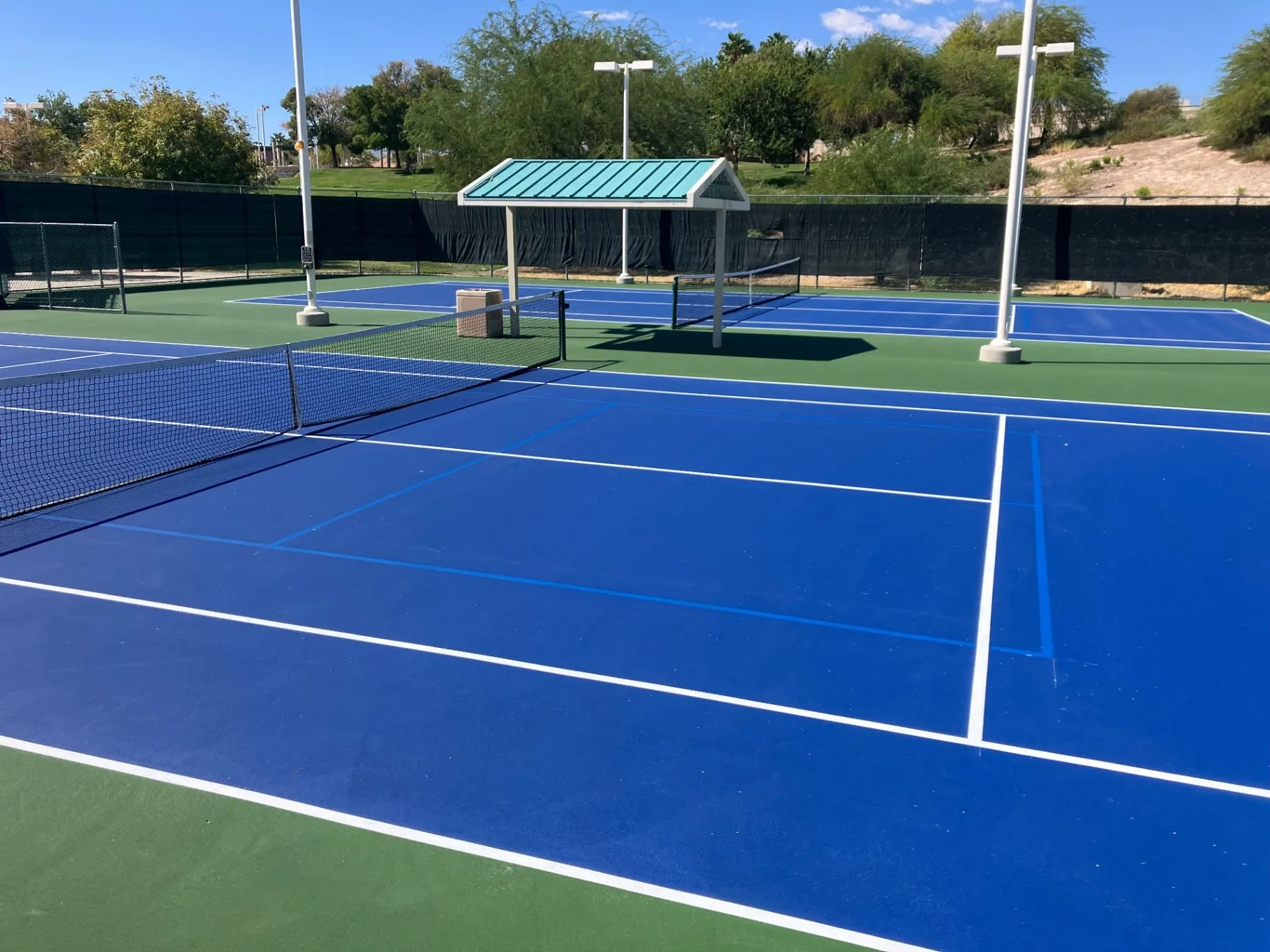
Yes, and it’s the most common way pickleball players first try the sport. A tennis court has enough width to hold temporary pickleball lines, taped or painted inside the existing boundaries. A contrasting color helps players tell the two sports apart mid-rally. A tennis court’s total footprint is 7,200 square feet, compared with 1,800 for one pickleball court, so four pickleball courts fit inside that footprint on paper. That’s the figure you’ll see quoted for temporary or shared lines; for dedicated courts with proper run-out behind the baselines, two is the realistic build.
That difference in size is also why a backyard too tight for a tennis court can still fit one or two pickleball courts built from scratch, at a minimum of 30 by 60 feet each. The smaller court suits casual round robins better than tournament play, since players end up closer to a fence or a neighboring sideline than they expect.
For the full layout, including service areas and the kitchen, see our pickleball court dimensions guide.
The Net Height Problem
Tennis nets sit six inches higher at the post and two inches higher at the center than pickleball’s, a gap that matters every time a ball crosses the net, among the big differences a shared court has to solve. A pickleball serve that clears a proper 34-inch center clips a tennis-height net and dies. A third-shot drop past the kitchen line sails long instead, since the ball had to climb those extra inches first.
On Point’s Brian has played on borrowed nets set to the wrong height more than once. The game feels off: shots you’d normally put away turn into errors, and you can’t explain why until you check the tape measure.
Pickleball’s underhand serve gives a player more time to react at the net than a tennis serve’s faster pace allows, and the slow-paced dinks that follow reward strategic play over raw power. The fix is a portable pickleball net for open-play hours or dedicated posts set at the correct 36/34 spec from the start.
Shared Lines Versus Dedicated Courts
A well-marked shared court works for a family playing both sports casually, but not as well as separate courts. A striped shared court resembles tennis with an extra set of lines added. That confuses new players during fast exchanges, since a ball landing near a line forces them to decide which sport’s boundary applies. Contrasting colors cut through that confusion but still clutter the surface. Striped courts can’t meet tournament line and net requirements, regardless of color contrast.
Before you commit to sharing it, the tennis court construction page walks through what a resurfacing or build actually involves.
Three Options for a Tennis Court Owner
| Option | What Changes | Cost Range (Las Vegas) | Who It Fits |
|---|---|---|---|
| Add pickleball lines | New lines plus a portable or adjustable net | Lowest of the three, striping and net hardware | Casual households that want both sports |
| Convert fully to pickleball | Restripe the slab, remove tennis lines, reset net height for good | Resurfacing runs $4,000 to $8,500 on a sound slab | Households already playing mostly pickleball |
| Build separate pickleball courts | New construction, often two pickleball courts on one tennis-sized lot | New pickleball construction runs $16,000 to $35,000, versus $105,000 to $165,000 for a new tennis court | HOAs and clubs with room for both |
There’s no reliable local data tying any of these options to a fixed resale number, so treat any specific property-value claim as a guess. Pickleball demand across the valley is strong enough that a dedicated or well-built shared court appeals to a broader range of buyers than an idle tennis court.
What pushes that number up or down on your own lot is spelled out in our pickleball court cost guide.
Surface Wear on a Pickleball Court
Pickleball packs constant lateral movement and quick stops into a much smaller court than tennis covers. All that concentrated movement wears the surface texture and grip faster, so a court seeing regular pickleball play needs resurfacing on a shorter cycle than one used mainly for tennis.
Physical Demands: What Pickleball and Tennis Ask of Your Body
The physical demands differ sharply between them. Tennis requires more endurance across a larger court, with longer, more intense rallies, while pickleball is the lower-impact sport that works for a wider range of ages and skill levels. The sport offers a shorter path to a first real rally, and its doubles-heavy, social format is a big part of why it spreads through a household so fast.
Pickleball reached 24.3 million U.S. players in 2025, up 22.8 percent, and is still the country’s fastest-growing sport. Tennis grew too, reaching 27.3 million, per the Sports & Fitness Industry Association’s 2026 Topline Participation Report. Each sport keeps distinct characteristics even as both keep growing.
Pickleball in Las Vegas and Henderson: The Local Reality
Pickleball is the most requested court type we’re building and resurfacing across Southern Nevada, from backyard courts in Summerlin, Anthem, and Green Valley to facility work reaching North Las Vegas, Boulder City, and Mesquite. We recently finished a multi-court pickleball build at Wine Ridge RV Resort in Pahrump and a resurfacing at Dragon Ridge in Henderson.
Our tennis-side work stays just as active, including the 10-court resurfacing at Lorenzi Tennis Club and the courts at Darling Tennis Center, both in Las Vegas. Tennis clubs are still investing even as pickleball demand climbs, which matches what the SFIA numbers show nationally.
Our repair and resurfacing page has the upkeep costs by court type.
Getting the Right Court for How You Actually Play
How often each sport actually gets played on the court you already have decides which option makes sense, and net height and cost are the key differences worth weighing first. Brian Foley set up On Point specifically to walk homeowners through that exact decision. He played number-one singles at Boise State and picked up a round win at an early PPA pickleball event, so every recommendation comes from someone who has competed on both sides of the net in both sports.
Call (702) 686-7738 to set up a free on-site assessment, or start with our pickleball court construction page to see what a build or conversion looks like for your court.