July 17, 2026
Court Surfaces in Las Vegas: Every Option, and the Two We Actually Build
A local guide to tennis and pickleball court surfaces in Las Vegas: acrylic, cushioned acrylic, synthetic turf, clay, grass, and modular tile, and why only two of them make sense in the Mojave.
If you are planning a court in Southern Nevada, the surface is the decision that shapes everything else: how the court plays, how much it costs, how often it needs work, and how long it lasts before the sun and soil catch up with it. There are half a dozen court surfaces used around the world. In the Las Vegas valley, only two of them belong here, and this guide explains why.
We build and resurface courts across Las Vegas, Henderson, North Las Vegas, Pahrump, and Mesquite, and in nearly every case we recommend one of two systems: an acrylic hard court or a cushioned acrylic court. Everything else on the menu, from clay to natural grass to snap-together tile, either fails in our climate, drinks water we cannot spare, or costs more to maintain than it is worth. Here is the full picture, surface by surface.
First, the part under the surface
Before the color coat, there is a base, and in the desert the base is where courts live or die. Two options exist:
- Post-tension concrete. Steel cables are tensioned inside the slab after the concrete cures, which keeps the whole slab in compression. It resists the cracking that comes from Las Vegas caliche, expansive clay soils, and the wild daily temperature swings that push a slab through constant expansion and contraction. This is what we build on.
- Asphalt. Cheaper up front and common in older parts of the country, but asphalt softens in extreme heat, oxidizes under UV, and cracks sooner here. In a climate that regularly clears 110°F, an asphalt base is a short-term slab.
No coating can outperform the slab beneath it. A beautiful acrylic finish over a moving or failing base will crack again within a season or two, which is why we start every new build with an engineered post-tension slab. For more on how the base drives the total number, see our guide on how much a pickleball court costs in Las Vegas.
The two surfaces we build in Las Vegas
Acrylic hard court
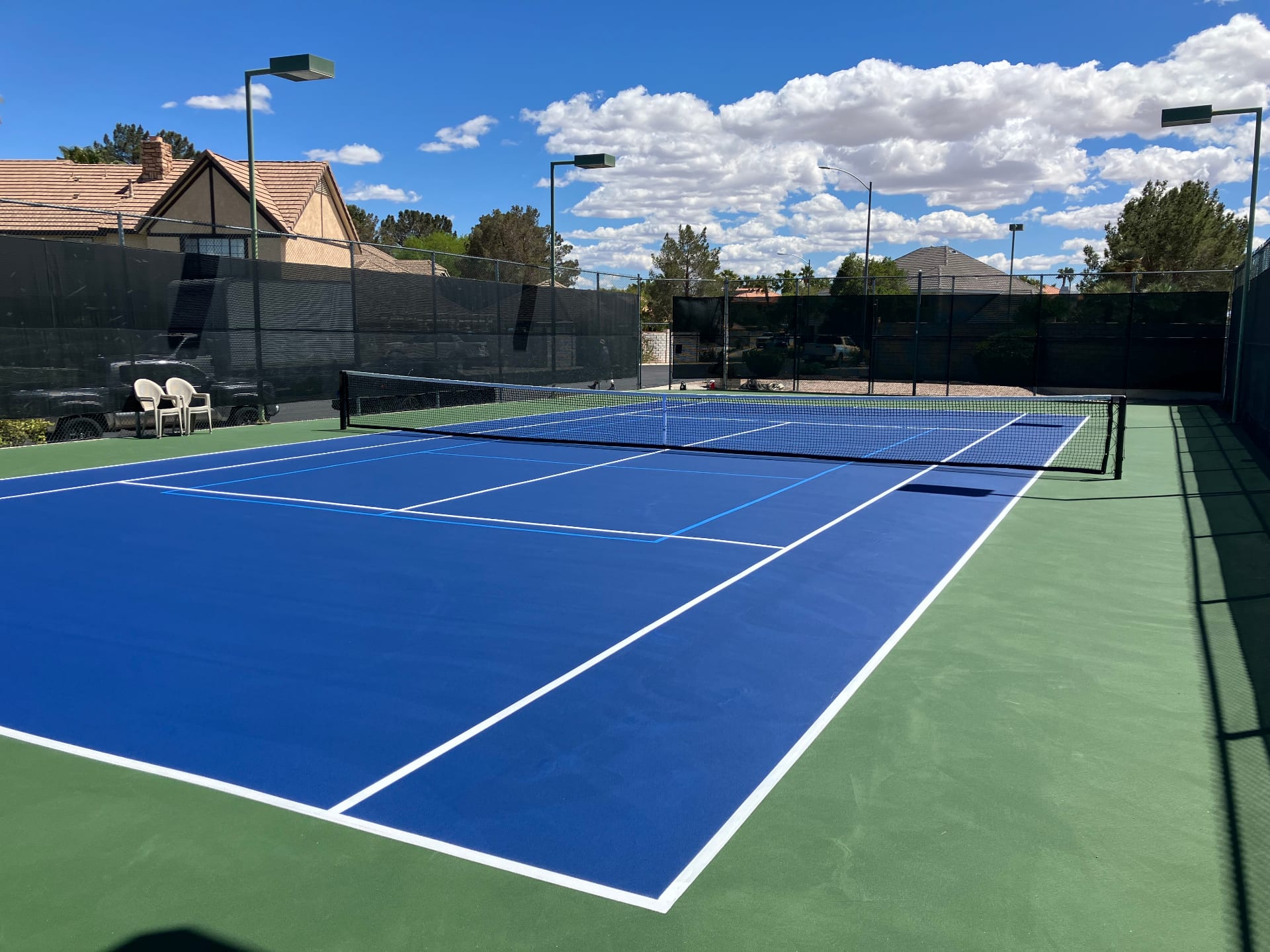
Acrylic is the workhorse of desert court building, and it is what most Las Vegas courts are finished with for good reason. An acrylic system is several thin layers of pigmented, water-based coating applied over the concrete, with silica sand blended in for texture and grip. It gives you a true, consistent bounce, crisp color that you choose, and a surface that shrugs off heat and UV better than any other option.
- Plays: medium-fast, predictable bounce, the standard for tennis and pickleball alike.
- Maintenance: low. An occasional wash-down and a resurface every 5–8 years in our climate.
- Cost: the most cost-effective long-term surface for the valley.
- Lifespan: the coating is a wear layer, not the structure, so on a sound slab you simply recoat when the color fades or the texture wears smooth.
We use acrylic paint with silica sand for texture and a genuine bounce, and we finish every court with custom color and regulation line striping. It is the default for a reason.
Cushioned acrylic
A cushioned court is an acrylic court with a resilient layer built into the system before the color coats go down. That cushion is easier on knees, ankles, hips, and backs, which makes it a favorite for players who are on the court often or want a more forgiving surface at home.
The important local detail is how the cushion is built. There are two ways:
- Liquid-applied cushion, where rubber granules are mixed into acrylic binder and troweled on in layers that bond to the slab. This is what belongs in Las Vegas. It is monolithic, it moves with the slab, and there is no glue line to fail.
- Glued-down cushion mats or rolls, prefabricated sheets adhered to the concrete. In our heat, the adhesive under a glued mat can soften and the sheet can bubble, lift, or delaminate. We do not recommend a glued cushion system for outdoor desert courts.
So when we say we build cushioned courts here, we mean liquid-applied cushioned acrylic. You get the softer feel and the same UV and heat resistance as a standard acrylic hard court, at a higher price point for the added layers.
| Surface | Feel underfoot | Upkeep | Best for |
|---|---|---|---|
| Acrylic hard court | Firm, standard | Low, resurface every 5–8 yrs | Most residential and commercial courts |
| Cushioned acrylic (liquid-applied) | Softer, joint-friendly | Low, resurface every 5–8 yrs | Frequent players, homeowners wanting comfort |
The surfaces we do not build here, and why
These surfaces exist, and you have probably played on some of them. None of them is the right call for an outdoor court in the Mojave.
Synthetic turf
Turf plays a little softer and can carry multiple sports on one surface, which is why you see it in some multi-use backyards. The trade-offs in the desert are real: UV degrades the fibers over time, infill can heat up dramatically in direct sun, and the ball response is different from the hard-court bounce most tennis and pickleball players expect. For a dedicated tennis or pickleball court, acrylic delivers a more consistent game and a longer service life. Turf is more at home on the padel side of the world, where the enclosed court and turf surface go together; see our padel page for that.
Clay
Clay is beautiful, slower-playing, and beloved by traditionalists. It is also one of the most maintenance-hungry surfaces on earth. A clay court needs daily watering to stay bound, plus rolling, brushing, line sweeping, and seasonal top-dressing. In a valley where water is a scarce, regulated, and rising cost, pouring water into a court surface every single day is hard to justify, and Las Vegas water restrictions make it harder still. The look is lovely; the desert math does not work.
Natural grass
Grass is the classic, and we understand the appeal, but it demands the most water and the most care of any surface, and it simply does not hold up in our climate. A grass court in the Mojave is a full-time landscaping project fighting the sun every day. For the look without the upkeep, a green acrylic or a green cushioned court gets you most of the way there with none of the water bill.
Modular tile
Snap-together polypropylene tiles are quick to install and can go over an existing slab, which makes them popular for quick backyard basketball setups. For a serious tennis or pickleball court, the ball response and foot feel are not on par with a bonded acrylic system, the tiles expand and contract in extreme heat, and a suspended plastic surface in direct desert sun ages faster than a coating designed for UV. They have their place for casual hoops, but they are not how we build a court meant to last.
Why Las Vegas narrows the field
Everything above comes down to four local realities:
- Heat. Slab surface temperatures can pass 140°F on a summer afternoon. That punishes adhesives, plastics, and asphalt, and rewards monolithic, liquid-applied acrylic that bonds to the slab and moves with it.
- UV. Relentless sun oxidizes coatings and fibers. UV-stable acrylic pigments are formulated to hold color far longer than turf fibers or a clay line.
- Soil. Caliche and expansive clay move, so the slab has to resist that movement. Post-tension concrete does; a surface that cannot flex with a good base cracks.
- Water. Clay and grass are thirsty, and in Southern Nevada water is expensive and restricted. Acrylic needs almost none.
Put those together and the field narrows to two surfaces that were practically made for the desert: acrylic and cushioned acrylic.
So which one is right for you?
For most homeowners and nearly every commercial or HOA court, a standard acrylic hard court is the answer: lowest lifetime cost, proven durability, and the game players expect. Choose a cushioned acrylic court when comfort matters, if you or your family play often, want to be easier on your joints, or are building a court you plan to spend real time on.
Either way, the surface sits on a post-tension slab engineered for local soil, gets custom color, and carries regulation line striping. If you are weighing a new build, a resurface, or a tennis-to-pickleball conversion, start with our tennis court page or pickleball court page, then request a free written quote and we will help you choose the surface that fits how you play.